
Indonesia's low-carbon shift presents opportunities and risks for domestic industry
Indonesia's transition to clean energy and electric vehicles could strengthen manufacturing and create jobs, but success depends on converting foreign investment into domestic production capabilities, skills and technological independence.

Indonesia's low-carbon shift presents opportunities and risks for domestic industry
Indonesia's shift toward a low-carbon economy presents a critical juncture for industrial development, as clean technology investment creates opportunities to strengthen domestic manufacturing while simultaneously introducing new dependencies on international supply chains.
The transition gains urgency as global energy and transportation markets evolve, opening demand for electric vehicles, renewable energy infrastructure, battery storage systems and energy-efficient technologies. Indonesia enters this shift with considerable advantages, including a large domestic market and an established manufacturing base that employed 19.99 million workers in the second quarter of 2026.
Non-oil and gas manufacturing grew 5.32 percent year on year during that period, contributing 16.83 percent to gross domestic product. Indonesia's manufacturing value added reached $275.61 billion in 2025, ranking first in Southeast Asia and 12th globally.
Yet the country also holds a strategic resource advantage that underpins its battery and electric vehicle ambitions. Indonesia controls approximately 22 percent of global nickel reserves and accounts for over 50 percent of worldwide nickel mine production, making it the world's largest nickel producer. The government leveraged this position through a 2020 ban on unprocessed nickel ore exports, designed to attract investment in higher-value processing and battery manufacturing as part of its resource downstreaming strategy.
Minister of National Development Planning Rachmat Pambudy estimates the green economy could generate about 1.2 million jobs annually and support average annual GDP growth of 6-7 percent. A national roadmap covers 28 strategic commodities across eight sectors, with investment requirements estimated at $618.1 billion through 2040, spanning electric vehicles, batteries, battery energy storage systems, solar components, biofuels and hydrogen.
The value-addition challenge
The scale of opportunity does not automatically translate into stronger domestic industry. Despite controlling over 50 percent of global nickel production, Indonesia's share of global battery cell manufacturing capacity remains minimal at approximately 0.4 percent, revealing significant untapped value-addition potential.
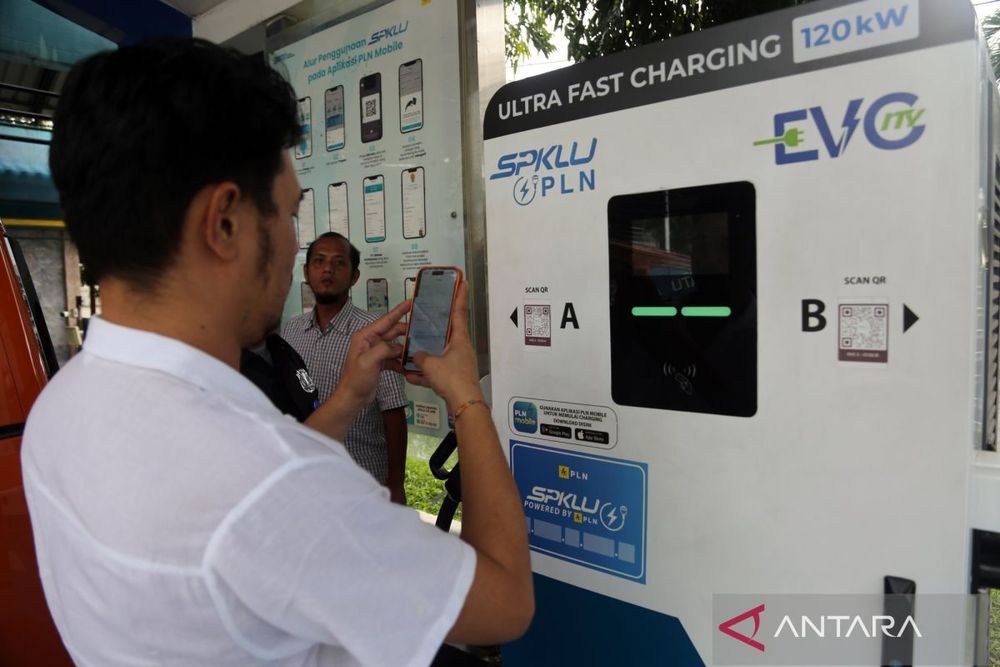
Electric vehicles illustrate the challenge concretely. Indonesia currently has about 541,000 electric vehicles on the road, with total investment in vehicle assembly approaching Rp30 trillion, according to House of Representatives Commission VII Deputy Chair Evita Nursanty. She emphasized that rapid growth should be directed toward strengthening the component industry and developing technological capabilities rather than simply expanding the market.
The government promotes this objective through its Domestic Component Level policy, which sets minimum domestic component requirements at 40 percent in 2026, rising to 60 percent in 2027-2029 and 80 percent from 2030. Fourteen companies have invested Rp24.13 trillion in four-wheeled electric vehicle manufacturing, creating annual production capacity of 409,860 units.
Progress in domestic battery production has begun to materialize. PT HLI Green Power commenced commercial production of EV battery cells at its Karawang facility in April 2024, marking Indonesia's entry as Southeast Asia's first domestic battery cell producer with an initial capacity of 10 GWh.
Domestic content creates greater value when it develops into genuine production capabilities. Local suppliers require opportunities to improve quality, solve technical problems and meet evolving global standards. Investment can begin to deepen the industrial base when these conditions are met.
Capabilities developed through EV manufacturing could support other low-carbon industries, including battery energy storage systems, industrial efficiency technologies and related equipment. Knowledge and skills represent another critical dimension of this process.
Building technical capacity
James Karnadi, chairman of the Youth Community for Securing Indonesia, said the country needs to play a more active role in production, innovation and value creation of low-carbon technologies. He stressed the importance of knowledge transfer, workforce development and stronger local industrial ecosystems.
Investment provides a foundation for continuous learning. Experience gained during production helps domestic companies and workers build capabilities needed to increase capacity and eventually move from using technology toward developing their own solutions.
Indonesia's industrial sector currently accounts for approximately 23 to 28 percent of the country's greenhouse gas emissions, with the sector projected to comprise 55 percent of the nation's final energy demand by 2050 under existing policies. Manufacturing alone contributed between 35 and 40 percent of final energy consumption during the 2010-2018 period, underscoring why energy efficiency and clean energy are critical for sustainable industrial expansion.
Meeting global standards
Deepening production will have limited impact if Indonesian products cannot remain competitive in international markets. Changing environmental standards increasingly determine access to global supply chains.
Dendy Apriandi, director of Investment Deregulation at the Ministry of Investment and Downstreaming, noted that use of green energy is becoming an early consideration for products seeking access to some markets, including Europe. Indonesia's renewable energy share in the national energy mix reached 15.75 percent in 2025, with total renewable capacity of approximately 15.6 GW, including 1.49 GW of solar and 152 MW of wind power.
The government has announced plans to develop 100 GW of solar power capacity, with an initial target of 30 GW in 2026, as part of its broader renewable energy transition strategy. This infrastructure development supports manufacturing competitiveness as environmental requirements tighten.
Indonesia's commitment to net-zero emissions by 2060 or sooner aligns with broader regional efforts. Eight out of ten ASEAN member states have pledged to achieve net-zero emissions targets, while the region collectively faces the challenge of transitioning from fossil fuels that currently comprise over 80 percent of energy demand.
Manufacturers must maintain cost efficiency and product quality while adapting production processes to environmental requirements. Meeting those standards will determine whether Indonesian products can remain in global supply chains rather than simply enter them temporarily.
Technology and workforce development
Technology determines how much economic value Indonesia can capture. Foreign technology can accelerate development of production capacity, but greater benefits emerge when Indonesian companies learn to operate, adapt, maintain and eventually develop technologies for their own production needs.
That capability cannot be built through physical investment alone. Industries need workers whose skills keep pace with technological change, while vocational schools, universities and research institutions require stronger links with actual production and supply-chain needs.
Bappenas estimates about 2.5 percent of the workforce, or 3.45 million people, is currently directly engaged in environmental activities. Another 36.5 percent, or 49.12 million workers, could potentially transition to green jobs. The agency has identified supporting ecosystems, vocational education and training, and partnerships with businesses as part of its strategy to develop green jobs.
These figures indicate that technological transition is also a workforce development agenda. Without appropriate skills, investment could expand production capacity without sufficiently increasing domestic expertise to develop new technologies and processes.
Closer links between industry, education and research can help address that gap. Production problems provide opportunities for applied research, while process improvements and new solutions build knowledge within companies and their supply chains.
As capabilities grow, Indonesian companies can move into higher-value positions in global supply chains, increase value added and expand export markets. This is where the low-carbon transition meets Indonesia's industrialization agenda.
Demand creates markets, investment adds capacity and supply chains expand production. Technology and skills determine how much of the resulting economic value can be retained domestically. If these elements develop alongside investment, the expansion of clean technologies can strengthen manufacturing, workforce capabilities and export competitiveness simultaneously.
Without that foundation, growth of the low-carbon market could simply shift the form of dependence, from fossil-fuel technologies to clean technologies whose higher-value components and expertise remain concentrated overseas. The strategic value of Indonesia's low-carbon transition will depend on its ability to convert global technological change into domestic production capacity, knowledge and competitiveness.