
Bahlil warns contractors to develop approved oil fields or return concessions
Indonesia's Energy and Mineral Resources Minister Bahlil Lahadalia told upstream oil and gas contractors to act on approved development plans or risk losing their concessions, saying the state could offer stalled projects to companies able to carry them out.

Pertamina also faces pressure to act
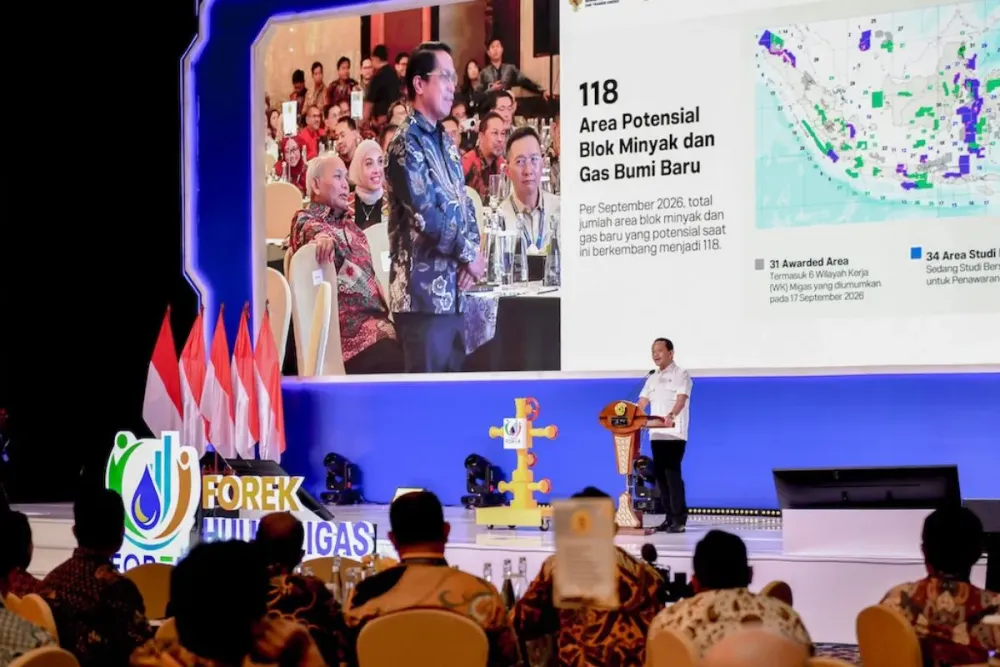
Bahlil issued the directive at the opening of the 2026 Upstream Oil and Gas Forum (FOREK) in Jakarta on October 28. Addressing contractors with approved Plans of Development, he said: "If you are unable to do so, return the concession to the state. We will then offer it to those who are capable of carrying out the work."
State-owned Pertamina is subject to the same demand. Bahlil said government support was no excuse for delays and that the company should share management responsibilities if it could not move projects forward faster. He described his message as an effort to spur corporate action, rather than a direct threat.
Bahlil spoke in his capacity as Energy and Mineral Resources Minister; he also holds the post of Coordinating Minister for Downstreaming and Energy Transition.
The minister separately called for faster development of 118 new oil and gas blocks. Director General of Oil and Gas Laode Sulaeman said just 60 percent of those blocks had been tendered as of October 28.
Organized by state-owned Pertamina Hulu Energi, the October 28-29 forum brought together more than 1,100 participants and over 40 speakers. It was the first FOREK since 2018, ending an eight-year hiatus.
Imports fill a large domestic shortfall
The development push comes as Indonesia uses about 1.6 million barrels of oil a day but produces only around 600,000 to 650,000 barrels per day (bpd). ANTARA reported estimates that the B50 biodiesel program offsets 250,000 to 300,000 bpd of oil consumption, while imports still total roughly 700,000 to 750,000 bpd.
Bahlil contrasted that position with the country's production peak in 1996-1997. At the time, crude output reached 1.5 million to 1.6 million bpd and domestic consumption was only about 500,000 bpd. Indonesia exported 1 million to 1.1 million bpd, with oil and gas accounting for 40 to 43 percent of state revenue.
For 2026, the state budget sets an oil lifting target of 610,000 bpd. Speaking ahead of the forum, SKK Migas deputy Desti Melanti said the agency aimed to sustain that level despite falling output from mature fields.
The international backdrop adds to the urgency. As oil prices and demand rise and geopolitical uncertainty persists, countries are giving greater priority to their own energy reserves, prompting concern about possible regional supply tensions.
Technology, new wells and incentives
Bahlil said aging wells and a decade of declining production made raising oil lifting a major challenge. He encouraged contractors to use new technology to improve extraction, pointing to Exxon's modernization work in Cepu, East Java, as an example of efforts to optimize output.
SKK Migas head Djoko Siswanto presented early production results from two new development wells in Riau. Pertamina Hulu Rokan's Tiang 00004 began producing on October 24, 2026, at 1,246 bpd, about 542 percent above its target of 230 bpd. Pudu 00025 started production a day earlier, on October 23, at 1,038 bpd, about 830 percent above its 125-bpd target.
Bahlil also said SKK Migas had been asked to prepare incentives for upstream companies capable of increasing lifting. He identified Djoko as the official who would provide those incentives.
Proposed licensing and tax changes
To simplify licensing, Bahlil said a proposed revision of the Oil and Gas Law would establish a special business entity known as BUK. The entity would bring licensing authority under one body. Under the plan, companies would not have to pay taxes during exploration, with VAT becoming due once results were obtained.
He urged oil and gas contractors, known as KKKS, to tell him directly about any under-the-table practices, particularly those involving licensing at the Directorate General of Oil and Gas. Tenders and permits should be processed quickly and transparently, he said.
Bahlil said he was confident that faster project development could help Indonesia meet President Prabowo Subianto's energy self-sufficiency targets for 2029-2030.