
Indonesia Reassesses Power Exports, Casting Doubt on Singapore Supply Plan
Indonesia is reviewing plans to export electricity as it weighs its own substantial power needs, Chief Energy Transition Minister Bahlil Lahadalia said Monday. His warning that exports are unlikely anytime soon puts a planned supply of at least 3.4 gigawatts of green electricity to Singapore by 2035 in doubt.

Domestic supply and export constraints
Bahlil did not name Singapore when discussing the review with reporters on October 26. "Our domestic electricity demand is pretty huge. I doubt the export will happen in the near future," he said. "We will reassess everything by making the necessary calculations."
He had previously made pricing a condition of electricity exports to Singapore, arguing that Indonesia should set the tariff as the supplier. The two countries have been working through approvals and other arrangements needed to begin deliveries.
Infrastructure was already an obstacle. On June 9, Coordinating Minister for Economic Affairs Airlangga Hartarto ruled out starting exports in 2026 because transmission infrastructure was still being developed. He estimated that construction would take at least one to one-and-a-half years.
Regulatory uncertainty has also held up projects, according to a Wood Mackenzie assessment reported by The Business Times on October 12. The firm said Indonesian electricity export projects had largely stalled because permits must be renewed every five years and export quotas can be withdrawn if domestic supply is threatened.
The reassessment comes as relations face pressure on two other fronts: smoke from forest fires in Kalimantan is choking Singapore, and Indonesia has reduced pipeline gas exports. Bahlil has maintained that the gas reductions did not violate any contract with Singapore.
Agreements behind the planned trade
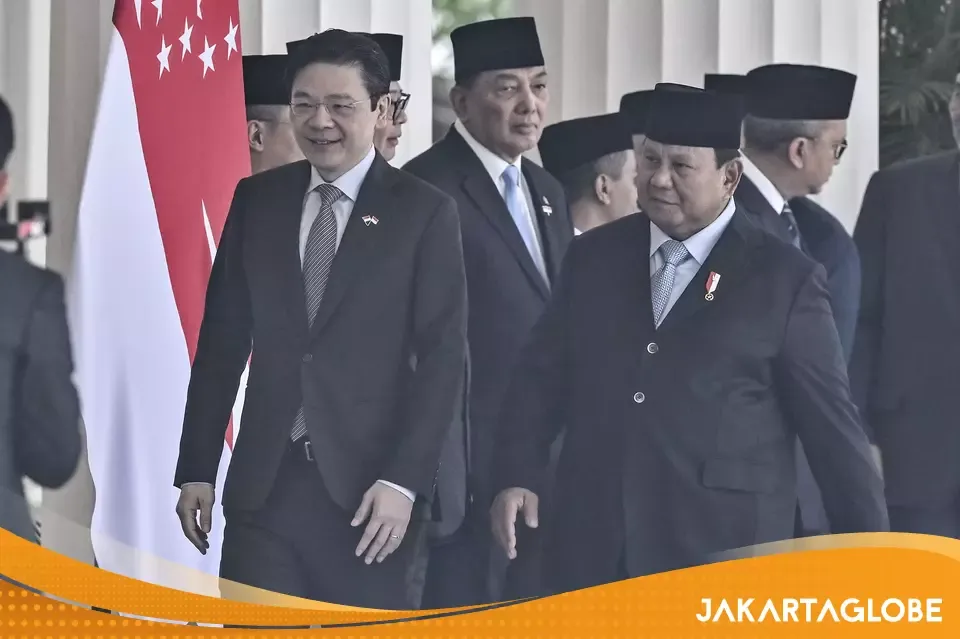
Singapore's limited land and renewable energy resources underpin its search for imported green power. Indonesia's proposed contribution became a major topic during Prime Minister Lawrence Wong's July visit to Jakarta, where he told President Prabowo Subianto the trade would be a "win-win for both countries."
At the July 6 leaders' retreat, Prabowo assigned sovereign wealth fund Danantara to lead implementation. Danantara's portfolio includes Indonesia's state-owned electricity utility, PLN.
Petromindo reported that Danantara's investment arm signed memoranda of understanding with Keppel Electric and Sembcorp Utilities covering purchases of imported low-carbon electricity. A separate MoU with Singapore Energy Interconnections addressed commercial and technical matters for the transmission link. Danantara also agreed on a negotiation and implementation roadmap with Singapore's Ministry of Trade and Industry. Altogether, the retreat produced 26 government-to-government and business-to-business agreements.
The cooperation followed a clean electricity export MoU signed in Jakarta on June 13, 2025, by Indonesian Energy Minister Bahlil Lahadalia and Singapore's Second Minister for Trade and Industry Tan See Leng. According to ANTARA News, the agreement was projected to attract $30 billion to $50 billion in solar generation investment and $2.7 billion in solar panel and battery manufacturing investment.
The 2025 agreement also held the potential to create 418,000 jobs across manufacturing, construction, operations and maintenance. Its scope included sustainable industrial zones in Bintan, Batam and Karimun, along with cooperation on carbon capture and storage.
New generation proposed for exports
Danantara Chief Executive Officer Rosan Perkasa Roeslani said in July that the export projects would rely on additional renewable generation, not electricity diverted from Indonesia's domestic supply. He presented the initiative as a catalyst for green industrial development within Indonesia.
One export-linked development cited by Petromindo in July was a $210 million solar project at the Morowali industrial park in Central Sulawesi. Singapore's Sembcorp, Indonesia's SESNA and sovereign wealth fund INA are partnering to build a 200-megawatt solar photovoltaic plant with an 80-megawatt-hour battery storage system.
Earlier Indonesian news reports identified Batam as an expected source of some exported electricity. The island, a data center hub, recently experienced major power outages.
Singapore's broader import plans face uncertainty
Indonesia's review is also a setback for ASEAN's effort to link its electricity networks. Singapore is seeking 6 GW of low-carbon electricity imports by 2035, with Malaysia, Vietnam and Australia among its other prospective suppliers.
On October 12, Singapore's Energy Market Authority described that target as "aspirational," The Business Times reported. The authority said delivery would depend on regulatory approvals in countries supplying or transmitting the power, as well as commercial demand from consumers based in Singapore.
That statement followed an October 7 Wood Mackenzie analysis forecasting that imports would reach only about half the target, roughly 3 GW, by 2035. The firm estimated that this would represent 15 percent of Singapore's power-generation mix.
As of October 12, the authority had issued conditional licenses and approvals for renewable electricity imports totaling 9.25 GW from Malaysia, Indonesia, Vietnam, Cambodia and Australia. Wood Mackenzie said construction had not begun on any of those approved projects.