
Ampace Demonstrates Fire Containment in Large-Scale UPS Battery Test at Singapore Conference
Battery manufacturer Ampace presented test results showing its PU100 system contained thermal runaway without fire spread or sprinkler activation, meeting newly strengthened safety standards for data center installations.

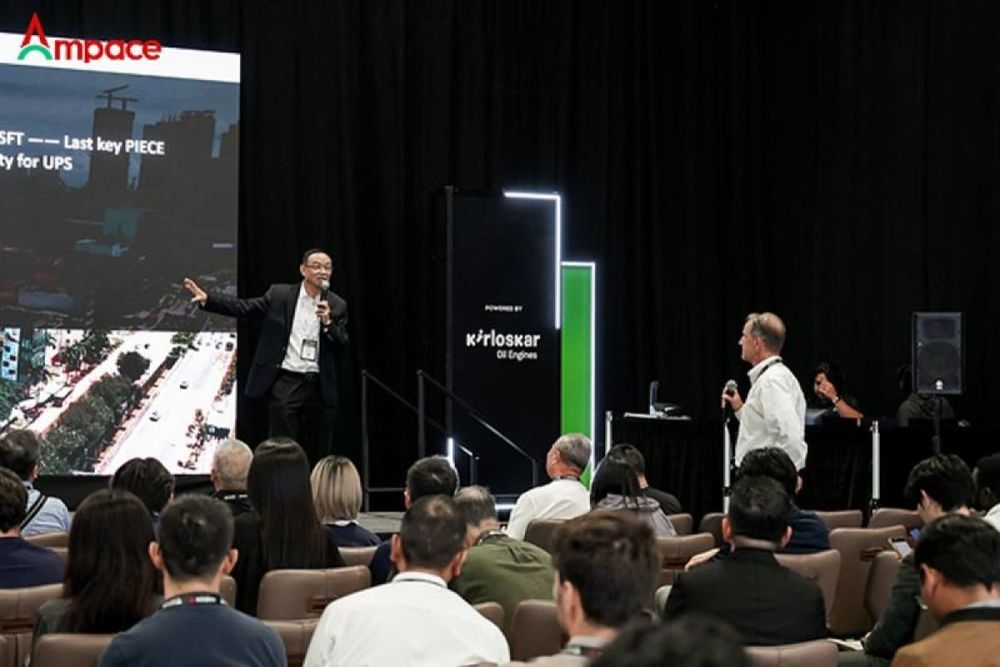
Ampace Demonstrates Fire Containment in Large-Scale UPS Battery Test at Singapore Conference
Ampace, a lithium-ion battery technology company established in 2021 as a joint venture between Contemporary Amperex Technology Limited (CATL) and Amperex Technology Limited (ATL), presented results from a large-scale fire test of its PU100 UPS battery system at Data Centre World Asia 2026. The conference took place September 29-30 at Marina Bay Sands in Singapore, serving as a platform for AI-ready infrastructure and next-generation data center technologies.
In a presentation titled "LSFT for UPS Battery System: Last Key Piece toward Ultimate Safety," Dr. Drew Feng shared findings demonstrating that thermal runaway remained confined to the initiating module under test conditions, with no propagation to adjacent modules or target cabinets. No sprinklers activated during the test, the fire self-extinguished after approximately 40 minutes, and no re-ignition occurred during the subsequent 24-hour observation period.
Industry Context and Testing Standards
The presentation comes as lithium-ion batteries are projected to account for 40-50 percent of the data center battery market by 2025, up from 15 percent in 2020. This growth follows several high-profile incidents, including a September 2025 fire at South Korea's National Information Resources Service that crippled 647 government systems for nearly a week and destroyed all 384 batteries in a 22-hour fire, causing damages exceeding 22.4 billion won (approximately $17 million USD). That fire involved batteries that had exceeded their 10-year lifespan despite passing safety inspections. Additional incidents occurred at data centers in Singapore in September 2024 and at Microsoft facilities in Arizona and Virginia.
Thermal runaway is a chain reaction that occurs when a lithium-ion battery cell becomes damaged, overheated, or defective, producing intense heat that can reach temperatures exceeding 300°C, accompanied by flammable gases and fires that are extremely difficult to suppress.
The sixth edition of UL 9540A, published March 13, 2026, formally incorporated large-scale fire testing (LSFT) into the certification framework to demonstrate that a thermal runaway event in one energy storage system does not propagate to adjacent systems. This represents a shift from previous editions released between 2017 and 2025, which focused primarily on cell, module, and unit-level testing, toward installation-level evaluation that includes demonstration of fire behavior in realistic deployment configurations. UL 9540A is the only consensus standard explicitly cited in NFPA 855 for large-scale fire testing and the only national standard in the US and Canada for fire safety testing methods for battery energy storage systems.
Test Configuration and Results
Dr. Feng's presentation examined the installation-level LSFT provisions in the sixth edition of UL 9540A and the importance of evaluating fire propagation, thermal exposure and re-ignition. The test configuration represented dense data center installations, with a 3-meter ceiling height, zero side-by-side cabinet clearance, 20-millimeter back-to-back clearance and 850-millimeter face-to-face clearance. All cabinets were at 100% state of charge.
Heaters initiated thermal runaway in the trigger module, which was then ignited to establish sustained combustion. The test tracked fire development, propagation and sprinkler activation, followed by observation for re-ignition and post-test teardown analysis.
The results presented included:
- No thermal runaway propagation to adjacent modules and no fire spread to target cabinets
- No sprinkler activation throughout the test
- Self-extinguishment after approximately 40 minutes with no re-ignition during the following 24 hours
- No burning debris escaping the cabinet
- Wall temperature rise below 80°C and ceiling steel beam temperature below 250°C
According to Ampace's comparison presented at the conference, the test met the UL 9540A sixth-edition LSFT criteria assessed and demonstrated additional margins on several measures. These included wall temperature rise below the cited 97°C limit and ceiling steel beam temperature below the cited 538°C limit. The 24-hour observation also extended beyond the 12-hour re-ignition period referenced in the presentation.
The testing aligns with NFPA 855 Section 9.2.1.2.1, which requires large-scale fire testing to characterize gas composition and fire behavior. The 2026 edition of NFPA 855 mandated LSFT for compliance and introduced guidance on implementing LSFT in Annex G.
System Design and Post-Test Analysis
Designed to support dynamic AI workloads and reliable backup power, the PU100 incorporates multiple layers of protection. These include all-metal module and cabinet enclosures, ceramic thermal insulation in the modules, high-voltage box and cabinet, and thermal barriers designed to limit fire propagation.
Post-test teardown provided evidence of containment. Modules adjacent to the initiating module showed no thermal runaway and retained normal voltage readings of 53.2 V. The initiating cabinet showed discoloration but no significant structural damage or collapse, while the adjacent cabinet retained its mechanical integrity and was reported to remain operational.
Dr. Feng brings experience in battery safety standards development to this work. He recently became the first expert from China's lithium-ion battery industry to receive the UL Standards Outstanding Contribution Award and was awarded the TC Members Five-Year Honorary Medal. As a voting member of UL technical committees, he has contributed to the development of 19 UL standards, including UL 9540 and UL 9540A.
By sharing the test configuration, measured results and teardown findings, Ampace aims to give data center operators and infrastructure partners a basis for evaluating UPS battery fire safety as deployment of lithium-ion systems accelerates across the industry.