
EU and Indonesia expand academic cooperation at Jakarta education fair
The 18th European Higher Education Fair opened in Jakarta on November 7, bringing together 92 institutions from 14 EU member states as Indonesia and the European Union work to expand university partnerships and student exchanges. The two-day event follows a November 4 fair in Yogyakarta that drew more than 5,000 visitors.

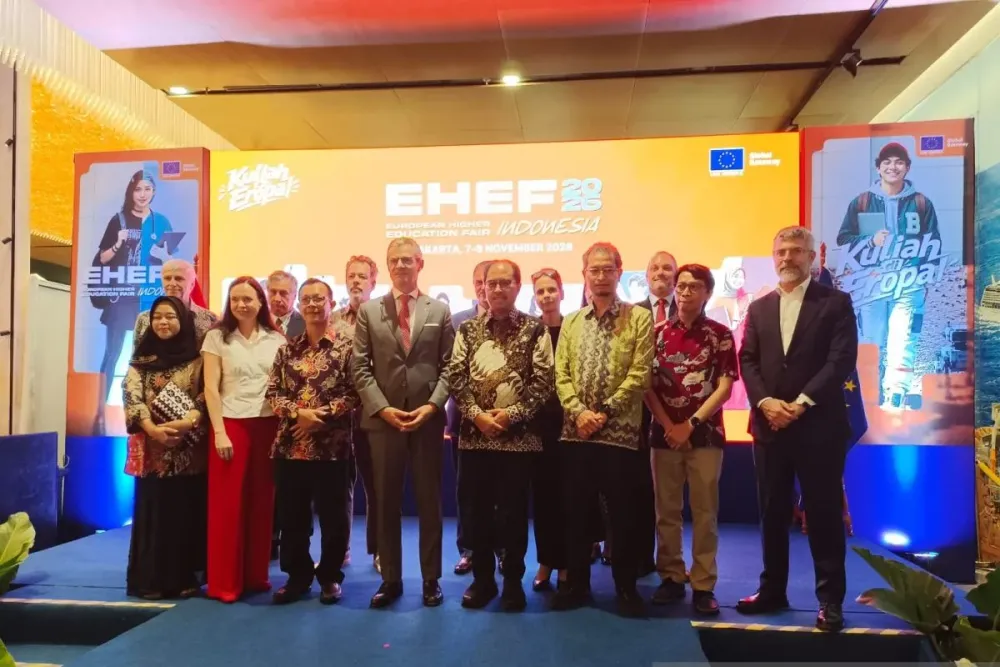
Universities and scholarship programs meet prospective students
The Jakarta fair runs November 7-8 at Catur Dharma Hall in Menara Astra, with hours of 11 a.m. to 5 p.m. local time. The Yogyakarta event took place at Gelanggang Inovasi dan Kreativitas at Universitas Gadjah Mada. Alongside the European institutions, the Jakarta edition includes Indonesia's government-funded Endowment Fund for Education (LPDP) and Beasiswa Garuda program.
At Saturday's opening, EU Ambassador to Indonesia Hervé Delphin said prospective students could use the fair to speak with European universities directly and learn about study options and scholarships. The EU and its member states award more than 1,000 scholarships annually to Indonesian students.
The EU has organized the European Higher Education Fair, or EHEF, in Indonesia since 2008. This year's edition operates under the EU-Indonesia Cooperation Facility project, supported by EU member states and the Delegation of the European Union to Indonesia and Brunei Darussalam.
The organizer's information pack set targets of 90 participating institutions, approximately 12,000 registrations and 6,000 visitors across the 2026 event. It reported more than 9,000 visitors in 2025 and average annual attendance exceeding 6,000.
A roadmap for closer university partnerships
The EU and Indonesia also launched a roadmap for the EU-Indonesia Network of University Partners at EHEF 2026, according to Medcom.id. The network is intended to support joint work on learning materials, teaching methods, research and knowledge transfer.
Beny Bandanadjaja, director of learning and student affairs at the Directorate General of Higher Education in Indonesia's Ministry of Higher Education, Science, and Technology, emphasized the opportunities such cooperation offers young people. He said partnerships between Indonesian and European institutions help students access information, gain academic experience abroad, broaden their perspectives and build international networks.
Delphin placed the education partnership within the EU's wider cooperation with Indonesia. "In line with the EU's Global Gateway strategy, we remain committed to investing in people, skills, research, and innovation to build trusted and enduring partnerships," he said.
The ambassador said education helps make skills and knowledge more accessible, supporting employment, innovation, entrepreneurship and sustainable economic growth. "This has been a reciprocal exchange between Indonesia and Europe," he said. He called for continued participation by universities and academic communities to strengthen higher education, improve mutual understanding and collaborate across sectors on global challenges.
Delphin also said he had met Indonesian President Prabowo Subianto the day before the opening. Education featured prominently in their discussion, he said, and he expected it to become a priority for EU-Indonesia cooperation in the coming years.
Study abroad and Erasmus+ exchanges
More than 10,000 Indonesians were studying or conducting research in the EU in 2025. Separately, the EHEF organizer's information pack says more than 4,000 students and scholars leave Indonesia to study in Europe each year, with both scholarship recipients and people financing their own studies among them.
Since 2021, the EU-funded Erasmus+ program has supported academic exchanges and cooperation between Indonesian and European institutions. It has facilitated 1,089 student and staff mobility placements from Indonesia to the EU and 1,182 in the opposite direction. Delphin separately said more than 3,000 Indonesian students had benefited directly from Erasmus+ programs since 2021.
According to the European Commission, Erasmus+ has a budget of €26.2 billion for 2021-2027, compared with €14.7 billion for 2014-2020. About €2.2 billion from the EU's external instruments supplements the current budget.
The Communication on the Union of Skills sets out an Erasmus+ goal of attracting at least 350,000 students from outside the EU by 2030.