
Natuna school showcases free education initiative for Indonesia's poorest families
Integrated People's School 32 Natuna held an open house Saturday to raise community awareness of the government's tuition-free boarding program serving children from the country's lowest socioeconomic groups.

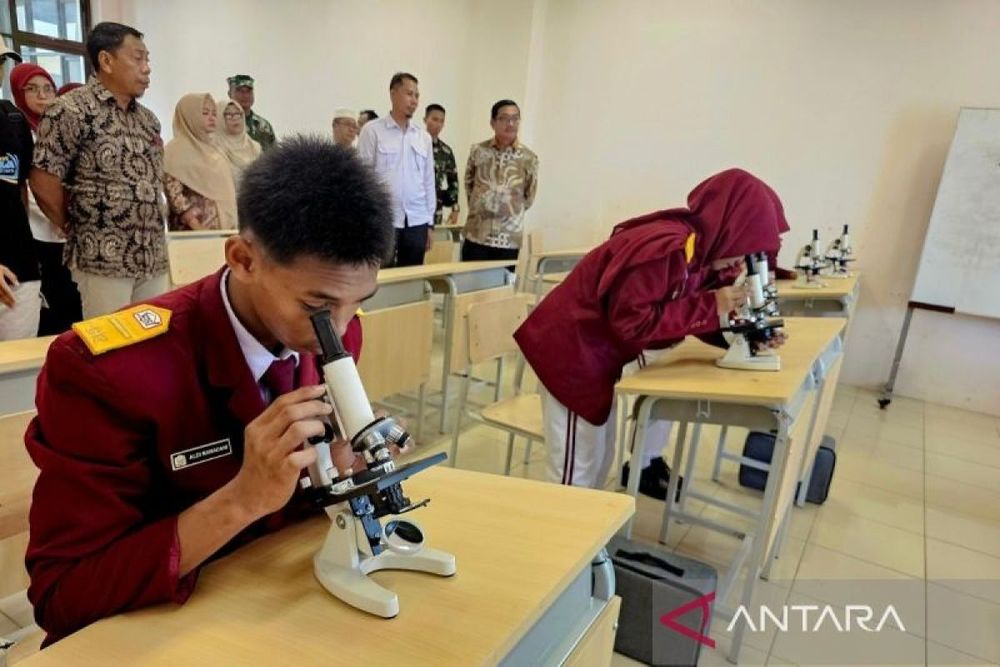
Natuna People's School promotes education programs to community
The Integrated People's School (Sekolah Rakyat Terintegrasi/SRT) 32 Natuna in Indonesia's Riau Islands hosted an open house on Saturday to showcase its free education programs for children from underprivileged families, featuring student performances and facility tours for local officials and community members.
Principal Bumiselan said the event aimed to introduce the community to the People's School concept, which provides fully funded boarding education for families in deciles 1 and 2 of Indonesia's National Single Socioeconomic Data (DTSEN). The DTSEN system divides the population into ten groups from the lowest to the most prosperous, using indicators such as income, housing conditions, asset ownership, employment, and family burden to determine welfare status.
Guests toured classrooms, the library, dormitories and other facilities at the school, which serves students from elementary through senior high school levels. Representatives of higher education institutions, religious leaders, subdistrict and village heads, Natuna district department heads and other residents attended the event.
Part of Presidential Initiative to Combat Poverty
The school is part of President Prabowo Subianto's flagship initiative to tackle extreme poverty through education. President Prabowo, who took office on October 20, 2024, inaugurated 166 Sekolah Rakyat schools across 34 provinces in January 2026, operating as fully funded boarding institutions providing free education, meals and accommodation for children from disadvantaged families.
The program has since expanded to 182 schools for the 2026-2027 academic year, with the government targeting enrollment of 28,568 new students comprising 6,305 elementary school students, 11,186 junior high school students, and 11,077 senior high school students. Social Affairs Minister Saifullah Yusuf reported that nearly 16,000 students had been enrolled across the initial 166 schools as of January 2026, including children who had never attended school or had previously dropped out due to financial hardship.
Addressing Educational Dropout Crisis
Bumiselan emphasized that the government covers all student needs at People's School, including living costs, dormitory housing, uniforms and school facilities. The initiative addresses a persistent challenge in Indonesian education, with Ministry of Basic and Secondary Education data showing 58,623 students dropped out in the 2025/2026 academic year, with elementary schools accounting for the largest share at 32,849 students or 56.03% of total dropouts.
Natuna Regency, an island district spread across 272 islands in the South China Sea, has a population of approximately 86,760, of which about 80 percent are Malay people. The remote location underscores the program's goal of widening access to education in underserved areas.
Future Expansion Plans
The government plans to add 100 to 200 schools per year through 2027-2028 across 38 provinces and 416 districts and cities, aiming to operate 500 People's Schools by 2029, each targeting 1,000 students. The program, which began initial operations in mid-2025, includes construction of permanent campuses at more than 100 locations across the country, with each campus expected to accommodate between 2,000 and 2,500 students.
East Java Province leads the national rollout with 26 fully operational Sekolah Rakyat schools as of January 2026, the highest number among all regions. President Prabowo has set a goal to eliminate extreme poverty in Indonesia by the end of his term through education and related social programs.