
Herzog Taps Eisenkot to Try to Form Government and Unseat Netanyahu
Israeli President Isaac Herzog gave opposition leader Gadi Eisenkot the first mandate to form a government on November 8, 2026, opening a possible route to replacing Prime Minister Benjamin Netanyahu after an election that left no bloc with a parliamentary majority.

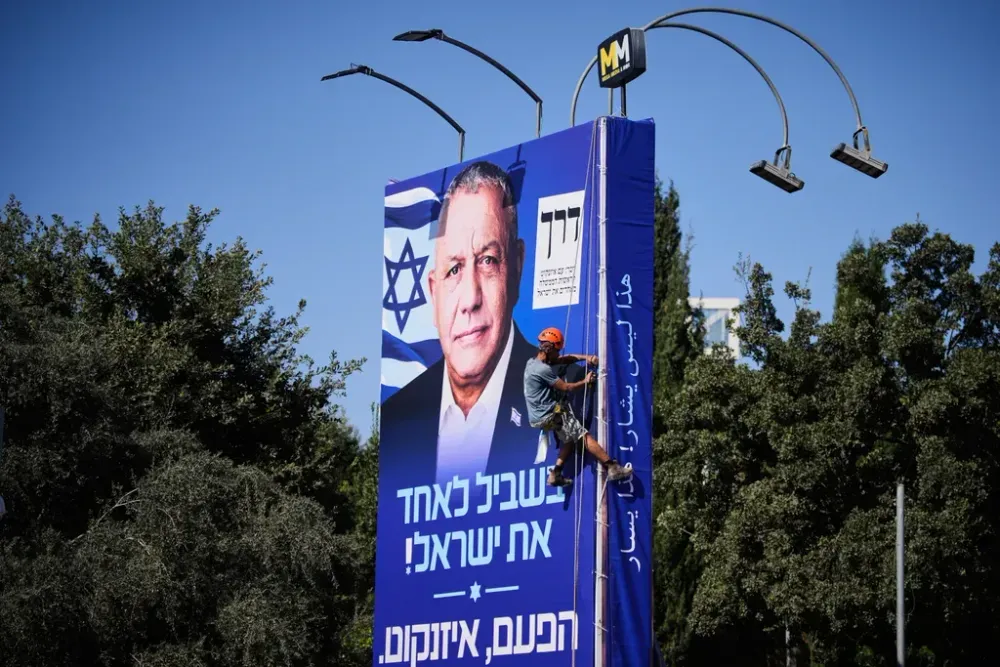
Election results leave coalition talks unresolved
Netanyahu's bloc took 53 Knesset seats in the October 27 election, compared with 48 for the Eisenkot-led opposition and 19 for Arab parties, Kompas reported. Forming a government requires 61 votes.
The presidential office said Eisenkot's appointment took place at a state ceremony at Herzog's residence in Jerusalem, following a week of consultations with all parties. Parties representing 67 seats endorsed Eisenkot for the mandate, while those backing Netanyahu represented 46 seats.
Herzog, formerly active in the left-leaning Labor Party, has remained neutral as president. He has nevertheless expressed interest in a national unity government bringing together Jewish Israelis across political divisions.
The largest faction does not automatically receive the mandate under Israeli law, according to the Israel Democracy Institute. In 2009, Shimon Peres chose Netanyahu to attempt coalition-building even though Likud's 27 seats trailed the 28 won by Tzipi Livni's Kadima. Peres judged Netanyahu more likely to assemble a government.
"Now is the time to form a national emergency government. I will do everything I can to ensure that we are worthy," Eisenkot wrote on X after receiving the mandate.
Arab parties and Haredi service complicate negotiations
Eisenkot is seeking support among secular and liberal Israelis while also reaching out to ultra-Orthodox Jews. His options include finding agreement with Arab parties on key issues or negotiating with ultra-Orthodox parties that he and his allies previously avoided. A unity government with Netanyahu remains another possibility, though Kompas described it as unlikely.
Eisenkot's endorsements include support from the right-wing opposition and parts of the divided Arab Israeli party coalition. He has rejected support from the Joint List, but Arab Israeli leaders ultimately chose to back him out of frustration with Netanyahu and his right-wing allies. The Joint List represents Israelis of Palestinian descent, who account for 21% of the population and are often marginalized in national politics, according to Kompas.
Before the results, BBC News reported that unprecedented Arab turnout was helping Arab parties toward a projected record 19 seats. Their participation in government has little precedent: Ra'am became the only independent Arab party to formally join a governing coalition in 2021, and the arrangement was short-lived.
Resistance to working with Arab parties also exists within the opposition. Members of the bloc led by Avigdor Liberman, a former Netanyahu aide who takes a hardline position on Palestine, have opposed such cooperation.
Military service is another issue in Eisenkot's outreach. He proposes a service requirement for all Israeli citizens, with civilian service available as an alternative to military duty. Kompas described the proposal as a possible way to integrate the ultra-Orthodox, or Haredi, community.
Haredi men's military exemption dates to an arrangement made by David Ben-Gurion in 1948, according to Concordia University's Azrieli Institute of Israel Studies. In July 2026, the Knesset temporarily halted arrests and prosecutions of Haredi draft evaders, protecting yeshiva students from arrest until January 2027. IDF Chief of Staff Eyal Zamir called the law "clearly and unequivocally inconsistent with the IDF's needs."
Eisenkot's path from military command to opposition
The son of Moroccan immigrants, Eisenkot could become Israel's first prime minister from the Mizrahi community, whose roots are in the Middle East and North Africa. He was already the first person of Mizrahi background to serve as Israel Defense Forces chief of staff, a post he held from 2015 to 2019, according to Encyclopaedia Britannica.
His political career began in 2022 with Benny Gantz's National Unity party. After leaving in July 2025, he announced a new party that September: Yashar! (Straight Ahead!).
Eisenkot also served as a nonvoting observer in Netanyahu's war cabinet during the Israel-Hamas war. He left in June 2024 after arguing that Netanyahu's war objectives were unrealistic and pressing for an agreement to free hostages, Britannica reported.
As opposition leader, he has criticized Netanyahu's handling of the Gaza war and tensions with Western countries, while opposing the prime minister's right-wing partners Itamar Ben-Gvir and Bezalel Smotrich. On November 6, Eisenkot called replacing Netanyahu urgent, describing him as a threat to "the very existence of Israeli democracy."
Netanyahu faces political and legal pressure
The election came after the United States and Israel attacked Iran in February 2026. That war remains underway, with no peace agreement between Washington and Tehran, Kompas reported. Netanyahu has threatened further attacks on Iran despite not having approval from U.S. President Donald Trump.
Netanyahu also faces corruption charges and an International Criminal Court arrest warrant. The ICC issued warrants for him and then-Defense Minister Yoav Gallant on November 21, 2024, covering alleged conduct from at least October 8, 2023, through at least May 20, 2024.
The warrants concern starvation as a method of warfare; murder, persecution and other inhumane acts as crimes against humanity; and intentionally directing attacks against civilians. Kompas reported that Netanyahu could face imprisonment if removed from office after nearly two decades in power.
As pressure for a unity government grows, Netanyahu has attacked opposition efforts to negotiate with Arab parties. "A government like that, which relies on Islamist groups, will destroy Israel from within, as has happened in European countries, and even worse than that," he said in a recorded speech.
Eisenkot's Yashar Party has urged Netanyahu and Likud members to join a unity government under Eisenkot's leadership. It has also demanded that Netanyahu and his allies publicly break their alliance with extremist groups.
A deadline, then further attempts
Eisenkot has 28 days to gather the 61 votes needed to form a government. Herzog can extend that period by 14 days before offering the mandate to someone else.
Under Israel's Basic Law: The Government, the president has three days after the first candidate fails to decide whether to give another Knesset member the task, the Israel Democracy Institute explains. A second candidate gets 28 days, without an extension.
If that effort also fails, a group of at least 61 Knesset members has 21 days to jointly request a specific lawmaker for another attempt. That candidate would have 14 days to form a government.
Failure at every stage would lead to the Knesset's dissolution and another election. Recurring coalition deadlocks previously sent Israelis to the polls five times between 2019 and 2022.