
Prabowo Pledges Crackdown on Smuggling and Illegal Resource Activities
Indonesian President Prabowo Subianto pledged on October 21, 2026, to combat illegal economic activities that drain the country's natural resources, telling his cabinet that protecting that wealth was a matter of national survival and must serve the public.

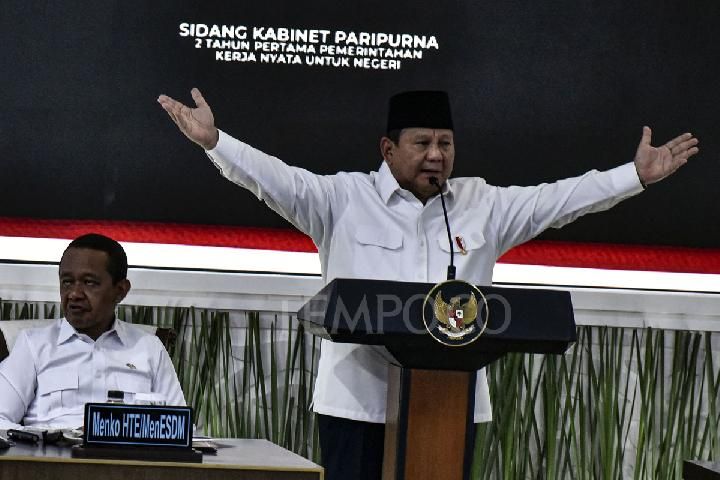
Resource protection and economic independence
At Wednesday's plenary cabinet meeting at the Presidential Palace complex in Jakarta, Prabowo compared the loss of natural resources to blood loss. "We are now in a situation where we must survive. We must persevere and safeguard our wealth. Our natural resources are like our blood. If we keep losing blood, our bodies cannot survive," he said.
Prabowo said Indonesia's wealth had been taken away for hundreds of years. He presented resource protection as a step toward economic independence, arguing that national and public interests must take priority over allowing others to continue profiting from the country's resources.
He framed the choice as accepting the difficulties of protecting Indonesia's wealth or allowing it to keep flowing abroad each year through practices he regarded as fraudulent. Smuggling, he said, hurt both the state and the public: "Smuggling is like stabbing our nation, stabbing our own body. Smuggling is an attempt to kill our economy. Killing our economy means killing our nation."
The president said his administration's efforts fulfilled a public mandate that required it to confront challenges and difficulties with courage.
Export reporting through a state-owned gateway
The government's measures include a single-gateway export policy covering strategic commodities such as crude palm oil (CPO), coal and iron alloys. It took effect on June 1, 2026, beginning with a transition phase, and is intended to prevent underinvoicing, transfer pricing, profit shifting and the diversion of export proceeds abroad.
The policy operates through state-owned exporter PT Danantara Sumberdaya Indonesia (DSI), according to ICIS. DSI brings export reporting together so authorities can track declared values, foreign exchange earnings and tax compliance. Government Regulation (PP) No. 24/2026 on Governance of Strategic Natural Resource Commodity Exports provides its legal basis.
Prabowo has cited gaps between declared export prices and international benchmarks to explain the problem. Before DSI started operating, he said, some commodity exports were priced at least 30% below those benchmarks, with the gap approaching 40% in some cases. In one crude palm oil shipment, he cited a declared price of about Rp15,000 per kilogram against a benchmark of Rp27,000 per kilogram. He characterized that case as Indonesia losing up to 50% of its wealth on a single shipment.
Full implementation was initially targeted for January 1, 2027. At a July 20, 2026, cabinet meeting, Prabowo announced that the target would move forward four months to September 1. The government attributed the accelerated schedule to early progress in closing reporting loopholes and strengthening oversight of coal, CPO and ferroalloy exports, ICIS reported.
ICIS also cited state news agency Antara's account of a July 27 statement by Coordinating Minister for Food Affairs Zulkifli Hasan. He said DSI had accumulated $12 billion in foreign exchange during June and July after its introduction in June. Hasan described that as tripling from around $3 billion in May.
Enforcement in state forest areas
A separate effort targets illegal plantations and mining operations in forest areas through the Forest Area Enforcement Task Force, known as Satgas PKH. Prabowo established it by signing Presidential Regulation No. 5 of 2025 on January 21, 2025, according to ANTARA News. Forestry Ministry figures cited by the agency put Indonesia's oil palm plantation area at 16.38 million hectares, including about 3.3 million hectares illegally located within state forest zones.
After severe floods and landslides hit Aceh, North Sumatra and West Sumatra in late 2025, the task force carried out expedited audits of natural-resource companies in those provinces. Investigators found that companies had extended operations beyond their legal boundaries into protected headwater forests. Following a Prabowo-led review in early 2026, the government revoked 28 companies' operating licenses. Most held forest utilization permits, and their concessions covered roughly 1 million hectares.
By the time of ANTARA's report, the task force had reclaimed state control over more than 6 million hectares of illegal oil palm plantations and tens of thousands of hectares of unauthorized mining sites within state forest zones. Prabowo put the reclaimed land's economic value at nearly Rp400 trillion, or about $22.3 billion.
On October 6, 2026, Satgas PKH transferred its eighth payment installment to the state treasury, totaling Rp13.24 trillion, or about $739.6 million. Tax payments accounted for the largest portion, at Rp8.23 trillion.