
Indonesia Has Not Yet Responded to Malaysia's Firefighting Assistance Offer
Indonesia has not addressed Malaysia's offer to help extinguish forest fires in Sumatra and Kalimantan, as fires threaten critical conservation areas including Tanjung Puting National Park during the country's most severe wildfire season in over a decade.

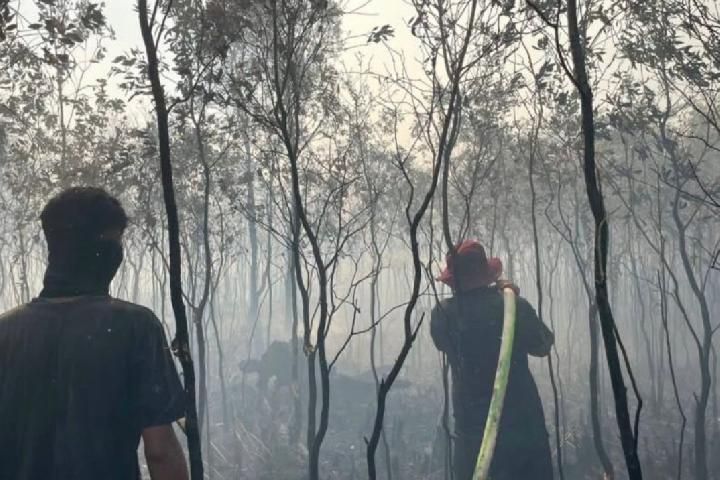
Indonesian Govt Yet to Respond to Malaysia's Forest Fire Aid Offer
Indonesia has not responded to Malaysia's offer of firefighting assistance to combat forest and land fires in Sumatra and Kalimantan, Coordinating Minister for Political and Security Affairs Dudung Abdurachman confirmed on Monday, October 12, 2026.
The offer was not discussed during a limited cabinet meeting on forest and land fires held at the Presidential Palace in Jakarta that evening, Dudung told reporters when asked whether the government had addressed assistance offers from Malaysia and Singapore.
Malaysian Deputy Prime Minister Ahmad Zahid Hamidi said his government remains waiting for Indonesia's response. Malaysia's National Disaster Management Agency and Foreign Ministry have sent formal letters to their Indonesian counterparts to follow up on the assistance offer, but had received no reply as of Sunday, according to reports in Kompas.
The 2026 wildfire season has been described by Indonesian authorities as the most intense in 11 years. A strong El Niño phenomenon reinforced by a positive Indian Ocean Dipole left approximately 90 percent of the country with little to no rain in early August. By mid-August, Indonesia's Ministry of Forestry reported that 202,000 hectares of forests and land had burned across the country, representing a 110 percent increase compared to the same period in 2023.
Between September 1 and September 7, Indonesia released 19.7 million metric tons of fire emissions, the highest of any country globally that week and more than one-third of the worldwide total during that period.
Threats to Critical Conservation Areas
Forest and land fires continue to threaten conservation areas across Indonesia, with particular concern focused on Tanjung Puting National Park in Central Kalimantan. The park, which was originally protected in 1936 and designated a UNESCO Biosphere Reserve in 1977 before becoming a national park in 1982, is home to the world's largest population of wild orangutans and houses Camp Leakey, the pioneering orangutan research center founded by Dr. Biruté Galdikas in 1971.
President Prabowo Subianto has paid particular attention to the fires at Tanjung Puting, according to Dudung. The Bornean orangutan, classified as critically endangered by the IUCN with an estimated population of approximately 104,700 individuals, has seen its numbers drop more than 50 percent over the past 60 years while its habitat has declined by over 80 percent in the past two decades.
Firefighting operations are also underway in other parts of Central Kalimantan and South Sumatra. More than 39,000 personnel have been deployed as part of joint operations to extinguish the fires, with efforts including ground operations, water bombing, and weather modification.
Operational Challenges
Thick smoke has hampered aerial firefighting in some areas, forcing authorities to rely more heavily on ground operations, Dudung said. According to a report from the National Disaster Management Agency chief, helicopter operations have been conducted, but efforts are now concentrated on ground-based firefighting because some areas are difficult to reach from the air due to dense smoke.
The diplomatic situation unfolds against the backdrop of the ASEAN Agreement on Transboundary Haze Pollution, signed by all ASEAN member states on June 10, 2002, to prevent, monitor and mitigate land and forest fires causing cross-border haze. Indonesia was the last ASEAN country to ratify the agreement in October 2014, with the ratification deposited in January 2015.
Regional cooperation on Indonesian forest fires has historical precedent. Operation Haze in 1997 was the largest cross-border firefighting mission in history, when Malaysian firefighters assisted Indonesia with major fires that caused severe haze across Southeast Asia. Malaysia's Bombardier CL-415MP amphibious aircraft was previously deployed to South Sumatra in 2015, dropping 546,000 liters of water during a five-day mission.