
Indonesia's BNPB calls for village-level readiness against forest and land fires
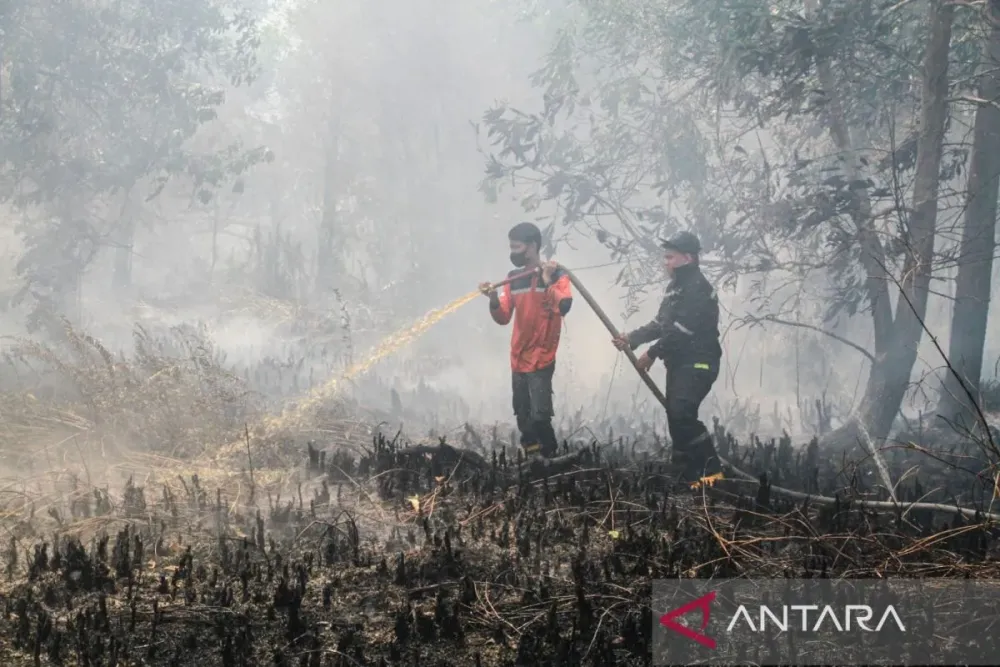
Indonesia's National Disaster Mitigation Agency (BNPB) urged regional governments on October 28 to activate fire-response posts and task forces in villages, with patrols and hotspot monitoring to address continuing fires in Sumatra and Kalimantan.

Local prevention and public precautions
At a virtual news conference Wednesday, Berton SP Panjaitan, acting head of BNPB's Disaster Data, Information, and Communication Center, said local readiness must address both ongoing fires and potential hydrometeorological disasters as the country moves from the dry season into the rainy season.
BNPB called for particular attention to peatlands during patrols and hotspot monitoring. It also urged authorities to enforce the prohibition on clearing land with fire and to use existing canal blocks and deep wells to rewet peatlands, reducing their fire risk.
The agency asked residents not to burn land, gardens, or trash under any circumstances. It also said people should ensure that cigarette butts and bonfires are fully extinguished after use.
Fire extent and standby forces
BNPB's October 27 figures put the burned area across three Kalimantan provinces at 1,566 hectares, according to Kompas.com. Central Kalimantan accounted for 1,140 hectares, West Kalimantan for 391, and South Kalimantan for 35. South Sumatra was the only province on Sumatra where fires remained, covering 23 hectares.
Berton said BNPB was keeping crews and equipment ready in districts and cities that had experienced fires to respond to new hotspots. Personnel on standby included 16,387 in Central Kalimantan, 14,458 in West Kalimantan, 12,287 in South Sumatra, and 7,927 in South Kalimantan.
Fire-suppression equipment was also being held ready through Regional Disaster Mitigation Agencies (BPBD), regional governments, and district and city task forces.
Aerial support comprised 61 operational units on standby as of October 27, Kompas.com reported. Of those, 24 were assigned to patrols and weather modification operations; the other 37 were helicopters designated for water bombing.
Peatland damage and delayed rains
Indonesian officials have characterized 2026 as the country's worst wildfire season in 11 years, driven by drought associated with El Nino, according to The Straits Times. Deputy Food Minister Hanif Faisol Nurofiq linked the severity to peatland degradation caused by earlier food-estate projects, including one dating to the 1990s.
The nongovernmental organization Pantau Gambut estimated that ecosystem damage had left 16 million hectares of Indonesia's 24 million hectares of peatland more susceptible to fire. The government said it planned to drill wells and improve canal management to restore moisture to peatlands.
An October 21 situation report from the Muhammadiyah Disaster Management Center (MDMC), published on ReliefWeb, cited the meteorology agency BMKG as reporting a very strong El Nino, with a Nino 3.4 anomaly of +2.83, alongside a positive Indian Ocean Dipole. Those conditions had delayed the rainy season's arrival in 61 percent of the country.
BMKG expected peak rainfall only between December 2026 and January 2027 and warned that fire and haze risks would persist for several more weeks.
Haze strains health services and travel
BNPB urged local governments to have health services ready and keep residents informed about air quality to limit the effects of fire-related haze.
By mid-October, hundreds of thousands of people across seven Indonesian provinces had contracted respiratory illnesses, The Straits Times reported. Pollution index readings were far above the "hazardous" threshold of 300. On October 15, Katingan district in Central Kalimantan recorded nearly 1,600, while the provincial capital, Palangka Raya, recorded nearly 1,300.
The Straits Times also reported on October 15 that haze had spread to neighboring countries, polluting their air and prompting school suspensions in Timor-Leste and some Malaysian states.
Indonesia's Transportation Ministry said reduced visibility affected 2,604 domestic flights from August 11 through October 19, according to BBC News. The ministry recorded 1,129 delays and 1,420 cancellations or postponements, along with 23 diversions, six returns to base, and 26 flights that departed ahead of schedule.
Company investigations and emergency relief
As of October 20, Singapore had sent legal notices to 10 named companies over fires it believed had contributed to regional haze, BBC News reported. The notices instructed the companies to stop burning on their Indonesian land and submit fire-suppression plans. Indonesian authorities said they were investigating about 100 cases involving companies linked to the wildfires, including some involving foreign investors.
MDMC's emergency operation has covered multiple provinces since August 18. The organization reported mobilizing 413 volunteers at more than 24 command and service posts, putting out fires at 294 points, distributing 128,265 masks, and supplying 407,502 liters of clean water.
MDMC has also launched a 100-Day Action Plan scheduled to run from November 1, 2026, through February 8, 2027. It covers fire suppression, clean-air health services, water filtration, and peatland restoration.