
Indonesia brings 502 hectares of peatland fires under control in priority provinces
National firefighting operations have extinguished over half of targeted fire areas across six provinces, deploying more than 71,000 personnel and 51 aircraft to combat blazes in critical peatland regions amid severe drought conditions.

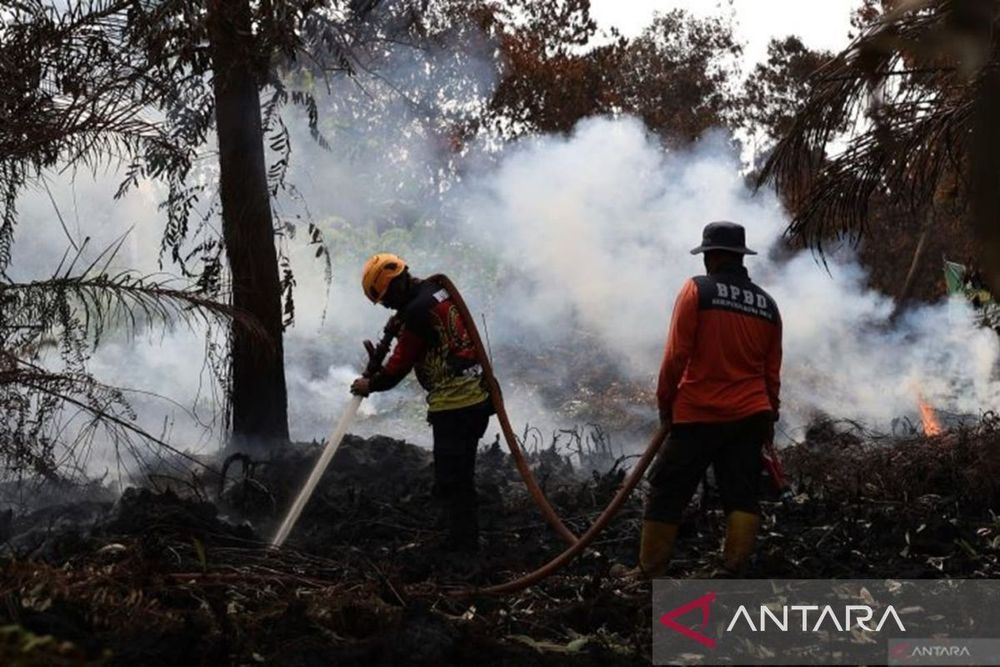
Indonesia extinguishes more than 502 hectares in 6 priority provinces
Firefighting operations across Indonesia have successfully extinguished more than 502 hectares of forest and land fires in six priority provinces, according to the National Disaster Mitigation Agency (BNPB). The achievement represents just over half of the 983 hectares targeted for immediate suppression, leaving 481 hectares still requiring active firefighting efforts.
Berton Panjaitan, Acting Head of BNPB's Disaster Data, Information, and Communication Center, reported on Wednesday that Central Kalimantan faces the most severe situation with over 321 hectares of unextinguished fires, followed by South Sumatra Province with more than 84 hectares remaining ablaze.
The six provinces receiving priority attention—Central Kalimantan, South Sumatra, Jambi, South Kalimantan, West Kalimantan, and Riau—were selected based on their extensive critical peatland areas, vulnerability to fire hotspots, and exposure to extreme weather conditions. Indonesia is home to approximately 36 percent of the world's tropical peatlands, making these regions globally significant for environmental conservation.
Drought conditions fuel severe fire season
The 2026 fire season has proven particularly challenging due to a developing El Niño event that created severe drought conditions, with approximately 90 percent of Indonesia receiving little or no rainfall in early August. According to Indonesia's Ministry of Forestry, 202,000 hectares of forests and land had burned across the country by August 18, representing a 110 percent increase compared to the same period in 2023.
The environmental impact of peatland fires extends beyond their immediate destruction. Peatlands store about one-third of the world's soil carbon despite covering only about three percent of global land area, making peat fires particularly harmful for climate change when they release stored carbon into the atmosphere.
More than 12.5 million people across seven Indonesian provinces have been exposed to haze from the 2026 fires, with respiratory infection cases rising to over 283,000 as of October 13. The transboundary haze has affected neighboring countries, forcing school suspensions in East Timor and several Malaysian states, and triggering the highest-level alert from ASEAN's meteorological monitor.
Massive deployment of personnel and equipment
Panjaitan explained that field operations employ two main approaches: the Land Task Force and the Air Task Force. The Land Task Force has deployed a total of 71,878 personnel across the six priority provinces, including an additional 11,000 personnel recently sent to reinforce operations, primarily in Central Kalimantan, which now has 16,387 personnel on the ground.
Other provinces have also mobilized substantial joint forces, with 14,500 personnel in West Kalimantan, 12,285 in South Sumatra, 14,837 in Riau, 7,900 in South Kalimantan, and 5,984 in Jambi.
The Air Task Force has expanded its fleet of water-bombing and patrol helicopters from 49 to 51 aircraft. The additional aircraft, contributed by industrial forest plantation companies and the Indonesian Defense Forces (TNI), support water bombing operations, aerial patrols, and weather modification activities.
Beyond the six priority provinces, firefighting efforts cover an additional 1,044 hectares spanning areas from East Kalimantan to North Maluku. Of this area, 44 hectares have been extinguished, leaving approximately 1,000 hectares still requiring suppression operations.
Historical context and regional obligations
The scale of current firefighting operations reflects lessons learned from Indonesia's 2015 fires, which resulted in economic losses totaling between US$16.1 billion and US$28 billion and released 1.75 billion tons of greenhouse gas equivalents—exceeding Japan's annual emissions.
In 2016, Indonesia established a peat restoration agency tasked with restoring 2.6 million hectares of degraded peatland. The agency reported restoring about 1.6 million hectares before its mandate ended in December 2024, though remaining degraded peatlands continue to pose fire risks.
Indonesia ratified the ASEAN Agreement on Transboundary Haze Pollution in 2014, becoming the last of ten ASEAN nations to join the 2002 treaty aimed at preventing and monitoring cross-border haze from land and forest fires. The regional impact of the current fire season underscores the importance of these international commitments to neighboring countries affected by smoke and haze.