
Jakarta Air Rated Unhealthy for Sensitive Groups on November 1
Jakarta recorded an air quality index of 140 at 5:00 a.m. Western Indonesian Time on Sunday, November 1, 2026, according to IQAir. The reading placed the city in the unhealthy-for-sensitive-groups category, with people in those groups advised to wear masks outdoors.

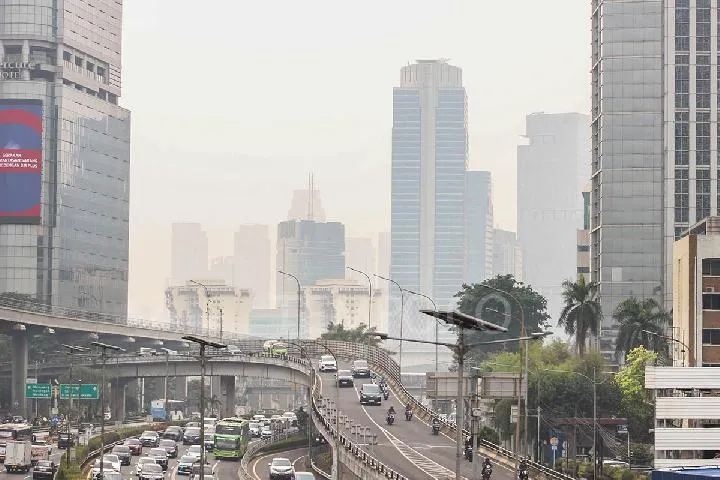
Pollution levels and health precautions
IQAir measured Jakarta's PM2.5 concentration at 51.5 micrograms per cubic meter, or 10.3 times the World Health Organization's annual air quality guideline. Among Indonesian cities, Jakarta had the fourth-worst air quality at that time. Palembang recorded an index of 175, followed by Tangerang at 163 and South Tangerang at 152.
PM2.5 consists of airborne particles less than 2.5 micrometers in size, such as dust, smoke and soot. Exposure over the long term is associated with premature death, especially for people who have chronic heart or lung conditions. Along with wearing masks outside, sensitive groups are advised to avoid outdoor activities, close windows to keep polluted air out and use air purifiers.
The morning measurement follows a year in which Jakarta's annual average PM2.5 concentration reached 23 micrograms per cubic meter. The October 2026 Jakarta Clean Air Investment Roadmap, published by Systemiq with support from the Clean Air Fund, puts that 2025 average at close to 4.5 times the WHO guideline and 1.5 times Indonesia's national standard of 15 micrograms per cubic meter.
Estimates of the health burden
The Systemiq roadmap describes a substantial health burden beyond individual daily readings. It cites estimates that air pollution shortens average life expectancy in Jakarta Province by 2.2 years and contributes to about 2 million respiratory illnesses in the city. Children account for almost 20% of those cases.
An estimated 4 out of 5 Jakarta children encounter hazardous PM2.5 levels every day, according to the report. It also cites earlier analysis suggesting that better air quality could avert 32,747 premature deaths between 2025 and 2030, with health and economic benefits equivalent to $27 billion.
Local emissions and pollution from outside Jakarta
Road transport accounts for roughly 60% of PM2.5 emissions within Jakarta, the Systemiq roadmap says. Industry contributes about 20%, while open waste burning contributes about 10%. Together, transport, industry and waste generate around 90% of the city's PM2.5 emissions.
IQAir also identifies sources beyond the Jakarta metropolitan area. It estimates that coal-fired power plants outside the metropolitan area supply between 5% and 31% of Jakarta's total PM2.5 on any given day. Forest and peatland fires in Sumatra and Kalimantan during the April-October dry season account for an estimated 31% of Jakarta's PM2.5 pollution, it says. Indonesia's coal-fired electricity generation more than doubled from 2010 to 2020.
The city's pollution also varies by season. In IQAir's analysis of monitoring data from 2019 through 2023, monthly average PM2.5 levels were highest in June, July and August, during the dry season. Levels declined from September through April, during the wet season.
Clean-air measures and targets
Jakarta's provincial government is encouraging residents to take simple local actions through the collaborative #SatuLangkahDulu initiative, whose name means "Take One Step First." It is also seeking to reduce private vehicle use through policies including Car Free Day events on Jalan H.R. Rasuna Said and the Sudirman-Thamrin corridor. Tempo reports that these measures have reduced vehicle emissions and air pollution in Jakarta.
The province's broader target is a 41% reduction in PM2.5 by 2030. According to the Systemiq roadmap, that goal is set out in the 2023 Air Pollution Control Strategy, issued through Governor Decree No. 576/2023. At the national level, the Environment Ministry issued Regulation 5/2026 on Air Quality Protection and Management Planning in June 2026. The roadmap describes it as the first major update to Indonesia's national air-quality framework.
As a precedent, the roadmap points to Beijing, where annual average PM2.5 fell 66% between 2013 and 2022. Measures there included phasing out coal boilers, restructuring industry and applying vehicle emission standards. The report says Beijing residents' life expectancy is estimated to have increased by around 4.6 years as a result.
Enforcement and court rulings
Industrial enforcement has included shutdowns in Greater Jakarta. The Jakarta Post reported in January 2026 that the Environment Ministry halted operations at major emitting facilities operated by eight companies for breaching emission standards. Those actions followed inspections of 40 industrial complexes from January 16 to 22, 2026.
Court orders remain another point of scrutiny. Kompas reported in September 2026 that Indonesia's Supreme Court had upheld a citizens' clean-air lawsuit against the government through Decision No. 2560 K/Pdt/2023. The IBUKOTA Coalition says implementation remains incomplete and that some obligations have been fulfilled only administratively.
In a separate power-plant emissions transparency case, the Supreme Court rejected a cassation appeal in August 2026. That ruling requires state electricity utility PLN to make emissions data public.