
Farmer gets four-year prison term for illegal cultivation in Tesso Nilo
A court in Indonesia's Riau province sentenced farmer Manuturi Butar-butar to four years in prison on Oct. 30 for deforestation and unauthorized plantation activities in Tesso Nilo National Park. Judges also ordered him to pay Rp 600 million (US$33,227) for environmental restoration.

Court findings and payment terms
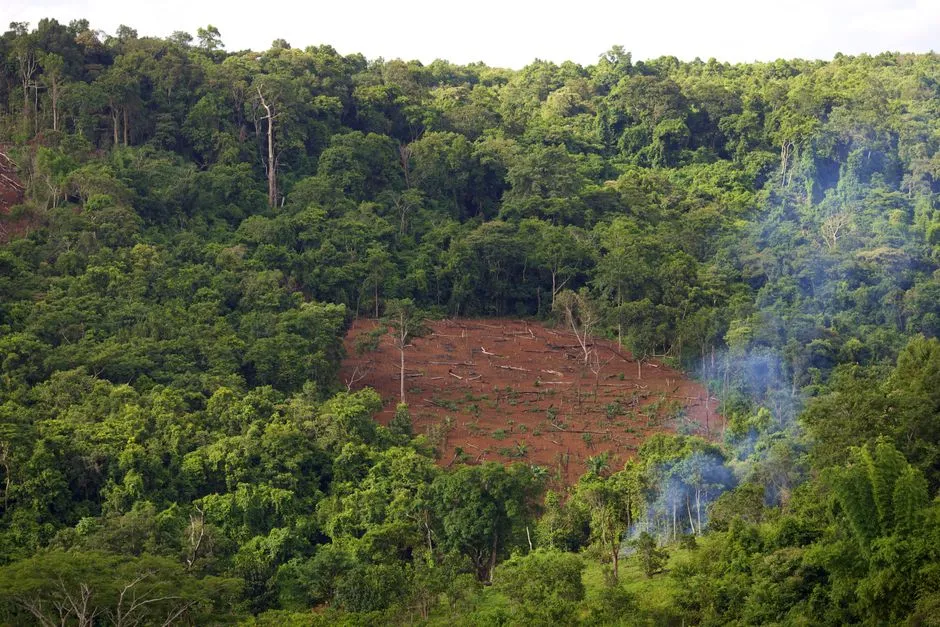
The case concerned land cultivated illegally in the park's conservation area and limited production forest (HPT), The Jakarta Post reported. Presiding judge Andry Simbolon said Manuturi had unlawfully changed the landscape, carried out activities incompatible with the conservation area's functions and deliberately operated a plantation in forest areas without a business permit.
The judges found that the activities, which took place in February, breached Articles 40B (1)d, 33 (2)d, 40B (1)e juncto Article 33 (2)e of Law No. 23/2024 on Natural Resources and Ecosystem Conservation. They also cited Article 92 (1)a juncto Article 17 (2)b of Law No. 6/2023 on Prevention and Eradication of Deforestation.
The ruling gives Manuturi one month to pay the restoration cost, with a further one-month extension, after which the verdict becomes legally binding. If he cannot pay, prosecutors may seek authorization from the head of the Pelalawan District Court to seize and auction his assets, assisted by the State Assets and Auction Service Office (KPKNL). If that process fails to cover the compensation, he faces an additional 190 days in prison.
Forest loss and wildlife habitat
Tesso Nilo, in Riau on the island of Sumatra, became a national park in 2004 on land previously used as a logging concession. An expansion in 2009 brought it to 81,793 hectares (202,115 acres), larger than New York City, according to Mongabay.
Satellite monitoring platform Global Forest Watch, managed by the World Resources Institute, found that 78 percent of the park's old-growth forest disappeared between the 2009 expansion and the end of 2023. Smallholder oil palm farms accounted for much of that loss.
The park supports thousands of plant species and is among the few habitats left for the critically endangered Sumatran elephant and Sumatran tiger. A 2021 Ministry of Forestry estimate put the remaining elephant population at around 60, attributing the decline to habitat fragmentation. Mongabay reported an increase in human-elephant conflict, from 13 incidents in 2017 to 39 in 2020 and 58 in 2024.
Land recovery, relocation and reforestation
Tesso Nilo is also part of a nationwide effort to recover forest land. President Prabowo Subianto established a forestry task force in January 2025 that brings together the military, police, prosecutors and multiple ministries. By January 2026, it reported reclaiming more than 4 million hectares used for plantations, mining and other activities within designated forest areas, according to Mongabay. The task force described that result as exceeding its initial 1-million-hectare target by more than 400 percent. The recovered land included 81,793 hectares in Tesso Nilo, which were returned to the Ministry of Forestry for restoration.
The government has also moved farming families out of the park as part of the restoration effort. On Dec. 20, 2025, more than 200 families left settlements inside its boundaries for replacement plantation land taken from companies operating outside the park, Mongabay reported.
The reported relocation figures included 47 families from Pangkalan Gondai, 72 from Pesikaian and 108 from Baturijal Barat. More than 200 families settled in Bagan Limau in December. Officials said at least 6,000 families were living within the park's boundaries.
The Ministry of Forestry formally launched its reforestation program on March 3, 2026, with a goal of restoring 66,704 hectares of degraded land by 2028, according to ANTARA News. The 2026 first phase covers 2,574 hectares. Planting started with 2,000 forest seedlings on a former oil palm plantation of about 400 hectares.
Forestry Minister Raja Juli Antoni called the restoration a national priority. He said research conducted with universities and research institutions guided the choice of species to supply food and shelter for wildlife, particularly Sumatran elephants. The government has also presented reforestation and relocation as an effort to protect Domang, an elephant calf born in the park in 2021, Mongabay reported.