
Indonesia Weighs Legal Changes After Prabowo's 'Ecological Terrorism' Directive
Indonesia's Justice Minister Supratman Andi Agtas is open to revising laws following President Prabowo Subianto's call for tougher action against forest and land fires, ANTARA reported on October 21. Specific amendments have not been detailed, while a separate Forestry Law revision faces scrutiny over corporate accountability and the limits of state authority.

A presidential directive and a pending forestry bill
Prabowo called for fires in Sumatra and Kalimantan to be categorized as "ecological terrorism" during a limited cabinet meeting on September 16, 2026, according to the Ministry of Environment/Environmental Management Agency. He instructed the State Secretary and the Minister of Law to strengthen the legal rules accordingly.
The Forestry Law revision remains a legislative proposal, not an enacted law. The House of Representatives, known as the DPR, approved the Fourth Amendment to Law No. 41 of 1999 on Forestry as a House initiative on August 27, 2026. That decision did not constitute approval of specific criminal provisions.
An earlier procedural step came on July 20, when the DPR's Legislation Body, or Baleg, approved the draft's harmonization for submission to a House plenary session, according to the NGO HuMa.
The legal questions extend beyond the severity of punishment. The revision offers lawmakers an opportunity to clarify how forest-use rights relate to protection duties and liability for damage. Identifying gaps in existing rules and explaining how proposed changes would address them are necessary to assess whether the bill tackles the causes of fires rather than only increasing penalties.
Burned area, health risks and economic losses
Indonesia's Sipongi monitoring system recorded 202,004.30 hectares of forest and land burned from January through July 2026. According to the Ministry of Forestry's system, that was 69% higher than in the same period of 2025, an increase of 82,791.04 hectares. It was also 80% higher than in 2023, or 109,080.25 hectares more, and 47% higher than in 2019, or 64,996.88 hectares more.
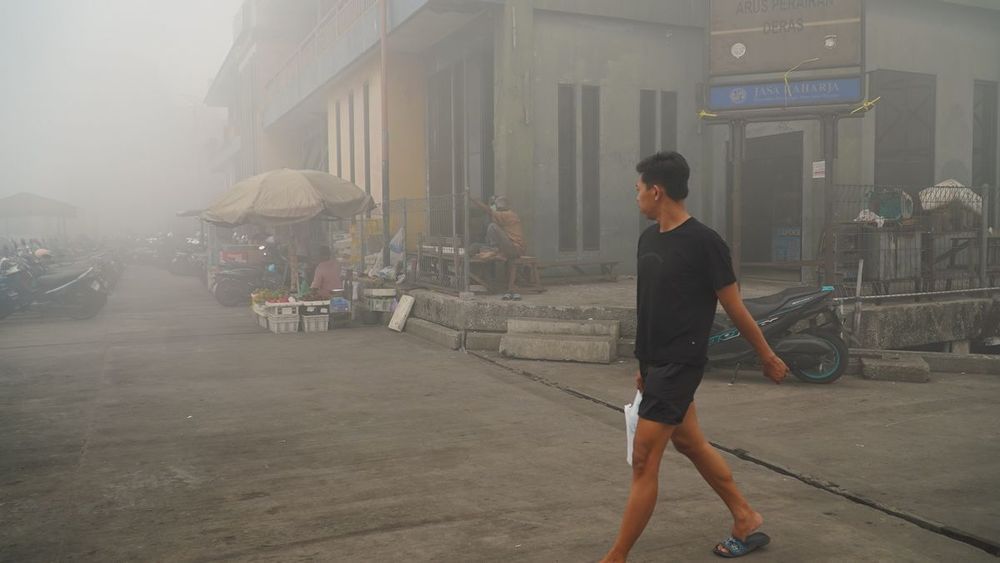
The damage reaches people outside the burned areas. Smoke enters homes, creates respiratory problems and restricts daily activities, including for residents who receive no benefit from land clearing. Fires also destroy habitat, disrupt water systems and release carbon that worsens the climate crisis.
The Ministry of Environment/Environmental Management Agency estimated economic losses from fires covering more than 202,000 hectares at Rp 39.29 trillion to Rp 123.1 trillion. Citing a Center of Economic and Law Studies (Celios) study, the ministry put losses to physical assets and activities alone at Rp 29.54 trillion.
The ministry also cited estimates that about 1.78 million people could suffer acute respiratory infections, known as ISPA, with associated health costs of approximately Rp 9.75 trillion. The fires could reduce net regional tax revenue by about Rp 269.86 billion in 2026.
Those figures describe the extent and estimated consequences of the fires; they do not establish who caused them. Assigning responsibility requires evidence about individual locations, their management history, ignition sources and compliance with fire-prevention and control duties.
Proving responsibility and defining corporate penalties
By late August 2026, Bareskrim Polri had named 72 suspects across nine regional police commands, or Polda, and issued 89 police reports relating to forest and land fires, according to the environment ministry.
For corporate cases, an investigation must connect conditions at the fire site with operational decisions: who controlled the work, who gave orders and who had a duty to prevent or contain a fire. A fire within a concession provides grounds for investigation, but violations still have to be proved.
A 2024 study by Ganitri, Sugiartha and Setiabudhi examined Decision No. 71/Pid.B/LH/2021/PN Snt and emphasized the need to establish intent and negligence in corporate fire cases. Distinguishing between them determines the basis for liability and keeps enforcement tied to conduct supported by evidence.
HuMa's July 2026 analysis also raises a specific question about the draft's treatment of corporate officers. According to the organization, Article 78(13) would narrow a one-third penalty enhancement that previously extended to imprisonment, limiting it instead to one-third of the base fine.
HuMa questions safeguards on state control
HuMa argues that the draft expands state powers without sufficient constraints. Its July analysis found that Article 4(2) includes all five forms of state control recognized in Constitutional Court ruling 001-021-022/PUU-I/2003: policy, administration, regulation, management and supervision. The current law includes only three.
The organization contrasted those powers with four limiting criteria in Constitutional Court ruling 3/PUU-VIII/2010: benefit, equity, participation and respect for hereditary rights. HuMa found none of those criteria incorporated into the draft as a norm, procedure or legal consequence.
The distinction between private and customary forests is another concern in the analysis. Under Article 5(4), private forest, or hutan hak, would transfer to the state only with the agreement of its owner and the government. Under Article 5(7), customary forest, or hutan adat, would revert to the state once the relevant customary community was declared no longer to exist.
HuMa also reported that Article 18(6) leaves the setting of the mandatory 30% forest-area threshold to a government regulation, including for national strategic project areas.
These provisions concern who can determine a forest's status, authorize its use and oversee its protection. Unclear divisions of rights and authority can prolong disputes and make protection duties harder to establish. HuMa's analysis cites its HuMaWin database as recording 382 agrarian and natural-resource conflicts in 2025, with corporations and the ministry responsible for forestry identified as the most dominant actors.