
Indonesia's sugarcane harvest launches ambitious bioethanol push amid production challenges
President Prabowo launches nationwide sugarcane harvest targeting 18.4 million tons to fuel Indonesia's bioethanol ambition, but production capacity lags far behind demand as the country races to reduce fuel import dependence.
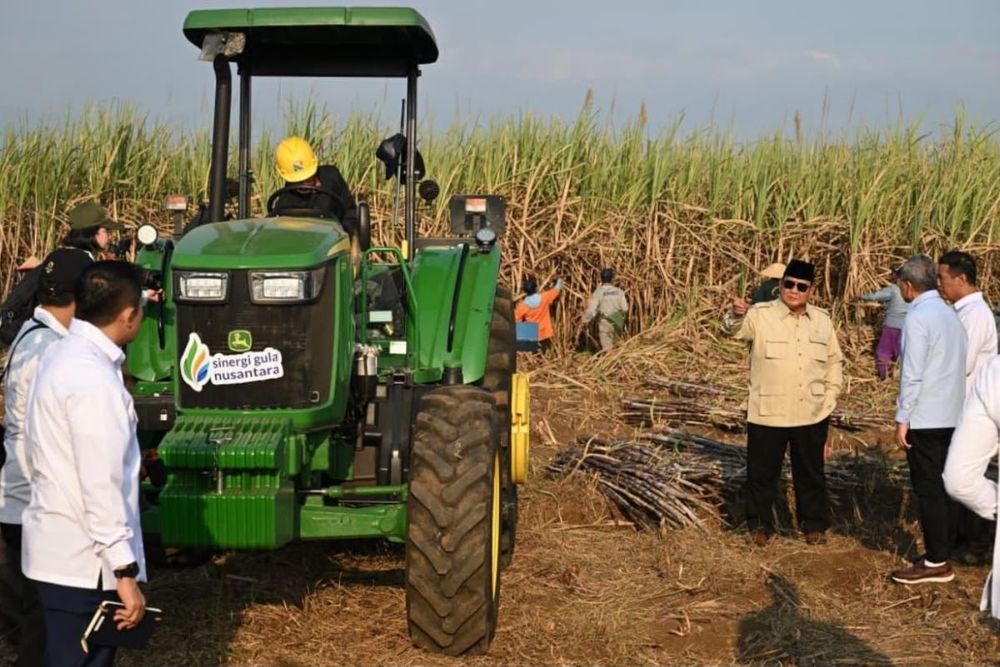
How sugarcane is powering Indonesia's bioethanol ambition
When President Prabowo Subianto landed at Abdulrachman Saleh Airport in Malang on July 17, 2026, the sprawling green fields visible from above told a story larger than sugar production. Those vast sugarcane plantations are now central to Indonesia's drive toward energy independence through bioethanol.
During his visit to the Air Force base, the President sounded the siren marking a simultaneous nationwide harvest across 43 locations for three key crops: sugarcane, rice, and soybeans. Sugarcane dominates the initiative, with land managed under the Indonesian Air Force's food security program spanning 236,048 hectares and projected to yield 18.386 million tons of cane, equivalent to 1.36 million tons of sugar.
The scale represents a striking reversal of history. In the 1930s, the Dutch East Indies produced up to 3 million tons of sugar annually on roughly 196,000 to 200,000 hectares in Java, achieving yields of 14.7 tons per hectare and exporting 2.4 million tons to become the world's second-largest sugar exporter after Cuba. Today's plantation area exceeds that colonial benchmark, yet production efficiency remains a work in progress.
From colonial exports to domestic energy security
The fundamental difference between then and now lies in the destination of the harvest. Colonial-era sugar flowed overseas, enriching Dutch coffers while leaving local farmers at the bottom of the value chain. After independence, Indonesia's sugar industry declined sharply, accelerated by World War II's devastation, transforming the nation from premier exporter to major importer for decades.
The simultaneous harvest in Malang marks an effort to reverse that trajectory, but with a modern twist. Rather than focusing solely on table sugar, facilities like Abdulrachman Saleh Air Force Base are converting processing byproducts such as molasses into bioethanol through yeast fermentation processes, alongside producing organic fertilizers and industrial materials.
The urgency becomes clear when examining Indonesia's fuel dependency. In 2025, gasoline imports reached 22.8 million kiloliters, accounting for 62 to 63 percent of national supply. Bioethanol production from domestic sugarcane offers a pathway to reduce this reliance, though the gap between ambition and capacity remains substantial.
Racing toward E20 amid production constraints
During the harvest event, Pertamina New and Renewable Energy officials presented comparisons with global leaders. India achieved its E20 blending target in 2025, five years ahead of schedule, rolling out the fuel nationwide despite consumer complaints about reduced mileage and engine compatibility. Brazil raised its mandatory blend from 27.5 percent to 30 percent in August 2025, with roughly 70 percent of new cars sold as flex-fuel vehicles capable of running on any petrol-ethanol mixture up to pure E100.
President Prabowo responded by directing officials to establish 50 new bioethanol plants, stressing Indonesia must rapidly close the gap with these nations. The government began implementing a five-percent bioethanol blend in July 2026 across six provinces: East Java, Jakarta, West Java, Banten, Central Java, and Yogyakarta. Pertamina established 179 distribution points with plans to add 30 more locations to support the rollout.
While the roadmap originally targeted E10 implementation between 2028 and 2030, Energy and Mineral Resources Minister Bahlil Lahadalia is preparing to jump directly to mandatory E20 beginning in 2028. The bioethanol market index price was set at Rp10,933 per liter in July 2026.
Yet production capacity tells a sobering story. As of mid-2026, Indonesia had only three companies producing fuel-grade ethanol with a combined annual capacity of approximately 26,000 kiloliters. To implement E10 nationally by 2027 would require at least 1.4 million kiloliters, while E20 demands an estimated eight million kiloliters. In 2024, installed capacity stood at just 303,325 kiloliters per year with actual output of merely 160,946 kiloliters.
Economic incentives and infrastructure challenges
The bioethanol program runs parallel to Indonesia's B50 biodiesel mandate launched on July 9, 2026, requiring diesel fuel to contain 50 percent palm oil-based biodiesel. Together, these initiatives form a comprehensive renewable fuel transition strategy aimed at energy self-sufficiency.
For sugarcane farmers, the shift creates new economic dynamics. Molasses, once merely a processing byproduct, now serves as raw material for substituting imported fuel. Every harvested hectare carries dual value as both food and energy source. Demand no longer depends solely on sugar prices but includes molasses prices linked to national energy needs.
India's experience demonstrates potential benefits. Its ethanol blending program has paid approximately 1.66 lakh crore rupees to farmers through 2026 and substituted roughly 270 lakh metric tonnes of imported crude oil. Such outcomes could reshape rural economies in Indonesia if the bioethanol infrastructure materializes as planned.
Building 50 new processing plants, expanding E5 across six provinces, and reaching E20 by 2028 represents bold national ambition. Success hinges on whether factories are actually constructed at the required pace, whether the molasses supply chain can scale reliably, and whether crop prices remain fair enough to keep farmers engaged in the fields where Indonesia's energy future is literally being grown.