
Midea Building Technologies Launches Power-Cooling Hyperconvergence Architecture at Singapore Event
Midea Building Technologies presents industry-first integrated power-cooling architecture and full-stack AI data center cooling solutions at Data Centre World Asia 2026, addressing critical challenges in high-density computing infrastructure.

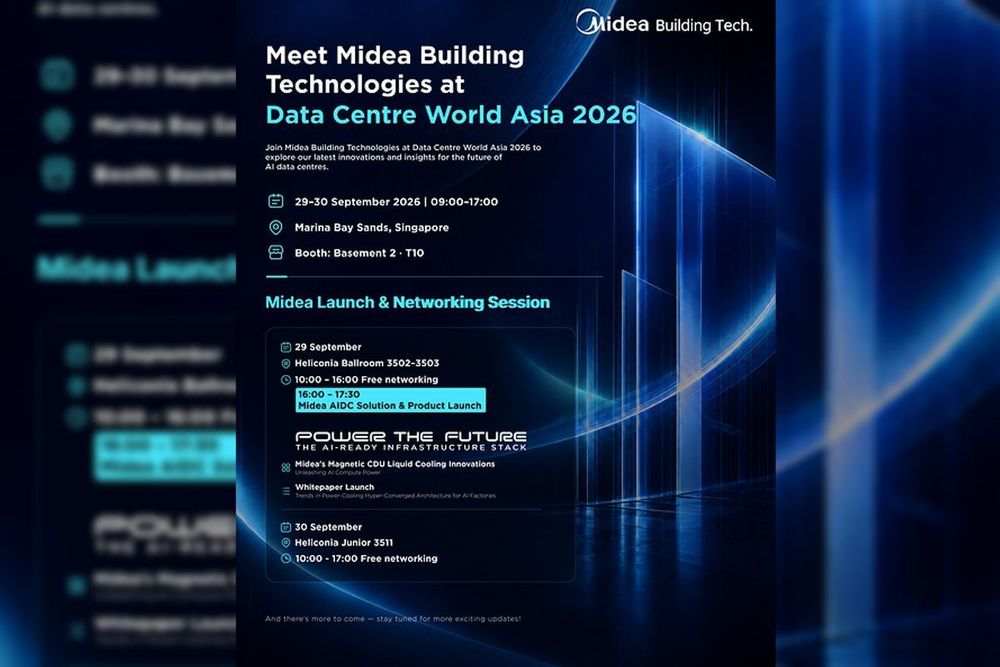
Midea To Unveil Industry-First Power-Cooling Hyperconvergence Architecture at Data Center World Asia 2026
Midea Building Technologies (MBT) showcased its latest innovations for AI data center infrastructure at Data Centre World Asia 2026, held September 29-30 at Marina Bay Sands, Singapore. The 12th edition of the event brought together over 17,000 infrastructure leaders, operators, and technology providers, providing a prominent platform for MBT's announcements.
At Booth T10, MBT unveiled three major developments: the industry's first power-cooling hyperconvergence architecture, a comprehensive AI data center cooling solution featuring three flagship products, and a strategic partnership with Keppel. The company also released an Omdia-commissioned white paper on September 29.
Addressing AI Infrastructure Challenges
The rapid growth of AI workloads has transformed data center requirements dramatically. Traditional data centers operated with rack densities of 5-15 kW per rack, but AI applications now demand 60-120 kW per rack, representing up to a five-fold increase. Modal rack density in data centers reached 11 kW in 2026, up from 9 kW in 2025, while Nvidia's GB300 NVL72 AI platform requires up to 142 kW per rack.
These escalating power requirements create two interconnected challenges: delivering sufficient electrical capacity to facilities and removing the resulting heat efficiently. Cooling typically accounts for 35-40% of total data center power consumption, making thermal management one of the most significant energy challenges in AI infrastructure. Conventional approaches treat power delivery and heat removal as separate engineering problems, an approach that becomes increasingly difficult to sustain as densities climb.
Hyperconverged Architecture
To address these challenges, MBT launched the AIDC Converged Infrastructure White Paper, developed in collaboration with CLOU Electronics. The document outlines a hyperconverged architecture that integrates electrical power systems, energy storage, magnetic-bearing cooling sources, and liquid-cooling coolant distribution unit (CDU) systems into a unified infrastructure stack. By coordinating power, storage, and cooling at the system level, the architecture provides a technical pathway for high-density, high-efficiency, and low-carbon AI data center development.
Full-Stack Cooling Solution
MBT presented its complete AI data center cooling solution, connecting cooling source, distribution, and terminal heat rejection for high-density, high-temperature, and water-constrained computing environments. The Magnetic CDU serves as the centerpiece: by integrating a magnetic-bearing cooling source with coolant distribution in one system, it reduces equipment footprint by up to 70%, shortens deployment time, and supports system Power Usage Effectiveness (PUE) below 1.2 under suitable operating conditions.
PUE, a globally accepted metric developed by The Green Grid Association in 2007, measures data center energy efficiency by comparing total facility energy consumption to IT equipment energy use. A PUE of 1.0 is considered perfect, meaning all energy goes to IT equipment. Advanced immersion cooling technologies can achieve PUE values around 1.02, meaning approximately 98% of energy consumed goes to computing, approaching perfect efficiency.
The solution lineup also includes the Air-Cooled Magnetic Bearing Centrifugal Chiller, offering a coefficient of performance (COP) of up to 5.4, and the Industrial-Grade CDU, delivering 2.6 MW of cooling capacity.
Strategic Partnership and Market Position
MBT and Keppel jointly presented the Gui'an Midea Cloud Data Centre project as part of their strategic cooperation. Keppel operates a global portfolio of 35 data center facilities across Europe and Asia Pacific with 650MW of power capacity, including around 200MW in Singapore. Combining MBT's HVAC capabilities with Keppel's digital infrastructure expertise, the Gui'an project delivers up to 7,654 hours of free cooling annually at a stable PUE below 1.2, demonstrating energy-efficient design and operation at scale.
The data center cooling market is projected to grow at a compound annual rate of 12-16%, potentially reaching $126.3 billion by the mid-2030s. MBT supports its market expansion through 193 local service sites across 29 countries and spare parts centers in 34 countries, backed by the world's first fully AI-powered chiller Lighthouse Factory. The company invested over RMB 1 billion in a Shunde liquid-cooling smart manufacturing base that began construction in March 2026 and is expected to start production in August 2027.
MBT invited customers, partners, and industry professionals to explore its system-level thermal management innovations for the high-density AI era at Booth T10 throughout the two-day event.