
Environment Ministry commits to green transition for economic prosperity
Environment Minister Moh Jumhur Hidayat pledges support for President Prabowo's environmental policies, emphasizing that conservation must deliver tangible economic benefits as Indonesia pursues ambitious climate targets amid growing disaster risks.
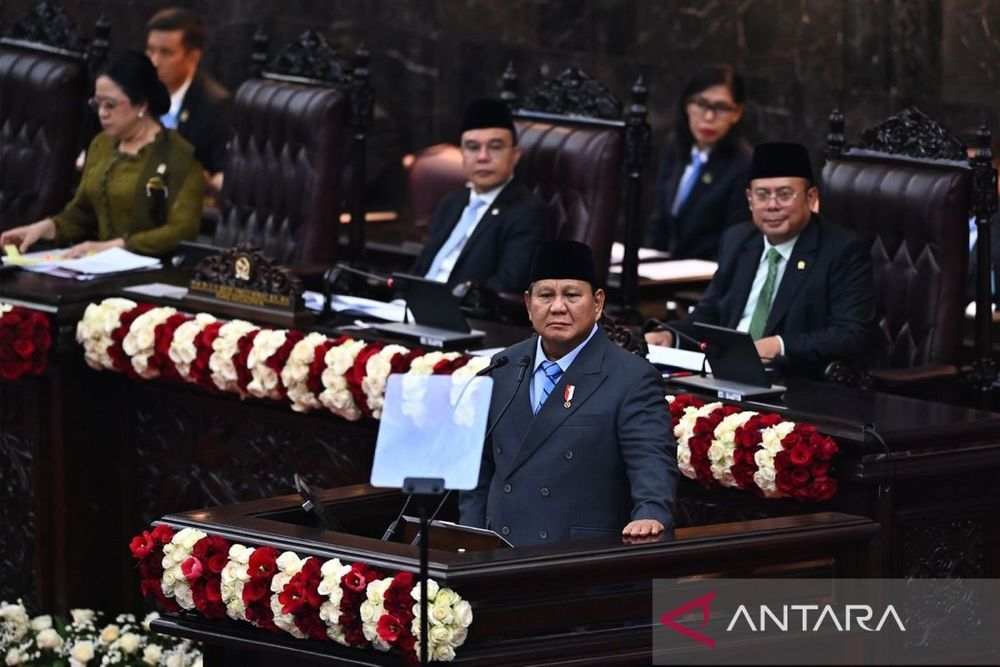
Ministry backs Prabowo's green agenda for public prosperity
Environment Minister Moh Jumhur Hidayat has committed his ministry to implementing President Prabowo Subianto's green policies, declaring that environmental conservation must translate into concrete economic gains and prosperity for Indonesian citizens.
Speaking Saturday in response to the president's State of the Nation Address delivered Friday at the People's Consultative Assembly Annual Session in Jakarta, Jumhur emphasized the government's obligation to future generations. "This is our collective commitment to the 'no generation left behind' principle, ensuring today's green transition becomes a legacy of prosperity, not a future burden," he said.
The minister's statement comes as Indonesia grapples with mounting climate challenges. Between 2023 and 2024, the country experienced 6,827 climate-related disasters affecting more than 13 million people, underscoring the urgency behind the administration's environmental agenda.
Economic stakes of environmental policy
In his address, President Prabowo outlined environmental protection and green transformation as central policy priorities, stressing the need to manage Indonesia's natural wealth for the benefit of all citizens. The president also reported strong economic performance, with growth reaching 5.61% in the first quarter of 2026 and 5.45% in the first half—the highest first-quarter and first-semester expansion in 13 years.
The economic imperative for environmental action is substantial. Climate change threatens to cost Indonesia between 2.5% and 7% of its GDP, with agriculture—which contributes approximately 13% of annual GDP—particularly vulnerable to climate impacts. Natural resource sectors including agriculture, forestry and mining account for roughly 25% of Indonesia's GDP and about 30% of government budget revenue.
Jumhur, who was appointed Environment Minister on April 27, 2026, replacing Hanif Faisol Nurofiq, brings a labor background to the role, having previously served as chairman of the All Indonesia Workers' Unions Confederation. He outlined the ministry's focus on natural resource protection, social justice and practical community solutions.
Policy framework and targets
Indonesia's environmental agenda operates within established frameworks. The country launched its National Circular Economy Roadmap and Action Plan in 2024, creating a structure for sustainable resource management, waste reduction and low-carbon growth. The nation has also committed to reducing greenhouse gas emissions by 31.89% unconditionally, with a conditional target of up to 43.20% below business-as-usual levels by 2030, according to its Enhanced Nationally Determined Contribution from 2022.
Looking further ahead, Indonesia's Long-Term Strategy for Low Carbon and Climate Resilience aims to achieve net-zero emissions in the electricity subsector by 2050. Among concrete initiatives, the Environment Ministry plans to plant two billion trees as part of its protection program.
The ministry emphasized that the state must actively ensure natural resource wealth is distributed collectively across society. It is pursuing environmental policies designed to prioritize public interests while shielding Indonesia from threats, including economic risks tied to global climate change.
Conservation and biodiversity
Indonesia's environmental responsibilities are magnified by its exceptional natural heritage. The country ranks among the world's 17 megadiverse nations as recognized by Conservation International, harboring approximately 3,305 known species of amphibians, birds, mammals and reptiles, plus at least 29,375 endemic vascular plant species.
Jumhur expressed confidence that robust cross-sector cooperation would enable the green transition to safeguard Indonesia's ecosystems while supporting strong and equitable economic expansion. The ministry's approach aims to ensure conservation delivers measurable benefits that are shared fairly throughout Indonesian society.