
USABC proposes eight measures to support Indonesia's 8% growth target
The US-ASEAN Business Council has put forward eight policy recommendations to help Indonesia reach its 8% economic growth goal, focusing on clearer rules, investment conditions and trade. The proposals support the country's National Medium-Term Development Plan (RPJMN) and the government's Asta Cita priorities.

Rules, trade and investment
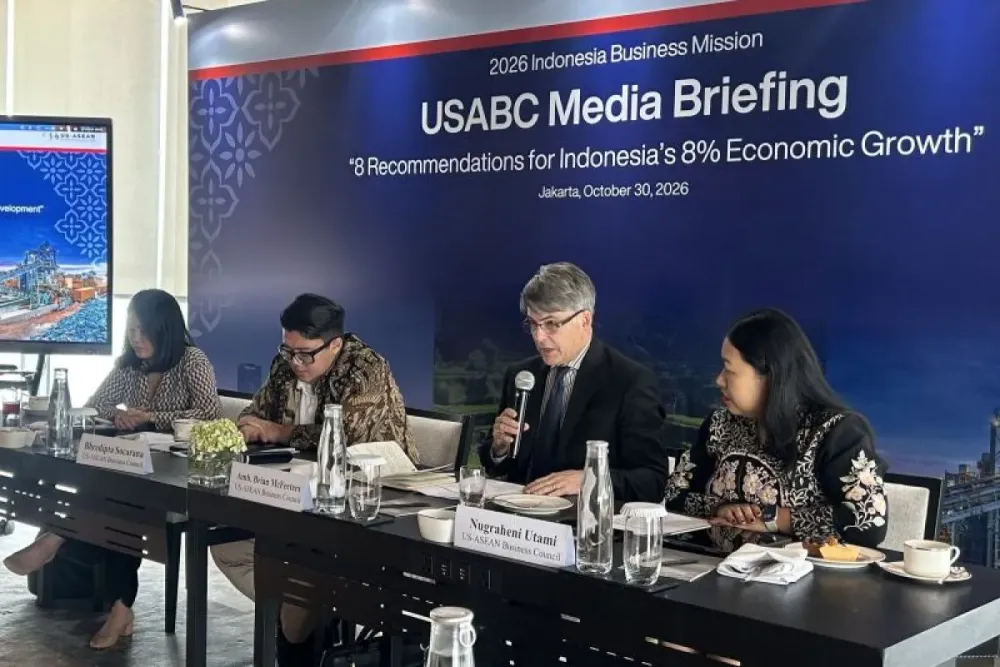
At a media discussion in Jakarta on October 30, USABC President and CEO Brian McFeeters said the proposals reflect member companies' experience, a year of dialogue with the Indonesian government and discussions during the Indonesia Business Mission. He described the recommendations as "a very high-quality product."
The council published the "2026 Indonesia Business Mission Whitepaper" on October 27, 2026. Written by Nugraheni Utami and Bhre Socarana, it argues that reaching 8% growth depends on businesses having confidence in how regulations are applied, because that confidence influences both investment decisions and day-to-day operations.
Four recommendations address modernizing imports, building mutual trust over standards and certification, strengthening the government's technical expertise in digital technologies, and making regulation more predictable.
The other four call for the government to act as a long-term investment partner, increase knowledge transfer and local capacity, balance foreign exchange reserves with flexibility for reinvestment, and translate trade commitments into practical results.
McFeeters said the council and its members want to continue working with the government on investment conditions and sustainable business expansion, while extending the benefits of growth to communities, workers, local suppliers and Indonesian businesses.
Why US companies are looking at Indonesia
Indonesia, Vietnam and the Philippines are consistently among the ASEAN markets where USABC members seek new opportunities or look to expand, McFeeters said. He attributed Indonesia's appeal in part to its young, digitally savvy population, along with growth opportunities in technology, health, education, energy and agriculture.
"The USABC is trying to find ways to build mutual trust between the government of Indonesia and the companies," McFeeters said. "The companies are here to make a profit, but they're here to obey the rules and follow the regulations that the government puts out; but they need clarity and consistency."
The council has also documented US companies' activities in Indonesia through its 2026 "Bisnis AS untuk Indonesia" (BISA) Report. Launched on September 16 with support from the US Embassy in Jakarta, the report identified 91 innovation initiatives involving 43 US companies between 2020 and 2026. Those initiatives covered digital technology, energy, agriculture and financial services.
Founded in 1984, USABC represents more than 175 US multinational companies across ASEAN and describes itself as the region's premier advocacy organization for US corporations. According to the council, its members generate almost $7 trillion in revenue and employ more than 14.5 million people worldwide. It maintains nine offices globally, including one in Jakarta.
Growth figures and regional monitoring
Indonesia's growth remains below the 8% goal. Kompas, citing BPS data, reported growth of 5.03% in 2024 and 5.11% in 2025, followed by 5.29% in the second quarter of 2026. The latter figure leaves a gap of roughly 2.7 percentage points.
The government has also established a system for tracking regional sources of growth. Following a September 4-6, 2026, coordination meeting involving the Ministry of Home Affairs, Bappenas and BPS, the home affairs minister issued Decision No. 500-1981/2026, Kompas reported.
The decision created a Monitoring, Supervision and Acceleration Team for Regional Economic Growth, with responsibility for monthly reporting on growth sources down to the district and city level.
Transport investment invitation
A day before McFeeters' media discussion, Transportation Minister Dudy Purwagandhi met with USABC in Jakarta and invited US companies to invest in Indonesia's transport sector, according to ANTARA News.
At the October 29 meeting, Purwagandhi identified port modernization, airport development, road and railway expansion, and the integration of urban transport systems as priorities supporting the country's ambition to reach 8% growth by 2029.