
Indonesia needs households and businesses to drive growth, finance minister says
Indonesia's State Budget represents only about 14 to 15 percent of the economy, Finance Minister Suahasil Nazara said on October 26, calling for government, households and businesses to coordinate their efforts to support growth.

Coordinating the wider economy
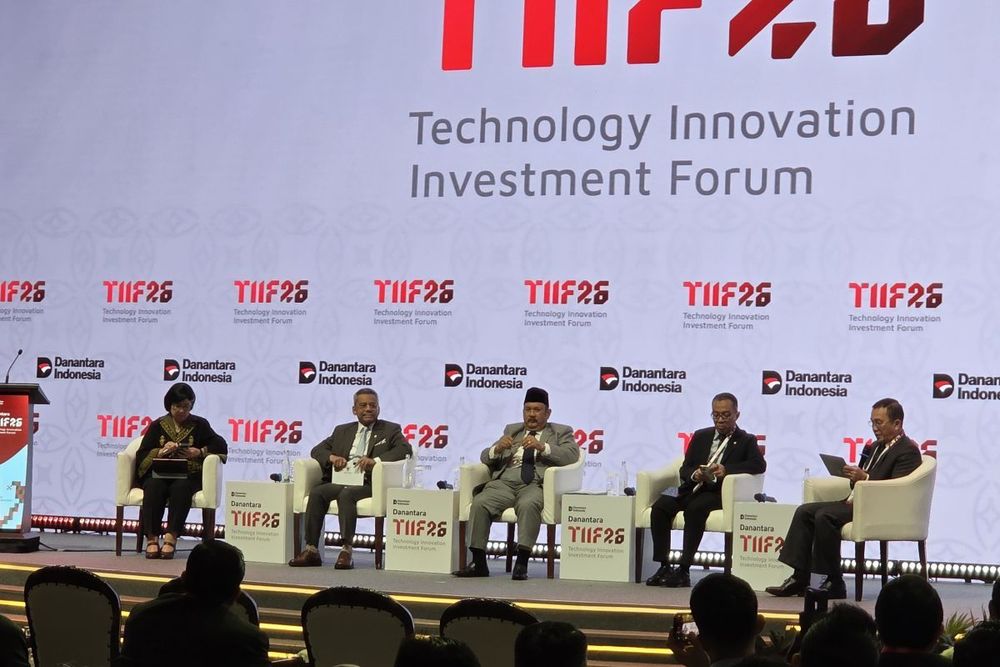
Speaking at the Danantara Technology Innovation Investment Forum (DTIIF) 2026 in Jakarta, Suahasil said public spending alone could not drive Indonesia's economic growth. Household consumption and business investment account for much of the activity outside the budget.
"If the State Budget accounts for 15 percent, who generates the remaining 85 percent? It is generated by society as a whole—households through their consumption and companies through their investments," he said.
He urged a coordinated national approach rather than reliance on the government's fiscal resources. "What our nation needs is the orchestration of the entire economy—coordinating all economic actors so that, collectively, we can maximize gross domestic product," he said.
The forum is Danantara Indonesia's flagship event, running October 26-28 at the Fairmont Jakarta under the theme "Investing in Tomorrow: Advancing Technology, Innovation, and Sustainable Growth." Its official site said organizers expected more than 1,500 participants, including 131 global technology CEOs, 170 global innovators, 67 research and innovation centers, and representatives of more than 50 state-owned enterprises.
Danantara's role alongside the budget
Suahasil said government spending should produce a substantial multiplier effect throughout the economy. He described the budget's responsibilities as fostering growth, keeping the macroeconomy stable and protecting fiscal credibility.
He also called for the budget and Danantara, the government's investment arm, to work together on national development. "When there are grand ideas or a major vision for Indonesia, two 'hands' are at work. The first is the State Budget, and the second is Danantara, acting as Indonesia's investment arm. We must work together," he said.
Danantara's official name is Badan Pengelola Investasi Daya Anagata Nusantara (BPI Danantara). According to its official site, the strategic investment management institution was created under Law No. 1 of 2025 and operates independently under the president. Led by CEO Rosan Roeslani, it manages and optimizes state investments and assets from state-owned enterprises.
Five priorities for development
During the same appearance, Suahasil set out five foundations for Indonesia's transition to a high-income developed nation, ANTARA News reported. The first two were investment in people through education and health, and physical infrastructure funded through blended public-private financing.
The remaining priorities were institutional reform grounded in good governance and environmental, social and governance (ESG) standards; ongoing structural reform to streamline work across agencies; and the preservation of social and macroeconomic stability.
Oil costs and the fiscal position
Suahasil also described how the budget was cushioning the domestic economy against global oil prices of about $115-$116 per barrel, Investor.id reported. That compared with an Indonesian Crude Price assumption of $70 per barrel in the 2026 budget. By September, subsidies and compensation disbursements had reached Rp 376.8 trillion, or 84.3 percent of the ceiling.
Figures he cited at the forum put the budget deficit at Rp 319 trillion at the end of September 2026, equivalent to about 1.24 percent of GDP, according to Investor.id. The primary balance was Rp 125.5 trillion.
Suahasil has pledged to keep the deficit below 3 percent of GDP. According to CNBC Indonesia, he became finance minister on September 14, 2026, succeeding Purbaya Yudhi Sadewa after serving as deputy finance minister since October 2019.