
Bvlgari Resort Bali Marks 20 Years With Children's Kamasan Art
Bvlgari Resort Bali celebrated its 20th anniversary on September 23, 2026, by unveiling paintings by 20 Balinese children. The project brought a local art tradition into the commemoration at the Uluwatu resort, where a Kompas visit also documented Balinese influences in its architecture and daily activities.

An anniversary exhibition
The children were invited to create their own interpretations of Kamasan, a painting tradition with centuries of history. According to Bvlgari Hotels & Resorts, their work went on display at The Bvlgari Chapel on the anniversary date through a collaboration with Save the Children Indonesia, supported by Bank BRI. Every painting was offered for adoption, with all proceeds donated to Save the Children Indonesia.
The partnership between Bvlgari and Save the Children began in 2009. Bvlgari's official history traces it to a specially designed silver ring launched in support of Save the Future, a campaign intended to help disadvantaged children through education.
The Bali resort opened on September 23, 2006, becoming Bvlgari's second hospitality property after its first hotel opened in Milan in 2004. During Kompas writer Sarie Febriane's arrival the evening before the anniversary, public relations manager Michelle Jovina outlined the coming celebration in the resort's open lobby.
Architecture shaped by the clifftop
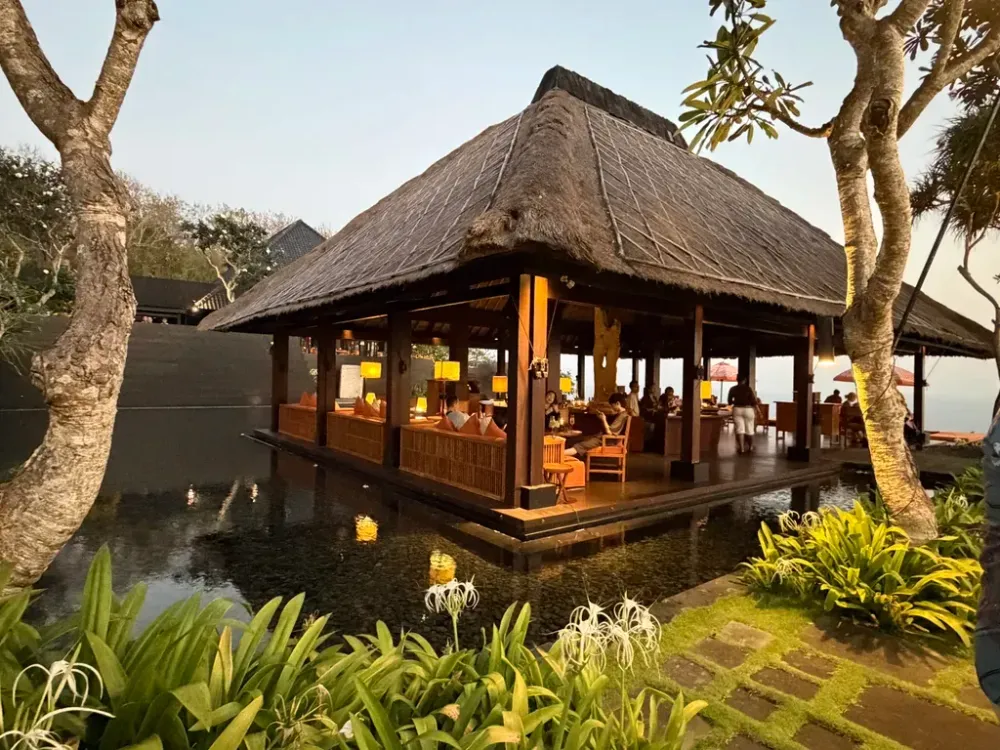
At Bali's southwestern tip, the resort overlooks the Indian Ocean from a cliff in Uluwatu. Kompas places it approximately 150 meters above sea level; Bvlgari's official history describes its position as more than 150 meters above the ocean's shores. Febriane arrived after the sunset colors had faded, with a strong sea breeze and the sound of waves rising from below.
Architects Antonio Citterio and Patricia Viel of ACPV Architects combined contemporary Italian design with Indonesian materials and Balinese influences. Bangkirai hardwood, rattan, bamboo and natural-fiber textiles appear alongside volcanic stone. The resort's own design account specifies hand-cut lava stone, indigenous woods and alang-alang thatching, with terraces that follow the model of Bali's rice fields.
The collaboration extended to local artisans, who helped create furniture and decorative pieces handcrafted in Bali. Each villa and mansion has a private swimming pool lined with jade-hued sukabumi stone, according to Bvlgari Hotels & Resorts.
On the following morning, Febriane described birdsong and a sense of separation among the 59 villas, screened by greenery and stone walls. In her account, the property remained well maintained after two decades. The freestanding lobby's pyramid-like roof and a metal name plaque set against stone provided architectural detail without elaborate ornamentation.
An informal welcome
The service made as much of an impression on Febriane as the setting. Davina, a staff member from Bandung wearing a stylish top and khaki pants, chatted with her while driving a buggy over the resort's winding, sloping paths. After explaining the villa's facilities, she handed over the key: "Here's the key, just take it with you, enjoy it."
Febriane found the exchange warm and easygoing, rather than marked by the exaggerated deference she associated with some luxury hospitality. She regarded that informality as more comfortable than service that creates distance between staff and guests.
The room's welcome amenities connected the hotel to Bvlgari's jewelry heritage: a handwritten card signed by general manager Carlo Bevilacqua, a slice of layer cake and three oranges decorated with small brown ribbons. The ribbons' twists recalled Serpenti, the snake motif that became a signature of the jewelry brand before its expansion into hotels.
Elizabeth Taylor helped popularize Serpenti. While filming Cleopatra in Rome in 1962, she wore a gold Serpenti watch bracelet set with emerald-cut stones and diamonds. The jewelry was also associated with her relationship with co-star Richard Burton, which began while both were married.
A temple visit before breakfast
Close to the lobby, Pura Kerti Bhuwana predates the full development of the 8.4-hectare resort. Its construction honored local traditions observed when opening a new area. The temple also hosts a purification ceremony offered to guests as an introduction to local culture.
A staff member named Dayu helped participants put on ceremonial cloth before a jero mangku led the ritual in front of the Ganesa statue. The ceremony described by Kompas began at 9 a.m. and lasted 35 minutes, with the priest sprinkling holy water on participants' foreheads.
Breakfast followed at Sangkar, the restaurant near the swimming pool overlooking the Indian Ocean. Febriane observed the same relaxed manner among its staff that she had encountered on arrival. Most guests during the visit were from overseas, particularly China.