
Indonesia balances food self-sufficiency drive with commitment to global trade
Indonesia reassures trading partners that its push for food self-sufficiency will not close doors to international commerce, as the country achieves rice surplus after dramatic production turnaround from 2024 deficit.
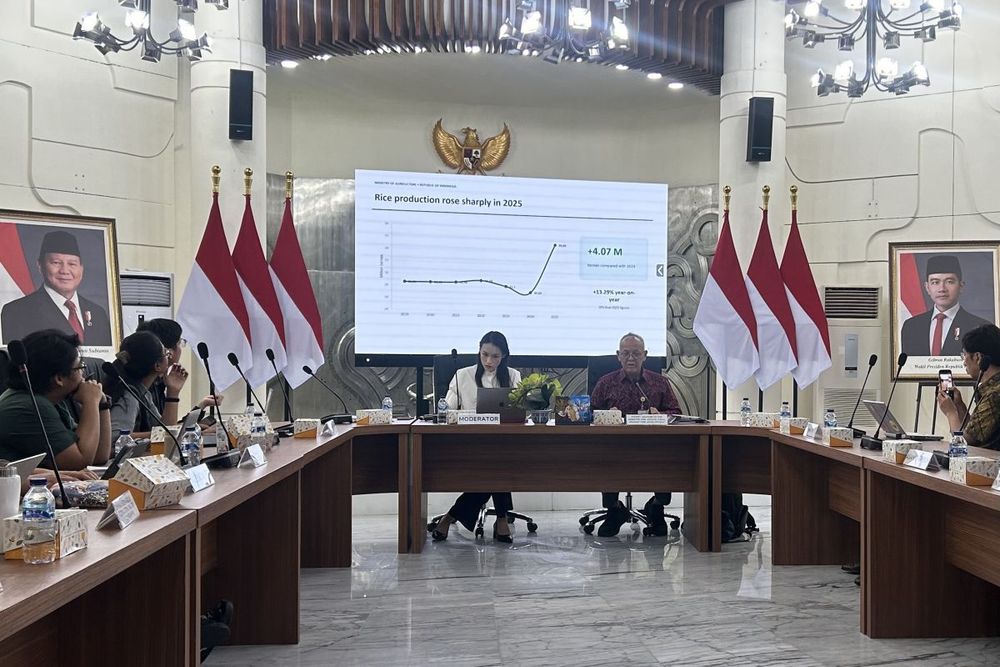
Indonesia balances food self-sufficiency drive with commitment to global trade
Indonesia has emphasized that its pursuit of food self-sufficiency will remain compatible with open international trade, as the government seeks to strengthen domestic production while maintaining access to global supply chains.
Hasil Sembiring, Special Adviser to the Minister of Agriculture for Agriculture Production Enhancement, told reporters in Jakarta on Monday that the government will prioritize domestic production for commodities where greater self-sufficiency is economically, environmentally, and socially sustainable, while continuing to rely on trade where domestic supply remains structurally insufficient.
"Indonesia is ready to partner with the world. Our pursuit of self-sufficiency is compatible with open, fair, and reliable trade," Sembiring said during the media briefing.
Historic production turnaround
The reassurance comes as Indonesia recorded a sharp increase in rice production in 2025, reaching 34.69 million tonnes, according to Statistics Indonesia (BPS). The figure represents a surge of 4.07 million tonnes, or 13.29 percent, from 2024. The increase was supported by both a larger harvested area and higher national output.
The 2025 achievement marks a dramatic turnaround from 2024, when rice production declined to 30.62 million tonnes, down 1.54 percent from 31.1 million tonnes in 2023. The recovery enabled Indonesia to shift from importing approximately 4.5 million tonnes of rice in 2024 to achieving a surplus of 4.7 million tonnes in 2025.
Between 2023 and 2024, Indonesia imported a total of 7 million tonnes of rice worth nearly Rp 100 trillion, equivalent to $6 billion. The higher 2025 production enabled Indonesia to meet domestic rice needs without relying on imports, while also rebuilding public rice reserves to historically strong levels.
Government rice reserves reached between 3.7 and 4.2 million tonnes in 2025, the highest level since state logistics firm Bulog was founded in 1969. President Prabowo Subianto achieved rice self-sufficiency in December 2025, one year into his administration, bringing forward the original four-year timeline.
Regional and global standing
The Food and Agriculture Organization (FAO) ranked Indonesia as the fourth-largest rice producer globally in 2025, behind India, China, and Bangladesh, and the largest in Southeast Asia. According to the FAO's June 2026 Food Outlook, Indonesia's rice closing stocks are projected to increase from 7.5 million tonnes in 2025/2026 to 7.8 million tonnes in 2026/2027, strengthening prospects of the country becoming a rice-exporting nation.
The production increase was driven in part by expanded cultivation. Indonesia's paddy harvested area during January to August 2025 reached 8.25 million hectares, up 18.5 percent from 7.27 million hectares during the same period in 2024, according to BPS estimates.
Broader food security achievements
According to the government's 2026 Food Balance Projection, Indonesia achieved self-sufficiency in eight strategic food commodities: rice, large chillies, bird's eye chillies, corn, sugar, chicken meat, chicken eggs, and shallots. Domestic production and availability now exceed demand for these commodities.
Starting January 1, 2026, Indonesia banned rice imports as part of a broader prohibition on 12 food and non-food commodities, including sugar and table salt, aimed at protecting farmers and domestic industries.
Trade policy framework
Despite the import restrictions, Sembiring emphasized that Indonesia wants trade to remain predictable, rules-based, and mutually beneficial, while diversifying sources of supply and improving domestic logistics.
Better data and clearer planning would help avoid abrupt policy decisions, reduce speculation, and provide greater certainty for farmers, consumers, food processors, and trading partners, he said.
"Farmers need confidence to plant. Consumers need affordable food. Processors need reliable raw materials. Trading partners need timely and transparent policy signals," Sembiring added.
The government said it will continue cooperation through ASEAN mechanisms, South-South cooperation, research partnerships, and humanitarian assistance. It called for stronger regional early-warning systems, emergency food reserve mechanisms, interoperable food-safety and traceability standards, joint research into transboundary pests and animal diseases, and investment in ports, cold chains, and storage facilities.
"In an era of compound shocks, resilience will not come from every country acting alone," the government said. "It will come from strong national systems connected through dependable regional cooperation."