
Central Sulawesi launches multi-stakeholder forum to strengthen sustainable palm oil governance
The Central Sulawesi Sustainable Palm Oil Multi-Stakeholder Forum brings together government, private sector, farmers, academia and civil society to advance sustainable palm oil practices across the province, supporting national certification and replanting programs.
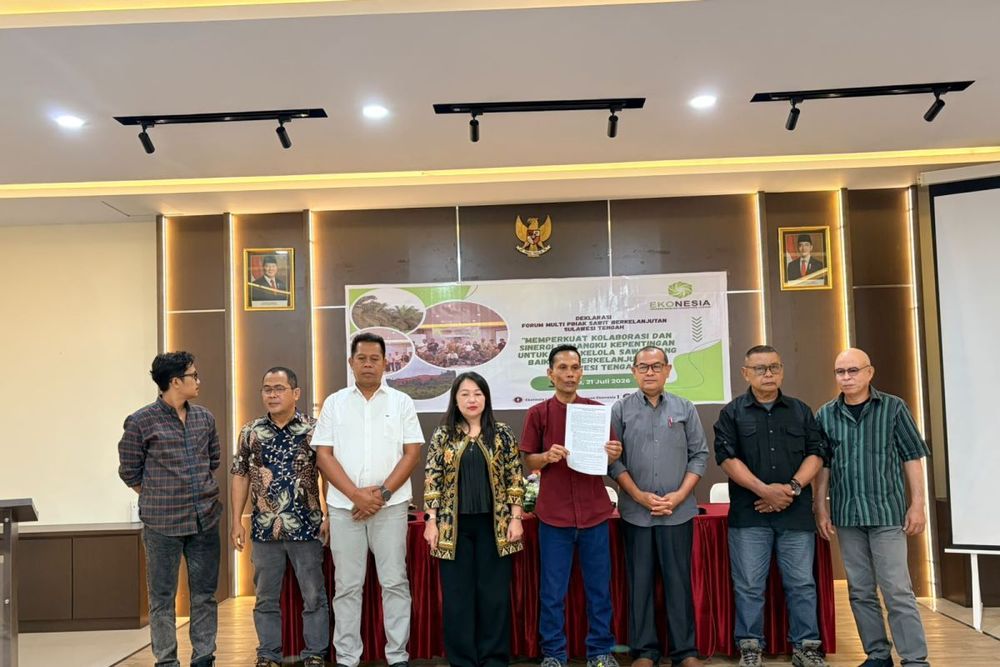
Central Sulawesi launches multi-stakeholder forum to strengthen sustainable palm oil governance
Central Sulawesi officially launched its Sustainable Palm Oil Multi-Stakeholder Forum (FMPSB-Sulteng) on Tuesday, establishing a collaborative platform to strengthen governance of the palm oil sector across the province. The forum unites government institutions, private companies, smallholder farmers, academic experts, civil society organizations and development partners in addressing shared challenges and advancing sustainable practices.
The initiative comes as Indonesia's palm oil industry manages approximately 16.8 million hectares of plantations nationwide, with smallholder farmers controlling nearly 7 million hectares—roughly 42 percent of the total area. These independent producers face mounting pressure to meet sustainability standards while maintaining productivity and livelihoods.
H Musliman, member of Commission III of the Central Sulawesi Provincial House of Representatives, emphasized the forum's role in driving concrete improvements.
We hope this forum will generate meaningful breakthroughs for the palm oil sector in Central Sulawesi. Collaboration among all stakeholders is the key, and together we can advance the sustainable development of the province's palm oil industry.
The palm oil sector remains critical to Indonesia's economy, generating between US$20 billion and US$27.75 billion in annual foreign exchange earnings and accounting for approximately 12 percent of non-oil and gas exports. The industry contributes around 1.6 percent to national GDP, generates substantial tax revenues, and directly employs more than 4.5 million people. Export data from 2024 showed total palm oil exports reached US$22.87 billion, with India representing the largest market at US$3.91 billion.
Government backing and regulatory context
Jen Kurnia Gembu, Head of the Legal Division at the Central Sulawesi Provincial Secretariat, confirmed provincial government support for the forum, describing it as essential for addressing regulatory compliance and field-level challenges.
The Legal Bureau of the Central Sulawesi Provincial Secretariat fully supports the establishment of the Sustainable Palm Oil Multi-Stakeholder Forum. Many challenges remain in the palm oil sector that require coordinated assistance to ensure sustainable management.
The forum's establishment aligns with Indonesia's mandatory Indonesian Sustainable Palm Oil (ISPO) certification requirements, which became compulsory for all plantation operators, including smallholders, by November 2025. ISPO has become the world's largest palm oil certification scheme, covering 5.68 million hectares and representing nearly 40 percent of global palm oil production.
Gembu emphasized that government coordination will be essential in ensuring legal certainty and developing policies supporting sustainable palm oil governance throughout Central Sulawesi.
The government's role is essential in coordinating all stakeholders so that challenges can be addressed collaboratively while advancing sustainable palm oil development in Central Sulawesi.
Academic perspective on collaboration
Professor Mohamad Ahlis Djirimu from Tadulako University in Palu stressed that effective collaboration represents the foundation of sustainable industry development.
What we need is stronger synergy among corporations, the provincial government, and district and municipal governments. Without collaboration, we will not be able to maximize the benefits of the palm oil industry.
Tadulako University, established in 1981 as Central Sulawesi's largest state university, brings academic research capacity to the forum's stakeholder network.
Professor Djirimu identified downstream processing as a continuing challenge for Central Sulawesi, noting that most processing facilities operate outside the province, creating inefficiencies in transporting fresh fruit bunches from production areas. He also emphasized the importance of upholding workers' rights and environmental protection as global markets increasingly prioritize sustainability.
Workers' rights must be protected, including the right to organize. We must also promote inclusiveness, particularly by safeguarding the rights of women workers. Global expectations will increasingly focus on sustainability issues in the years ahead.
Forum functions and strategic priorities
Azmi Sirajudin, Executive Director of Ekonesia, outlined the forum's strategic role in aligning diverse stakeholder interests around sustainable palm oil development.
We expect this forum to become a common platform for strengthening communication, enhancing coordination, and fostering collaboration among all stakeholders so that palm oil governance in Central Sulawesi becomes more effective, sustainable, and beneficial for local communities.
The forum will serve multiple functions, including building capacity among independent smallholders to implement sustainable agricultural practices, mediating disputes among stakeholders, and encouraging active participation in sustainable management. It will also support acceleration of national strategic priorities, including the Smallholder Palm Oil Replanting Program.
The replanting program, launched by President Joko Widodo in October 2017 as a National Strategic Program, has achieved technical recommendations for 423,305 hectares as of May 2026, with actual replanting completed on 295,691 hectares. The initiative aims to improve productivity among aging plantations, particularly those managed by smallholders.
The forum also supports implementation of ISPO standards, downstream industry development, and the transition toward deforestation-free production that respects environmental limits and human rights.
Through this forum, we aim to ensure that every stakeholder has a platform for dialogue, joint problem-solving, and supporting the implementation of sustainable palm oil practices in Central Sulawesi. Collaboration is the key to building an inclusive and globally competitive palm oil sector,Azmi concluded.
Indonesia's palm oil production is forecast to rise 3 percent to 48 million metric tons in 2026/27, driven by trees planted between 2021 and 2024 reaching maturity and wider adoption of higher-yielding seed varieties, according to projections. The Central Sulawesi forum positions the province to manage this growth through strengthened governance frameworks and stakeholder partnerships.