
Indonesian migrant workers and students strengthen Taiwan-Indonesia ties, official says
Head of the Taipei Economic and Trade Office Bruce Hung emphasized the vital role of more than 400,000 Indonesian migrant workers and 18,000 students in deepening people-to-people connections between Taiwan and Indonesia during Double Tenth Day celebrations in Jakarta.

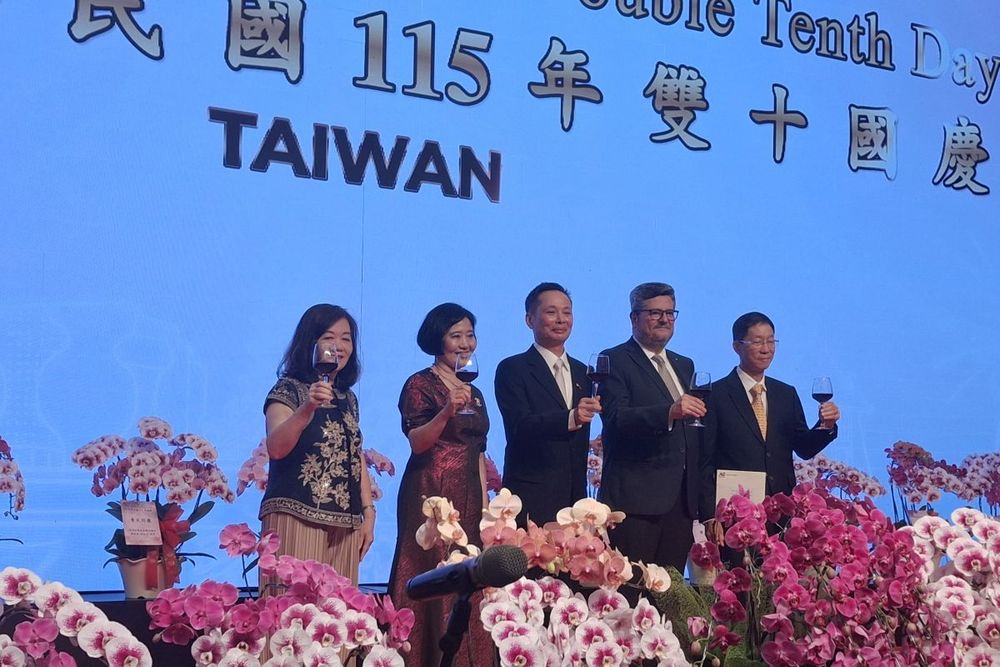
Indonesian migrant workers and students strengthen Taiwan-Indonesia ties
The head of Taiwan's representative office in Indonesia has underscored the critical role of Indonesian migrant workers and students in strengthening bilateral ties, describing them as valued members of Taiwanese society during national day celebrations in Jakarta.
Bruce Hung, head of the Taipei Economic and Trade Office in Indonesia, addressed guests at a Double Tenth Day celebration on Wednesday, highlighting how more than 400,000 Indonesian migrant workers and 18,000 Indonesian students currently living in Taiwan have become integral to people-to-people exchanges between the two sides.
Double Tenth Day commemorates the Wuchang Uprising that began on October 10, 1911, which led to the fall of the Qing Dynasty and the establishment of the Republic of China in 1912, ending over two millennia of imperial rule in China.
The Indonesian community in Taiwan represents the largest group of migrant workers in the island. As of March 2026, Taiwan had approximately 873,000 registered migrant workers, with Indonesians accounting for the largest share at 37.3 percent, followed by Vietnamese at 33.7 percent. Taiwan was the top destination country for Indonesian migrant workers in the first half of 2026, with 48,558 workers placed there, representing 32 percent of the total 153,049 Indonesian migrant workers deployed internationally during that period.
Hung expressed appreciation to President Prabowo Subianto, the Indonesian government, and the Indonesian people for their continued support in fostering close Taiwan-Indonesia relations. He noted that bilateral ties have continued to develop across trade, investment, education, and people-to-people exchanges.
Healthcare coverage for migrant workers
Among Taiwan's support mechanisms for Indonesian migrant workers is the National Health Insurance system, which covers approximately 400,000 Indonesian workers. Taiwan's National Health Insurance is a compulsory social insurance system launched in 1995 that covers over 99 percent of Taiwan's population, including foreign nationals with valid Alien Resident Certificates, with the same premium calculation standards and healthcare rights as Taiwanese citizens.
Foreign employees in Taiwan are automatically enrolled in the National Health Insurance system from the date of employment through their employer, with no waiting period, while premiums are shared between the employee (30 percent), employer (60 percent), and government (10 percent).
According to Hung, the system provides Indonesian workers with peace of mind while living and working in Taiwan, as they do not need to worry about medical expenses or hesitate to seek healthcare when they fall ill.
The economic significance of Indonesian migrant workers extends beyond Taiwan's borders. Indonesian migrant workers sent home $4.536 billion in remittances in the first quarter of 2026, with Taiwan serving as one of the largest remittance corridors alongside Malaysia, Saudi Arabia, and Hong Kong.
Economic and technological cooperation
Beyond employment and healthcare, Hung pointed to opportunities for further expanding cooperation in various fields. He highlighted Taiwan's economic and technological development, including its position in the global semiconductor and artificial intelligence industries.
Taiwan's stock market capitalization has reached $5.3 trillion, making it one of the world's largest stock markets, growth that is closely linked to Taiwan's position as a major player in the global semiconductor and AI industries. Hung cited US technology company NVIDIA's establishment of its first overseas AI supercomputing center in Taipei as an example of international investment in Taiwan's technological capabilities.
Bilateral trade between Taiwan and Indonesia exceeded $10 billion in 2024, with Taiwan ranking among the top five foreign investors in Indonesia, having created approximately 1 million jobs for Indonesians. In late December 2025, Taiwan and Indonesia signed two memorandums of understanding aimed at strengthening trade promotion and halal industry cooperation, expanding collaboration into fisheries, processed food, household goods, medical devices, and creative and digital sectors.
Cultural exchanges
Hung invited Indonesians to learn more about Taiwan through cultural exchanges, including culinary experiences. He noted that Taiwanese people have enjoyed a variety of Indonesian restaurants and dishes, while he sought to introduce several Taiwanese dishes to guests at the event.
The Taipei Economic and Trade Office in Indonesia, which was originally established in 1971 as the Chinese Chamber of Commerce to Jakarta before adopting its present name in 1989, functions as Taiwan's de facto embassy in Indonesia in the absence of official diplomatic relations.
Hung expressed hope that ties and exchanges between the people of Taiwan and Indonesia would continue to grow in the future.