
Singapore, Indonesia Foreign Ministers Meet After Gas Export Cut
Singapore's Foreign Minister Vivian Balakrishnan met his Indonesian counterpart, Arrmanatha Nasir, in Jakarta on October 27, 2026, three days after Indonesia reduced natural gas exports to Singapore to prioritize domestic energy needs.

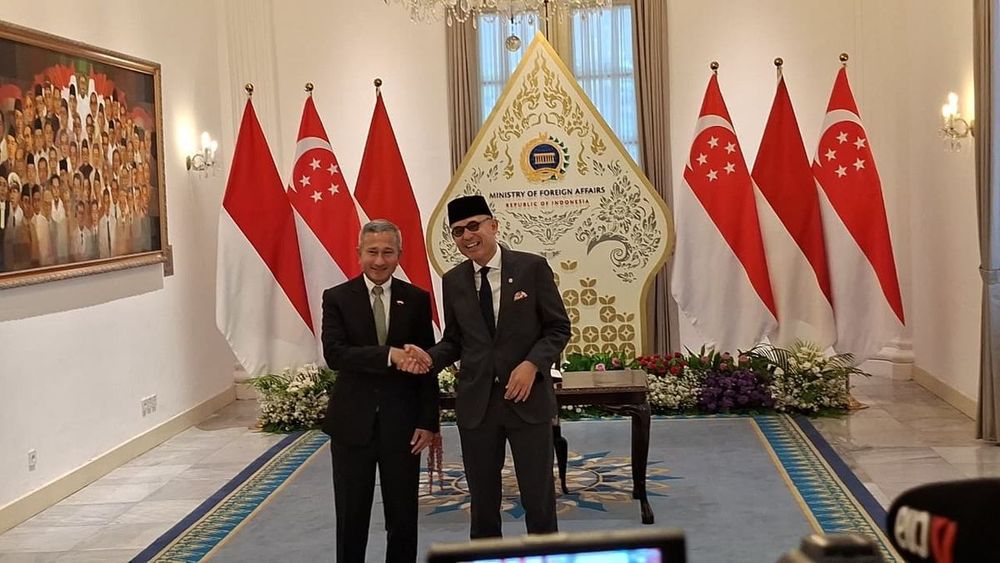
Meeting in Jakarta
Balakrishnan arrived at the Indonesian Foreign Ministry's Pancasila building at 3:36 p.m. local time, according to Kompas.com. Arrmanatha, who is known as Tata, greeted him and led him to the guestbook table.
The ministers shook hands and posed for photographers. Before they entered a private room for their talks, Balakrishnan chatted with Arrmanatha and tapped him on the shoulder several times.
Gas redirected to Indonesian electricity supply
Indonesia's export reduction took effect on October 24 and totals 31 billion British thermal units per day (BBTUD). Djoko Siswanto of the Special Task Force for Upstream Oil and Gas Business Activities, or SKK Migas, announced the cuts on the evening of October 23: 15 BBTUD from Natuna and 16 BBTUD from Sumatra.
The Sumatra reduction comes from the Jambi Merang gas field, The Star reported. Channel News Asia said that gas would be routed through the Gas Transportation Indonesia (TGI) pipeline to supply electricity needs in Batam, Bintan, and Sumatra. The Natuna gas would go to PT PLN Batam through the WNTS–Pulau Pemping–Batam pipeline.
About 30 percent of Indonesia's natural gas production is exported and 70 percent is consumed domestically, according to Indonesian state news agency Antara, as cited by Channel News Asia.
Indonesia says supplies remain within contract limits
Bahlil Lahadalia, Indonesia's coordinating minister for downstream and energy transition and minister of energy and mineral resources, said at an October 26 press conference in Jakarta that the cuts did not breach the countries' contracts. He said Indonesia continued to meet the minimum supply requirements.
According to The Straits Times, Bahlil put Indonesia's pipeline gas exports to Singapore from the Natuna Sea and mainland Sumatra at 409.55 BBTUD, with the 31 BBTUD cut representing about 8 percent of that volume. He also described the reduction as 31 mmscfd and said it remained within contractual limits, while a 10 percent cut would have breached the contract.
Bahlil also raised the possibility of force majeure on October 26, saying "force majeure circumstances can arise." He did not say Indonesia had invoked it.
The supply reduction follows years of Indonesian plans to lower gas exports to Singapore, The Star reported. Jakarta agreed in 2022 to extend supplies until 2028, but at volumes below those in the previous contract. In a September 2025 parliamentary reply, Singapore's Deputy Prime Minister Gan Kim Yong said the existing contracts run through the end of 2028, according to The Straits Times.
Singapore's response and supply assessment
Singapore Prime Minister Lawrence Wong said on October 25 that parties to commercial gas supply contracts were expected to honor their commitments. Singapore's gas importer would take the steps needed to protect its rights and interests, he added, according to The Business Times.
Singapore's Energy Market Authority gave a different assessment of the reduction. Based on information from natural gas importers, it said the total was 17 BBTUD over 18 days, Channel News Asia reported. The authority said the cut represented less than 2 percent of Singapore's daily gas demand, which exceeds 1,000 BBTUD.
Natural gas accounts for about 95 percent of Singapore's electricity generation, according to Channel News Asia.
At the opening of Singapore International Energy Week on October 26, Energy Minister Tan See Leng warned that resource nationalism that undermines existing contracts could discourage energy investment, The Straits Times reported. Singapore has granted conditional licenses to six Indonesian electricity import projects totaling 3 gigawatts of capacity, the newspaper said.