
Indonesia and South Korea strengthen intellectual property cooperation amid expanding strategic partnership
Indonesian and South Korean ministers agreed to deepen collaboration on IP protection, enforcement, and digital transformation during high-level talks in Seoul, building on their newly elevated Special Comprehensive Strategic Partnership.

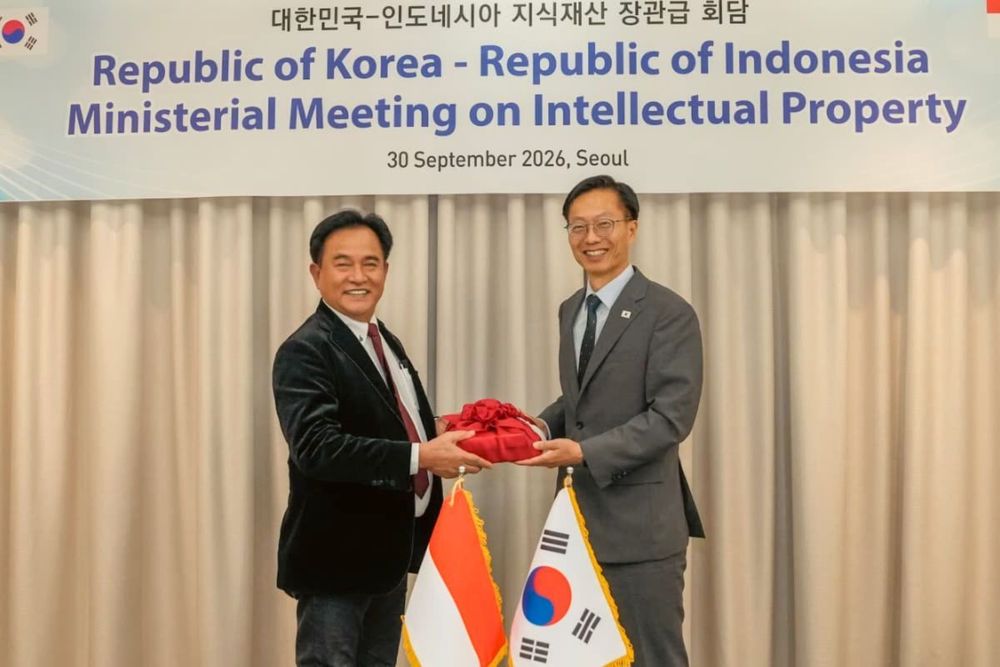
Indonesia and South Korea strengthen intellectual property cooperation amid expanding strategic partnership
Indonesia and South Korea have agreed to expand cooperation on intellectual property protection and enforcement, following bilateral discussions between Coordinating Minister for Law, Human Rights, Immigration, and Corrections Yusril Ihza Mahendra and South Korean Minister of Intellectual Property Kim Yong Sun in Seoul on Wednesday.
The talks, which build on the two countries' Special Comprehensive Strategic Partnership established in April 2026, focused on transforming bilateral relations into more concrete collaborative initiatives addressing IP infringements and strengthening legal frameworks for businesses operating across both markets.
Yusril, a seasoned lawyer and politician who previously served as Minister of Justice and Human Rights, emphasized that robust legal certainty remains fundamental to maximizing intellectual property's contribution to innovation, business climate improvement, investment attraction, and economic expansion.
The minister outlined five priority areas for enhanced cooperation:
- Strategic dialogue on IP governance
- Exchanges of expertise in developing national IP master plans
- Capacity building for law enforcement agencies
- Partnerships promoting IP-based downstream processing and commercialization mechanisms
- Collaboration on digital transformation challenges including artificial intelligence development
Framework for practical cooperation
The meeting followed the signing of a memorandum of understanding on IP protection cooperation and partnership plans extending through 2028. During discussions on implementing the agreement, both ministers explored mechanisms for sharing information on alleged trademark and copyright violations, as well as strategies for handling bad-faith trademark applications.
With more than 2,300 Korean businesses operating in Indonesia across manufacturing, retail, and infrastructure sectors—including major conglomerates like Lotte, Hyundai, and LG—both countries recognized the importance of streamlined IP registration and protection processes. The talks covered data-sharing protocols for patents, trademarks, and industrial designs, alongside potential training and education programs.
South Korea's Ministry of Intellectual Property, which was elevated from office to full ministry status in October 2025, now positions IP protection at the center of the country's economic strategy. Minister Kim expressed appreciation for the Indonesian delegation's visit, describing it as evidence of Indonesia's commitment to strengthening bilateral IP governance.
Addressing enforcement challenges
Indonesia operates under a first-to-file trademark system and recorded over 300,000 trademark applications in 2022, reflecting intense competition for brand protection in the archipelago nation. The country's Directorate General of Intellectual Property leads an IP Operations Task Force involving five ministries and agencies, which handled 554 infringement cases between 2019 and 2021, with trademark violations representing the most prevalent category.
Yusril highlighted the 2027-2036 National Intellectual Property Master Plan as a comprehensive framework for strengthening Indonesia's IP ecosystem. He reaffirmed the government's commitment to delivering optimal services for investors and IP rights holders registered in the country.
The IP cooperation forms part of broader economic ties between the two nations, with bilateral trade reaching $18 billion in 2025, making South Korea Indonesia's seventh-largest trading partner. The Indonesia-Korea Comprehensive Economic Partnership Agreement, which took effect in January 2023, eliminated tariffs on most goods and established frameworks for investment, human resource development, and technology transfers.
Global engagement on IP governance
Indonesia's push for stronger IP cooperation extends beyond bilateral relationships. The government plans to host a Global Forum on Royalty Governance in Bali in October 2026, aimed at strengthening international copyright governance frameworks in the digital environment.
Minister Kim indicated that the memorandum of understanding could serve as a platform for both countries to coordinate efforts in preventing and combating intellectual property infringements, supporting the broader goal of creating a more secure environment for innovation and investment across Southeast Asia and beyond.