
Indonesia backs Egypt's Nile water rights, urges peaceful diplomacy
Indonesian President Prabowo Subianto pledged support for Egypt's efforts to protect its Nile water rights during talks with President Abdel Fattah El-Sisi in Jakarta on October 11, 2026. Prabowo called for adherence to international law and diplomatic solutions to disputes over shared water resources.

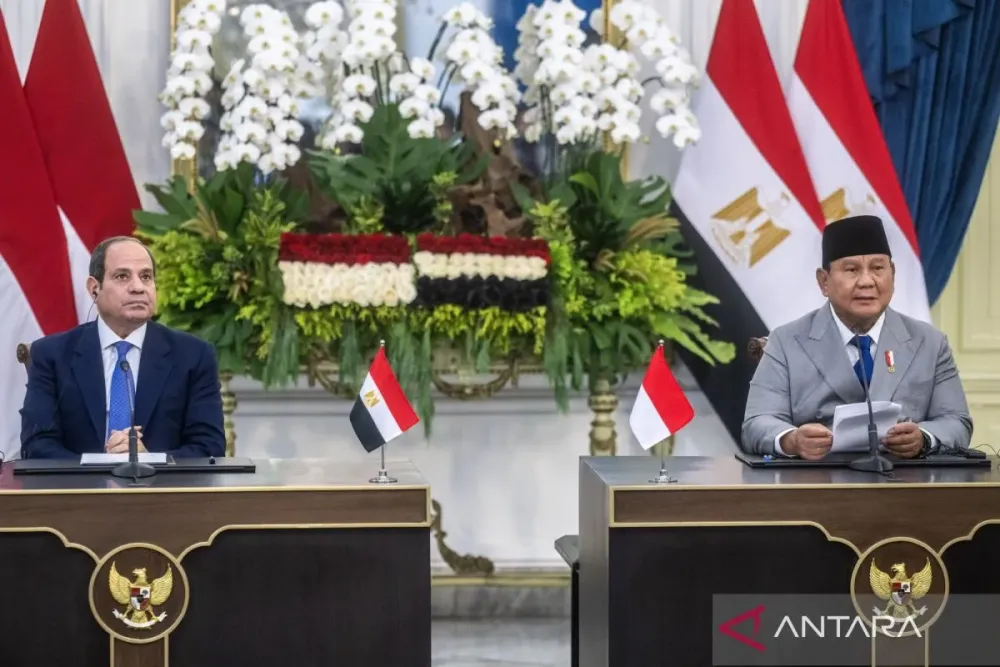
Water security at the Jakarta talks
At their joint press appearance at Merdeka Palace, Prabowo said countries should put common regional interests first when addressing natural resource disputes while protecting each nation's access to essential water supplies.
"We are deeply concerned if there are thoughts of violating international law to reduce a nation's right to secure water sources," he said. "We hope that all parties will promote mutual interests for the region, and we will support Egypt's efforts to secure its water rights," Prabowo added.
El-Sisi framed the Nile as essential to both Egypt's national security and its people's survival. "The Nile River is the lifeblood of the Egyptian people. I emphasize as strongly as possible that Egypt has its rights related to this water and rejects everything that would endanger its water security," he said.
Egypt's dependence on the river extends to agriculture and water supplies for more than 100 million people, according to a 2023 Asharq Al-Awsat report. The report said the country draws almost all its water from the Nile and that roughly 85 percent of the river's flow originates in Ethiopia.
The dam and competing water claims
The dispute centers on Ethiopia's Grand Ethiopian Renaissance Dam (GERD), upstream on the Blue Nile. Egypt and Sudan, both downstream, have strongly opposed the project because of concerns about how water is allocated and how droughts are managed.
Construction began in 2011, and Ethiopia formally inaugurated the domestically financed project in September 2025 at Guba in the Benishangul-Gumuz region. AllAfrica, carrying an Addis Standard report, put its installed generating capacity at approximately 5,150 megawatts and its reservoir capacity at about 74 billion cubic meters. It is Africa's largest hydroelectric project.
Egypt and Sudan cite the 1959 Nile Waters Agreement, under which Egypt is allocated 55.5 billion cubic meters annually and Sudan 18.5 billion. Ethiopia did not join that agreement and rejects using it to constrain its rights, according to The Rio Times.
Regional diplomacy and mediation
Before El-Sisi's Jakarta visit, regional tensions had increased following Ethiopia's decision to cut ties with Eritrea and subsequent diplomatic expulsions between Egypt and Ethiopia.
At the Alamein Africa Forum in New Alamein, El-Sisi met Burundian President Evariste Ndayishimiye, the African Union chairperson. He opposed using Nile water rights as political leverage and urged peaceful settlements to conflicts in the Horn of Africa. The African Union Commission called for calm and restraint among the countries involved, although Cairo voiced reservations about its recent statements on the dispute.
The Rio Times reported that US President Donald Trump had offered to mediate in a January 2026 letter. The United States counts Ethiopia as a partner and provides Egypt with about $1.3 billion in military aid annually, the publication noted.
Egypt and Sudan reaffirm demands in November
After the Jakarta meeting, Egypt and Sudan renewed their opposition to Ethiopia's unilateral management of GERD. In a November 2, 2026, joint statement, they called their water security "indivisible" and demanded a legally binding framework governing the dam's operation.
The statement followed the third round of their "2+2" consultations in Cairo, involving the two foreign ministers, Egypt's water minister and Sudan's agriculture minister. According to The Rio Times, the countries maintained that the dam dispute was a matter for Egypt, Sudan and Ethiopia alone and rejected bringing other Nile Basin countries into it. They also supported maintaining the Nile Basin Initiative and continuing discussions on the Cooperative Framework Agreement.
The Cairo talks also covered practical water projects. Egypt and Sudan agreed to broaden cooperation on harvesting rainwater and on groundwater stations powered by solar energy. They discussed rehabilitating the Jebel Aulia reservoir, on the White Nile south of Khartoum.
Agreements and trade goals
Water diplomacy was one part of El-Sisi's state visit to Indonesia. He thanked Prabowo for the invitation and sought broader cooperation, citing the strategic partnership established during Prabowo's April 2025 visit to Egypt as a basis for expanding ties.
The governments signed four memorandums of understanding in Jakarta: a Strategic Partnership Action Plan; visa exemptions for diplomatic, service and special passport holders; cooperation on statistics; and cooperation on marine affairs and fisheries, according to Indonesia's Cabinet Secretariat.
El-Sisi said the two countries aimed to raise bilateral trade to $5 billion by 2030 and remove existing barriers. He also presented Egypt as a gateway to Arab, African and European markets.