
House Speaker Puan Maharani calls for fiscal prudence, regional equity in 2027 budget
Indonesia's House Speaker emphasized four pillars of budget oversight—fair revenue collection, quality spending, debt control, and regional transfers—as President Prabowo submitted the 2027 draft budget targeting a 2.40 percent deficit.
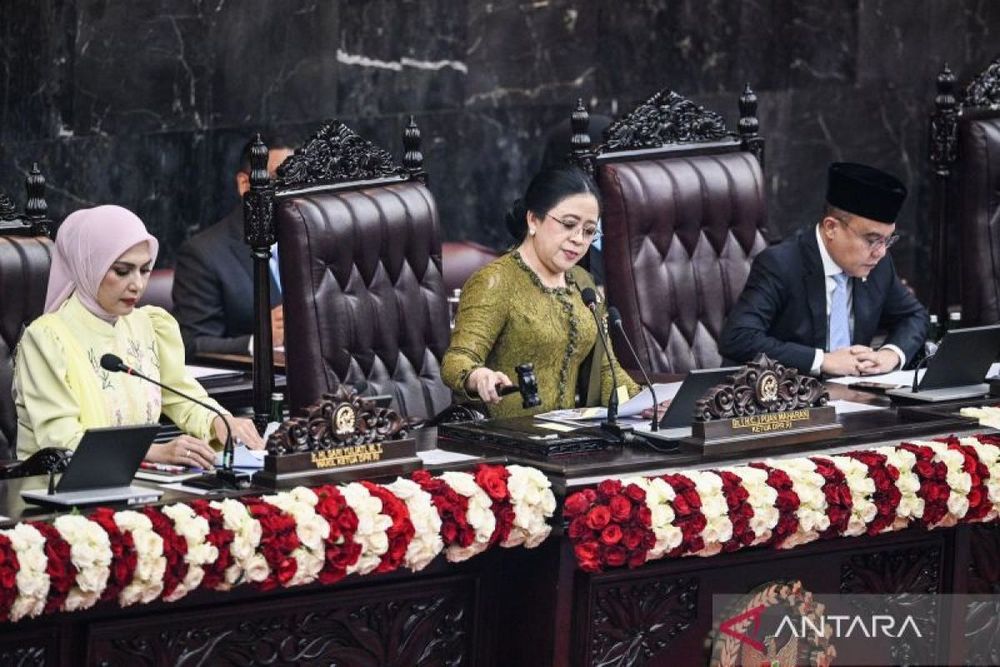
House Speaker Puan Maharani calls for fiscal prudence, regional equity in 2027 budget
House of Representatives Speaker Puan Maharani called on the government Friday to ensure Indonesia's 2027 state budget prioritizes equitable tax collection, prudent debt management, fiscal sustainability, and tangible public benefits across the archipelago's regions.
Addressing the parliamentary plenary session in Jakarta, Maharani—the first woman to serve as DPR Speaker and the first since the Reformation era to win two consecutive terms—outlined four core pillars of legislative oversight as President Prabowo Subianto formally submitted the draft 2027 State Budget and Financial Note.
The 2027 budget proposal projects state revenue at Rp3,426 trillion (approximately US$191.69 billion) and expenditure at Rp4,097.2 trillion (approximately US$229.24 billion), targeting a deficit of 2.40 percent of GDP—down from the 2026 deficit target of 2.68 percent and well below Indonesia's legally mandated 3 percent ceiling.
The State Budget is not just about numbers and programs. For the people, what is remembered is not the size of the numbers, but rather how much the budget can change people's lives for the better.
Fair revenue, quality spending
On revenue collection, the Speaker emphasized that tax burdens must remain equitable and sustainable.
First, state revenue must be collected fairly, without weakening public purchasing power and the sustainability of the business world,she stated, calling for spending to be targeted and results-oriented.
Maharani, who leads the Indonesian Democratic Party of Struggle (PDI-P)—the largest parliamentary faction with 110 seats—warned that deficit levels and national debt require strict prudence.
Today's policies must not leave an unfair burden on future generations,she stressed.
Through July 2026, Indonesia's state budget deficit stood at 0.91 percent of GDP, demonstrating fiscal discipline despite increased spending on social programs. The 2026 budget, approved by parliament with a 2.68 percent deficit target, allocated Rp3,153.6 trillion in revenue and Rp3,842.7 trillion in spending.
Regional transfers under scrutiny
Maharani emphasized that financial transfers to sub-national regions must directly strengthen local economies, public services, and balanced regional development. Her remarks carry particular weight following a significant reduction in regional transfers—from Rp919.9 trillion (US$56.4 billion) in 2025 to approximately Rp693 trillion (US$42.5 billion) in 2026, a decrease of roughly 25 percent.
Indonesia's fiscal decentralization framework, governed by Law No. 1/2022 on Financial Relations between Central and Regional Governments, establishes the legal foundation for these transfers and regional fiscal rights.
The measure of our success in preparing the State Budget is the extent to which policies, programs, and budgets can pave the way for people to live better lives,Maharani concluded.
President Prabowo, who took office as Indonesia's eighth president on October 20, 2024, after winning the February election with approximately 58.6 percent of the vote, delivered the government's formal budget statement following the Speaker's address.