
Indonesia anchors 2027 state budget on food and energy self-reliance
President Prabowo Subianto unveiled the 2027 state budget with Rp4,097.2 trillion in spending, prioritizing food sovereignty and energy independence through massive investments in agriculture and renewable power development.
Food sovereignty takes center stage
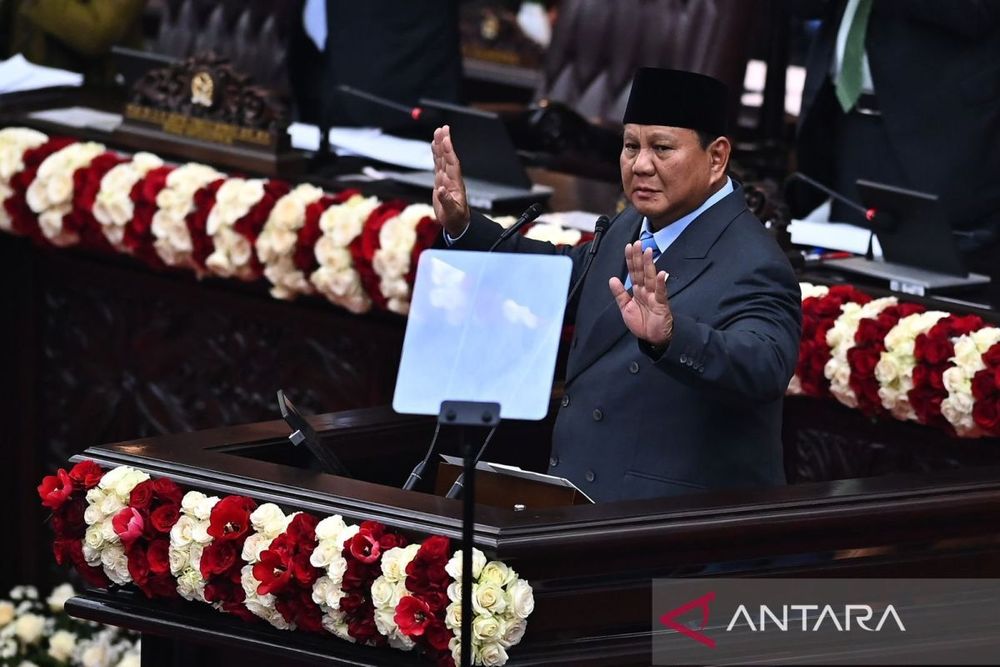
President Prabowo Subianto presented Indonesia's 2027 Draft State Budget on Friday, setting total state spending at Rp4,097.2 trillion against targeted revenues of Rp3,426.0 trillion. The budget framework aims to deliver economic growth between 5.8 and 6.5 percent while advancing the nation's core development priorities.
Speaking at the Nusantara Building in Jakarta's Parliamentary Complex on August 14, Prabowo emphasized that the state budget transcends mere fiscal accounting. He described it as an instrument of national struggle designed to protect citizens, strengthen the nation, and realize independence through improved living standards.
Food sovereignty takes center stage
The government allocated Rp195.3 trillion for food security in the 2027 budget, marking a 2.3 percent increase from the 2026 outlook of Rp190.9 trillion. This commitment reflects Indonesia's determination to secure domestic food production and reduce reliance on imports.
Recent agricultural performance supports this ambition. Rice production reached 34.69 million tonnes in 2025, climbing 13.29 percent from the previous year and enabling Indonesia to meet domestic needs without imports. The Government Rice Reserve exceeded 5 million tons by July 2026, the highest level in the nation's history, while the Farmer Exchange Rate hit a historic peak of 127.73 in May 2026.
The agricultural sector demonstrated robust economic performance, with GDP growth of 5.74 percent recorded in May 2026. Building on this momentum, the 2027 budget directs funds toward developing 2.7 million hectares of rice-growing areas, creating 100,000 hectares of new rice fields, and optimizing 200,000 hectares of existing farmland. With Indonesia's rice harvested area standing at approximately 10.20 million hectares in 2023, the planned expansion represents a significant 26 percent increase in cultivated land.
The budget also finances pre-harvest equipment assistance covering 23,528 units for food crops, revitalization of 616 hectares of salt fields, development of 55,765 hectares of irrigation networks, construction of 14 dams, and facility upgrades at 400 fishermen villages. Additional allocations support food aid programs for 5,000 people facing food insecurity and cheap food initiatives for 38 community groups.
Indonesia has achieved self-sufficiency in eight food commodities: rice, corn, large chili peppers, cayenne pepper, consumption sugar, chicken meat, chicken eggs, and shallots.
Energy independence through renewable power
Prabowo identified a fundamental paradox in Indonesia's energy landscape: despite vast renewable energy potential, the country remains dependent on fossil fuels and imported fuel oil. The Ministry of Energy and Mineral Resources reports that Indonesia possesses 3,687 gigawatts of renewable energy potential, dominated by solar, hydropower, and wind sources. Yet installed renewable generation capacity reached only 16.32 gigawatts as of June 2026, revealing enormous untapped potential.
The government set an ambitious target to develop 100 gigawatts of solar power capacity while phasing out diesel power plants. For 2026 alone, plans call for 30 gigawatts of solar development and retirement of 13 gigawatts of diesel capacity. Prabowo outlined a vision for every village to operate a 1-megawatt solar power plant. Government calculations indicate that building 100 gigawatts of solar capacity could save at least Rp73.9 trillion annually through reduced electricity production costs.
The budget allocates Rp272.95 trillion for energy subsidies in 2027, maintaining affordable fuel oil and electricity prices for consumers. Alongside renewable power development, the government is advancing a national electric vehicle ecosystem through incentives, charging infrastructure, and battery supply chain strengthening.
Biodiesel program delivers major savings
Indonesia has made substantial progress toward energy self-sufficiency through its biodiesel program. As the world's largest palm oil producer, the country has steadily increased biodiesel blending mandates, progressing from B40 to the current B50 standard implemented on July 1, 2026. The B50 blend, containing 50 percent palm oil-based biodiesel, completely eliminated diesel fuel imports and is saving the state up to Rp170 trillion per year in foreign exchange.
The biodiesel program generated cumulative savings of 673.73 trillion rupiah between 2020 and 2025 by reducing fossil diesel imports and utilizing domestic palm oil. Diesel imports fell 25 percent in 2025 compared to 2024, dropping to 5.29 million tons valued at US$3.49 billion. By 2025, diesel imports accounted for only 10.6 percent of national demand, while biodiesel consumption surged to 14.2 million kiloliters, up from 9.3 million kiloliters in 2021.
Fabby Tumiwa, CEO of the Institute for Essential Services Reform, welcomed the government's approach to gradually reducing fuel oil subsidies through transport electrification and incentives for domestically produced electric motorcycles. He noted the policy could reduce energy imports, improve urban air quality, and strengthen the national electric vehicle industry.
Fiscal strategy to protect households
Food security and energy self-reliance form key pillars of the government's strategy to strengthen domestic economic resilience. As domestic production of food and energy grows more robust, volatility in global commodity markets is expected to have less direct impact on public purchasing power.
The government targets inflation within a 1.5 to 3.5 percent range. In this context, food and energy security serve as buffers against global market fluctuations, protecting household budgets from external shocks.
The 2027 budget encompasses eight national priority work programs: food sovereignty, energy and water self-reliance, education, health, downstreaming and industrialization, infrastructure, housing and disaster resilience, strengthening the people's economy and village development, and poverty reduction.
Success will ultimately depend on effective implementation and oversight to ensure budget allocations deliver tangible benefits. Through hundreds of trillions of rupiah in strategic investments, the 2027 state budget aims not only to drive economic growth but also to function as a stability anchor, ensuring families can maintain their livelihoods and communities throughout the archipelago gain access to reliable energy.