
Indonesia Trails Vietnam in Manufacturing as Business Costs Weigh on Investment
Indonesia's factory sector faces high operating costs and uncertainty over industrial policy as Vietnam attracts global manufacturers and expands electronics production. Indonesia's latest manufacturing survey shows stronger activity, but economists say the country needs more efficient investment and better-connected supply chains.

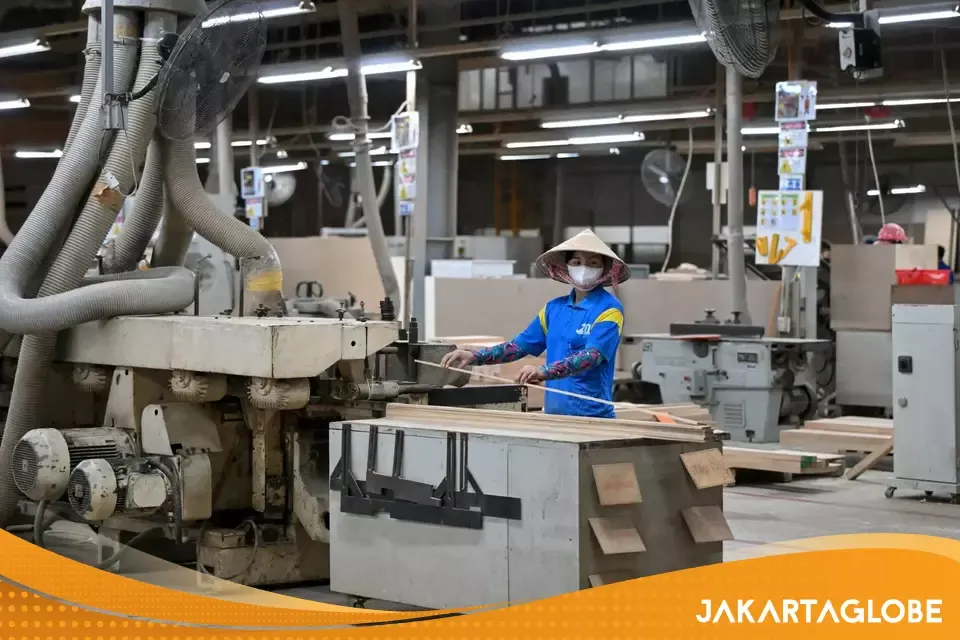
Growth and income figures show Vietnam's advance
Third-quarter economic growth in Indonesia reached 5.47% year over year, its best result for that quarter since 2023. Vietnam grew 9.5%, despite having an economy nearly one-third the size of Indonesia's. An 11% expansion in Vietnamese manufacturing over the first nine months helped support its growth.
Vietnam is also projected to move ahead in nominal GDP per capita. According to VnEconomy's account of the IMF's October 2026 World Economic Outlook, Vietnam's figure would rise 8.9%, from $4,829 in 2025 to $5,259 in 2026, compared with Indonesia's $5,153. That would place Vietnam fifth in ASEAN, after Singapore, Brunei Darussalam, Malaysia and Thailand, with Indonesia sixth.
The IMF projects that the difference will increase from $106 in 2026 to $161 in 2030, when GDP per capita would reach $7,105 in Vietnam and $6,944 in Indonesia. The countries would retain their respective fifth- and sixth-place rankings in ASEAN.
Bob Azam, who chairs Apindo's employment and manpower division, linked the shift to both economic growth and exchange rates: the rupiah weakened by about 8%, while the Vietnamese dong gained 1.9%. He told The Jakarta Globe, "It is not only the growth figure that matters. We need quality growth that creates a multiplier effect."
Electronics and foreign investment deepen Vietnam's industrial base
Vietnam's industrial development follows decades of opening to international trade and foreign capital, beginning with the Doi Moi reforms in 1986. More recently, manufacturers including Samsung and Foxconn have invested as companies diversify production away from China amid US trade tensions. Vietnam is also expanding from traditional labor-intensive production into higher-value electronics and technology manufacturing.
That shift is visible in exports. Vietnam shipped about $475 billion in goods in 2025, compared with approximately $283 billion from Indonesia. A 2026 Acclime Vietnam analysis cited by the Vietnam Chamber of Commerce and Industry (VCCI) put Vietnamese exports of computers, electronic products and components at approximately $107.7 billion, a 48.4% annual increase and nearly 22.7% of all exports.
Adding telephones and related components brings Vietnam's 2025 electronics exports to more than $164.4 billion, according to the analysis. It ranked the country among the world's 10 largest electronics exporters and reported a further $102.85 billion in electronics exports during the first half of 2026.
Vietnam's National Statistics Office reported foreign direct investment of $27.62 billion in 2025, 9% above the previous year and the highest level in five years. The Acclime analysis distinguishes between $38.4 billion in registered investment and $27.6 billion disbursed that year, also identifying the disbursed amount as a five-year high.
Investment commitments continued to grow in the first half of 2026. The analysis recorded $34.65 billion in registered FDI, up 61% year over year, and $13 billion in disbursements. Manufacturing and processing accounted for roughly 70-80% of those inflows.
Mohammad Faisal, executive director of CORE Indonesia, said low labor costs alone do not explain Vietnam's appeal. Manufacturers also look for consistent policies, regulatory certainty and incentives that last. "Investors do not really care whether a country is socialist, centralized or decentralized," he said.
Costs and investment efficiency constrain Indonesia
For Indonesia, matching Vietnam's position is unlikely in the near term, according to CORE Indonesia researcher Yusuf Rendy Manilet. He instead sees an opportunity to serve the ASEAN market as a production and distribution hub, conditional on cheaper inter-island logistics and a more consistent industrial policy.
Nailul Huda, digital economy director at the Center of Economic and Law Studies (CELIOS), called Indonesia a "high-cost economy." He identified official and unofficial levies, restrictions on imports and costly access to raw materials as burdens on manufacturers.
He also cited an incremental capital-output ratio, or ICOR, of 6.4 for Indonesia, versus about 4.2 for Vietnam. The measure describes how much investment is required to generate additional economic output. "The higher the ICOR, the less efficient the economy," Nailul said, warning that investors could favor Vietnam as a result.
A separate government assessment puts Indonesia's national ICOR at about 6.1. According to Antara, Coordinating Minister for Economic Affairs Airlangga Hartarto said on October 21, 2026, that the average in Indonesia's special economic zones was below 4. He said achieving the country's 8% growth target would require investment at an ICOR of 4.
Airlangga also contrasted the scale of the zones: those in Vietnam and Malaysia cover roughly 1.8 million to 2 million hectares, while Indonesia's cover about 24,000 hectares.
Bob called for stronger links between supply chains, agricultural modernization and expansion of both high-tech production and export-oriented industries that employ large workforces. He said Indonesia should compare its licensing processes, land costs and worker skills with regional competitors to identify investment bottlenecks. Nailul emphasized lower business costs, better logistics and more dependable regulation, particularly for technology-intensive manufacturing.
Local hiring dispute tests BYD project
Employment expectations have become a source of friction at BYD's planned $887 million electric-vehicle factory in Subang, West Java. Designed to produce up to 150,000 vehicles a year, the project has faced demands from nearby communities for more jobs.
Tempo reported that the facility spans 126 hectares and includes stamping, welding, painting and final assembly. In its September 3, 2026, report, BYD Vice President Liu Xueliang said the workforce included 5,000 local employees, with plans to reach 20,000 at full capacity. Tempo also reported BYD's delivery of its 100,000th vehicle to the Indonesian market.
Hundreds of people from surrounding villages protested at the factory in the Smartpolitan Industrial Estate on October 28, according to The Jakarta Post. The United Subang Community Forum (FMSB), which organized the demonstration, estimated that fewer than 20% of employees were Subang residents. Its demands included transparent recruitment, additional vocational training and a 70% local hiring quota for companies investing in the regency.
Industry Minister Muhammad Sarmuji said a government visit involving other agencies was possible to help settle the dispute. He suggested that BYD and residents might view the company's commitments differently: the manufacturer could regard its local hiring obligations as met, while residents still consider the opportunities inadequate.
Indonesia's broader manufacturing activity nevertheless strengthened in October 2026. The Manufacturing Purchasing Managers' Index rose from 52.4 in September to 54.0, marking the sector's strongest expansion since March 2024.