
Indonesia's stock index surges 4.16% on buyback plans and transparency reforms
The Jakarta Composite Index rebounded sharply on Tuesday, gaining 208 points to close at 5,204.63, driven by corporate buyback commitments, exchange policy reforms, and regulatory enforcement actions following last week's historic market crash.

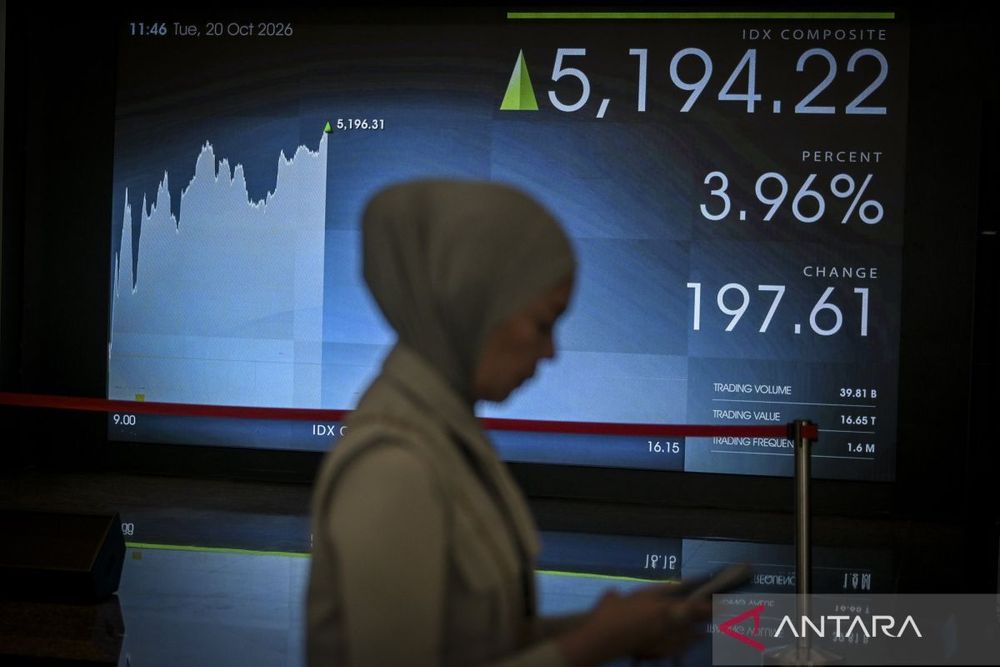
IHSG stock index rebounds 4 percent on buybacks, policy steps: Analyst
Indonesia's Composite Stock Price Index (IHSG) climbed 4.16 percent to 5,204.63 at the close of Tuesday's first trading session, recovering from days of severe losses as listed companies announced share buyback plans and regulators implemented sweeping transparency measures.
Analyst Helmy Kristanto of BRI Danareksa Sekuritas attributed the gains to multiple factors, including corporate support measures and policy initiatives by the Indonesia Stock Exchange (IDX) responding to market volatility triggered by international index concerns.
The rebound follows a tumultuous period for Indonesian equities. On Friday, October 16, the IHSG suffered its worst single-day decline in 28 years, plunging 11.57 percent to 5,185.11. The sell-off continued Monday, with the index falling another 3.6 to 5 percent to reach its lowest level since October 2020.
The sharp downturn came after MSCI announced on October 15 a consultation to potentially reclassify Indonesia from Emerging Market to Standalone Market status, with a final decision expected by the end of June 2027. MSCI cited market participants' concerns regarding lack of clarity in shareholding structures and suspected coordinated trading as key reasons for the proposal.
Exchange implements structural reforms
In response to the crisis, the IDX announced on October 19 that 80 stocks with high shareholding concentration will be excluded from the index calculation. These stocks currently represent approximately 18 percent of the IHSG's total weighting.
The exchange also plans to expand disclosure requirements for shareholder affiliations, targeting investors holding more than 1 percent of a company's shares. These measures build on transparency reforms completed in April 2026, which included publishing shareholder data for holdings above 1 percent, disclosing High Shareholding Concentration status, expanding investor classification to 39 categories, and raising minimum free float requirements to 15 percent.
"Implementation of this policy is in focus as part of efforts to restore investor confidence," Kristanto said, noting that resistance stands at 5,318 to 5,400, which represents the rebound target and initial test of recovery strength.
State investment and corporate buybacks
Support from Danantara, Indonesia's sovereign wealth fund established in February 2025 with initial capital of at least 1,000 trillion rupiah (approximately US$61 billion), also bolstered market sentiment. The fund's initiative to increase shareholdings in state-owned enterprises contributed to optimism toward state-owned bank stocks, including Bank Mandiri, Bank Rakyat Indonesia, and Bank Negara Indonesia, which Danantara manages alongside four other major state enterprises.
Several listed companies have prepared funds for share buybacks, which could help support demand for stocks amid ongoing market volatility, Kristanto noted.
Regulatory enforcement intensifies
The Financial Services Authority (OJK) has demonstrated commitment to market reform through aggressive enforcement actions. In October 2026, OJK imposed administrative sanctions totaling Rp2.1 trillion on three issuers — PT Dian Swastika Sentosa Tbk, PT Barito Renewables Energy Tbk, and PT Petrindo Jaya Kreasi Tbk — for alleged market manipulation and share offering violations.
From January to October 2026, OJK imposed sanctions on at least 835 parties with total fines exceeding Rp390 billion, demonstrating sustained enforcement efforts throughout the year.
"However, the market is still waiting for evidence of consistent implementation amid MSCI's consultation on the reclassification of Indonesia," Kristanto said.
Tuesday's trading session saw 1.63 million transactions, with 39.30 billion shares changing hands at a total value of Rp17.13 trillion. A total of 654 stocks rose, 137 fell and 172 remained unchanged.
The LQ45 index, which tracks 45 leading stocks, rose 31.27 points, or 6.40 percent, to 519.73. All 11 sectoral indices strengthened, with the transportation and logistics sector leading gains at 6.49 percent, followed by raw materials at 4.63 percent and property at 4.55 percent.
The recovery comes as Indonesia's equity market attempts to reverse a longer-term decline. In September 2026, the IHSG fell 6.96 percent, making it the worst-performing stock market in Asia for that month according to IDX monitoring of 12 regional exchanges.