
Danantara Sees Fintech as a Route for Indonesian Banks to Expand in Asia
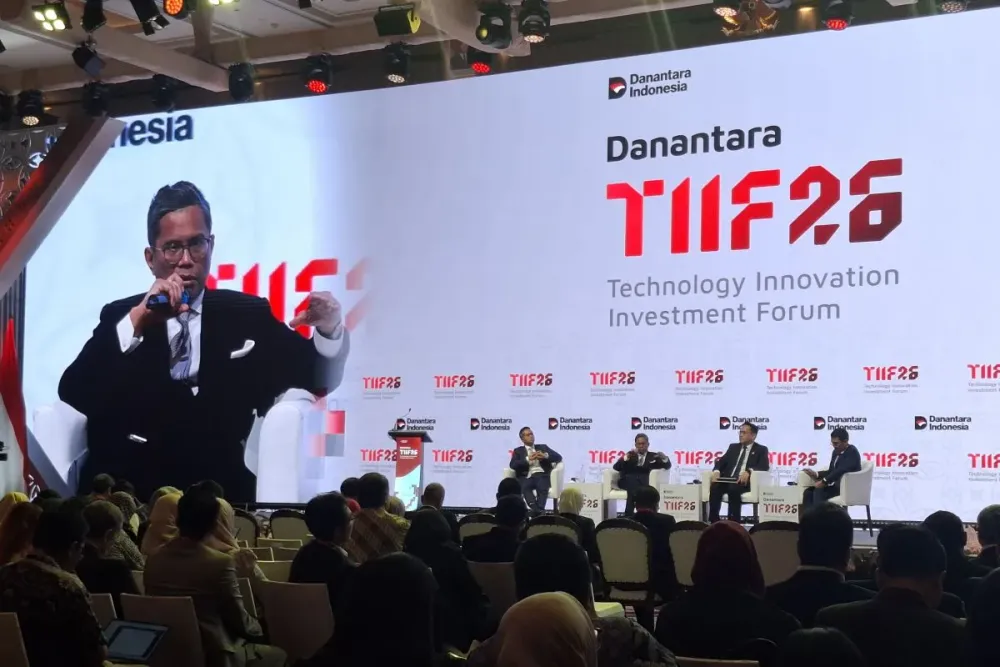
Indonesia's banks could use their domestic financial technology capabilities to build businesses across Asia, according to sovereign wealth fund Danantara. Pahala Nugraha Mansury, its managing director for global relations and communications, urged banks to look beyond their home market during an October 28 panel discussion in Jakarta.

Building on domestic banking experience
Speaking at the Danantara Technology Innovation Investment Forum (DTIIF) 2026, Mansury pointed to mobile banking and cross-border use of the Quick Response Code Indonesian Standard (QRIS) as examples of Indonesia's payment technology progress. "Indonesia can be a gateway for Indonesian companies to grow and become regional players," he said.
Mansury argued that Indonesian banks could draw on both their technology capabilities and a large home market to pursue opportunities abroad. He cited the expansion into Indonesia of Malaysia's Maybank and CIMB, Singapore's DBS, UOB and OCBC, and Thailand's Kasikornbank and Bangkok Bank as evidence of opportunities across national borders. Indonesians who live and work overseas also represent a potential market for cross-border financial services, he said.
"Very few Indonesian banks operate overseas. We at Danantara believe this requires a push to change mindsets," Mansury said.
Some Indonesian lenders already maintain overseas networks. Bank Negara Indonesia (BNI), a state-owned bank, listed six foreign branches in its 2025 annual report: Singapore, Hong Kong, Tokyo, Seoul, London and New York. Bank Mandiri also operates an international network serving customers' transactions and business activities abroad.
Drawing on roughly 15 years at state-owned Bank Mandiri, Mansury recalled its decision to put mobile banking investment ahead of ATM network expansion. He said competitive technology-based services require funding, committed leadership and investment in employees' capabilities.
The scale of QRIS at home and abroad
Bank Indonesia (BI) reported that QRIS had 70.6 million users and 49.4 million merchants in the third quarter of 2026. QRIS transaction volume rose 75.80 percent from a year earlier. Across digital payments overall, volume reached 18.09 billion transactions, a 39.24 percent increase.
The cross-border QRIS network connects Indonesia with Thailand, Malaysia, Singapore, Japan, South Korea and China. BI's figures through August 2026 put foreign users' QRIS transactions in Indonesia at 17.8 million, valued at Rp6.2 trillion. Indonesian users made five million transactions worth Rp1.85 trillion in partner countries.
QRIS Cross-Border also earned recognition in the Collaboration category of the "50-in-5 Awards 2026," organized by the Digital Public Goods Alliance (DPGA) and Co-Develop. BI Deputy Governor Filianingsih Hendarta received the award in New York on September 21, 2026, at the 50-in-5 Milestone Event held alongside the 81st UN General Assembly session.
Extending access for international travelers
Despite those connections, BI said in late September 2026 that the cross-border QRIS corridor covered only about 39.77 percent of foreign tourists visiting Indonesia. Roughly 60 percent of inbound visitors, including Australians, could not use the connectivity.
BI has been exploring additional partnerships. As of September 16, 2026, it was discussing potential cross-border QRIS cooperation with Saudi Arabia, India, Vietnam and Australia. Fitria Irmi Triswati, executive director of BI's Payment System Policy Department, described the talks as high-level discussions and said they could eventually extend beyond QRIS to Indonesia's BI-FAST system.
For travelers from countries not yet linked to cross-border QRIS, BI has positioned the Indonesia Travel Pack (ITP) 2026 as an interim option. Launched on September 26 at the FEKDI x IFSE 2026 event in Jakarta, the digital gateway brings together three pillars: Explore, Pay and Connect. Visitors access it through a QR code, with initial implementation limited to Jakarta and Banten.
Technology investment and the regional agenda
Mansury's remarks came during the three-day DTIIF 2026, held October 26-28 at the Fairmont Jakarta. Under the theme "Investing in Tomorrow: Advancing Technology, Innovation, and Sustainable Growth," the forum drew more than 1,500 participants, including global innovators, technology executives, research institutions, state-owned enterprises, investors and scientists.
Finance and banking was one of six priority sectors at the forum. The others were energy; agriculture, food and health; advanced materials and semiconductors; transportation and infrastructure; and artificial intelligence, digital infrastructure and telecommunications.
Danantara describes DTIIF as part of the lead-up to the inaugural New Asia Forum, scheduled for December 3-4, 2026, in Bali. That gathering is intended to convene world leaders, sovereign wealth funds and global business leaders to connect long-term capital with strategic opportunities supporting Asia's economic transformation.