
Indonesia tightens oversight of seafarer recruitment in Singapore
Indonesia's Transportation Ministry is strengthening enforcement of employment requirements for Indonesian seafarers in Singapore after reports that shipowners and operators were recruiting outside authorized manning agencies. The effort seeks to make placements transparent and protect workers' welfare abroad.

Recruitment requirements and worker protections
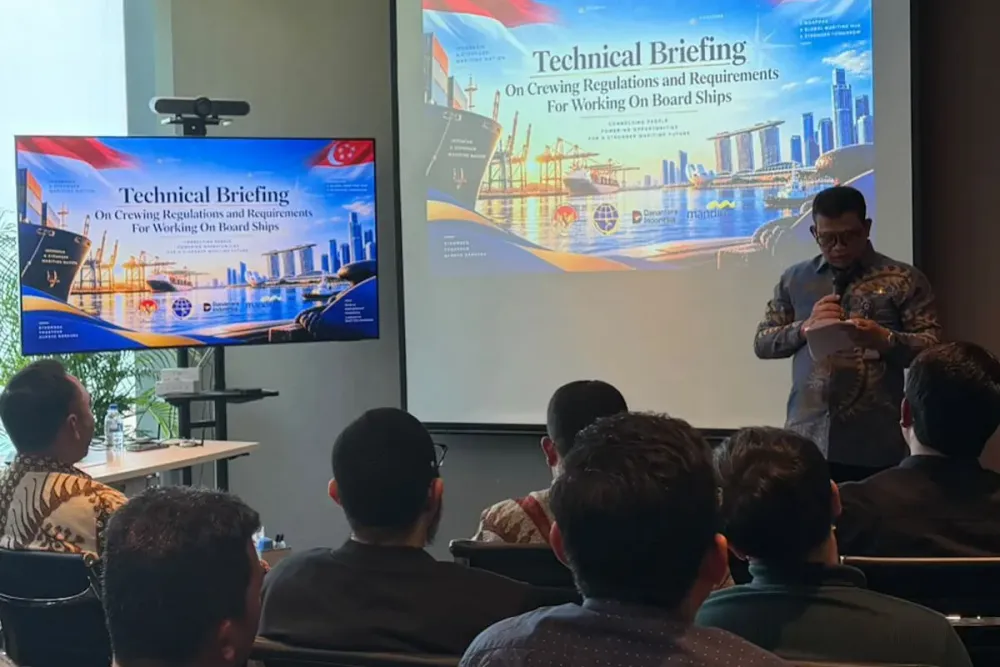
Acting Director General of Sea Transportation Samsuddin outlined the enforcement effort in a statement on Saturday. Recruitment practices were among the concerns discussed at a Technical Briefing on Crewing Regulations and Requirements for Working on Board Ships in Singapore, organized by the Indonesian Embassy's transportation attaché in collaboration with state-owned Bank Mandiri's Singapore branch.
Wahyu Ardhianto, the embassy's transportation attaché, called on shipowners and operators in the region to bring their hiring practices into line with Indonesian law. His office plans to introduce outreach programs in phases and enforce registration restrictions on personnel who do not comply.
Indonesia's Government Regulation 22/2022 requires agencies placing migrant merchant crew overseas to obtain a SIP3MI license from the minister and an agreement with the employer or principal endorsed by the Indonesian mission. According to KarirAman's guide to the regulation, agencies holding the Transportation Ministry's earlier SIUPPAK license were required to convert to SIP3MI within two years of the regulation's promulgation on June 8, 2022.
Singapore separately requires authorization from its Director of Marine to operate a seafarer recruitment and placement service. Its Merchant Shipping (Maritime Labour Convention) Act 2014 also bars anyone from demanding or receiving remuneration from a seafarer for providing employment. Violations carry a fine of up to S$5,000, imprisonment for up to two years, or both.
Indonesian law also limits costs charged to workers. KarirAman notes that Indonesia ratified the ILO Maritime Labour Convention 2006 through Law 15/2016. Under the convention, seafarers cannot be made to bear recruitment and placement fees, apart from the costs of a mandatory medical certificate, seafarer's book and passport; shipowners must cover visa costs. Article 30(1) of Indonesia's Law 18/2017 also prohibits charging placement costs to Indonesian migrant workers, including seafarers.
Ferry crew registration changes
The briefing also addressed difficulties with crew registration when passenger ferry workers move between vessels belonging to the same company on routes between Indonesia and Singapore.
"There are also challenges regarding the sign-on and sign-off procedures for crew members on passenger ferries operating between Indonesia and Singapore," Samsuddin said in the statement.
The Directorate of Shipping and Seafarers will prepare new standard operating procedures intended to simplify those crew rotations.
Planned rules for Wing-in-Ground craft
Another concern raised at the briefing was Indonesia's lack of formal qualifications for operating Wing-in-Ground (WIG) craft. The Directorate of Shipping and Seafarers plans to draft a ministerial regulation covering their operation.
A 2026 peer-reviewed study published in the Dinasti International Journal of Education Management and Social Science describes the existing regulatory gap. Although the Directorate General of Sea Transportation issued implementation guidelines in 2019 through Circular Letter No. UM.003/61/15/DK-19, the study found that neither an enforceable ministerial regulation nor a national construction standard had followed.
At the international level, WIG craft fall under the International Maritime Organization's International Code of Safety for Wing-In-Ground Craft, adopted in 2009 through Resolution MSC.285(86).
Embassy support for seafarers
About 6,000 Indonesian seafarers receive assistance from the transportation attaché's office each year. Its work includes issuing Seafarer Books (Buku Pelaut), arranging transit sign-ons and helping resolve labor disputes.
"We want to ensure that Indonesian seafarers have the opportunity to work in the international shipping industry, while consistently meeting competency standards and maritime regulations," Samsuddin said, describing the government's goals for international competitiveness and worker safety.
Indonesia's seafaring workforce exceeds 1.5 million people. The country has more than 100 maritime education institutions, which together produce about 3,000 graduates a year.