
BPK Auditor Explains How State Losses Were Calculated in Hajj Quota Case
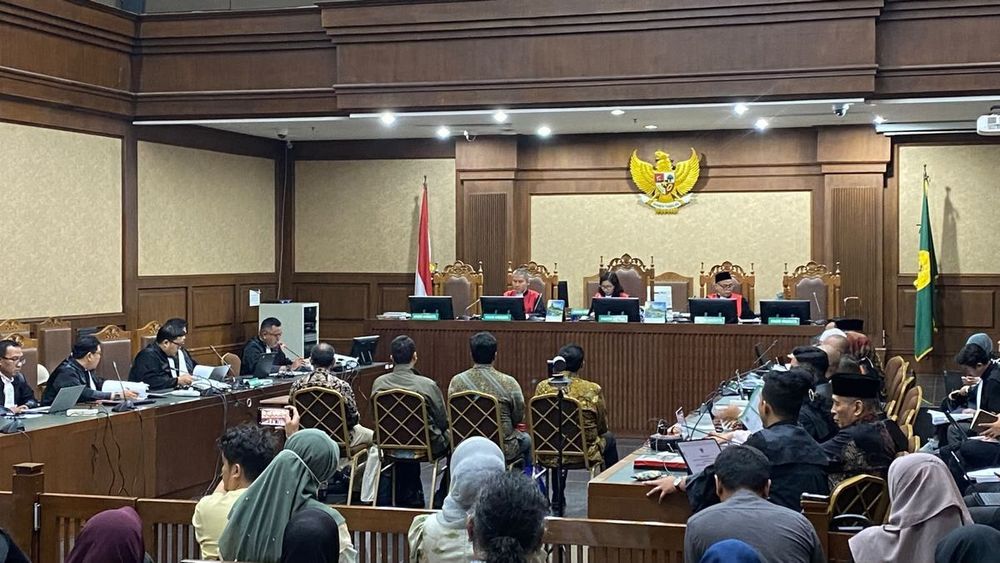
BPK auditor M Ramadhani outlined a four-stage process for calculating state losses as he testified at the Jakarta Corruption Court on October 27, 2026, in the additional hajj quota corruption case involving former Religious Affairs Minister Yaqut Cholil Qoumas.

From initial review to final report
Ramadhani and three fellow BPK auditors appeared before the court on Tuesday. All four serve on the investigative examination team assigned to calculate state losses linked to the Ministry of Religious Affairs' management of hajj quotas for 2023-2024.
"There are four stages that we need to go through regarding the process of calculating state losses," Ramadhani told the court.
He explained that the first stage, pre-planning, determines whether BPK will accept the assignment to calculate losses. Auditors review the circumstances of the case and evidence supplied by the relevant authorities, assess whether state finances are involved, and check whether the evidence supports the account of the case. They then analyze and discuss their findings before accepting or rejecting the assignment.
Once the work moves to planning, auditors prepare guidelines for carrying out the examination. This stage produces an audit assignment letter and an examination program.
The third stage is the examination itself: auditors investigate the case in greater depth, assess the evidence and gather further proof. They also prepare and discuss preliminary findings on deviations and the amount of state losses, producing a draft conclusion.
Reporting comes last. The team prepares and finalizes its findings, then issues the Investigative Audit Results Report on the calculation of state losses.
Standards governing the calculation
Ramadhani said the auditors worked under the State Financial Audit Standards in BPK Regulation No. 1 of 2017. According to detikNews, he also identified BPK Regulation No. 1 of 2020 on Investigative Examination, Calculation of State Losses, and Provision of Expert Testimony as a basis for their work.
The calculation also referenced Law No. 17 of 2003 on State Finance and Law No. 1 of 2004 on State Treasury, he testified.
What prosecutors say the losses cover
At the Jakarta Corruption Court on August 11, 2026, prosecutors accused Yaqut of causing Rp 622,090,207,166.41, or about Rp 622.09 billion, in state financial losses, detikNews reported. That amount came from the BPK RI Investigative Audit Results Report.
The indictment divides the alleged losses into three components. The largest is Rp 438,218,328,446.48, about Rp 438.2 billion, representing the difference between receipts and expenditures of special hajj organizers, known as PIHK, for pilgrims who should not have been eligible to depart for the 2024 hajj.
A second component is Rp 39,954,729,719.93, about Rp 39.9 billion, in PIHK receipts from sales of special hajj officer quotas in 2024. The third is Rp 143,917,149,000, about Rp 143.9 billion, in acceleration fees for filling additional special hajj quotas in 2023 and 2024.
Prosecutors further allege that Yaqut personally gained $271,500, equivalent to about Rp 4.83 billion at the exchange rate cited in court, and that 313 PIHK corporations were enriched by Rp 478.17 billion.
Four defendants on trial
Yaqut is one of four defendants in the case. The others are his former special staffer Ishfah Abidal Azis, also known as Gus Alex; Ismail Adham, operations director of PT Makassar Toraja, or Maktour; and Asrul Azis Taba, chairman of the Kesthuri association and commissioner of PT Raudhah Eksati Utama.
According to BBC News Indonesia, the Corruption Eradication Commission, known as the KPK, named Yaqut a suspect in January 2026. He became a defendant when the case went to trial on August 11, 2026.
The additional quotas at issue
BBC News Indonesia traced the case to Indonesia's 2023 hajj allocation of 221,000 places. Of those, 203,320 were regular hajj places and 17,680 were special hajj places, a 92:8 split.
Saudi Arabia's Ministry of Hajj and Umrah subsequently announced another 8,000 places. Indonesia received a further 20,000 additional places in 2024.