
Listyo Sigit Wiretapping Case Prompts Call for Police Ethics Hearing
Former Indonesian National Police Chief Listyo Sigit Prabowo has been named a suspect in an illegal wiretapping case a month after his dismissal. A Kompas commentary calls for a police ethics hearing without waiting for the criminal proceedings to conclude, arguing that the two processes serve separate purposes.

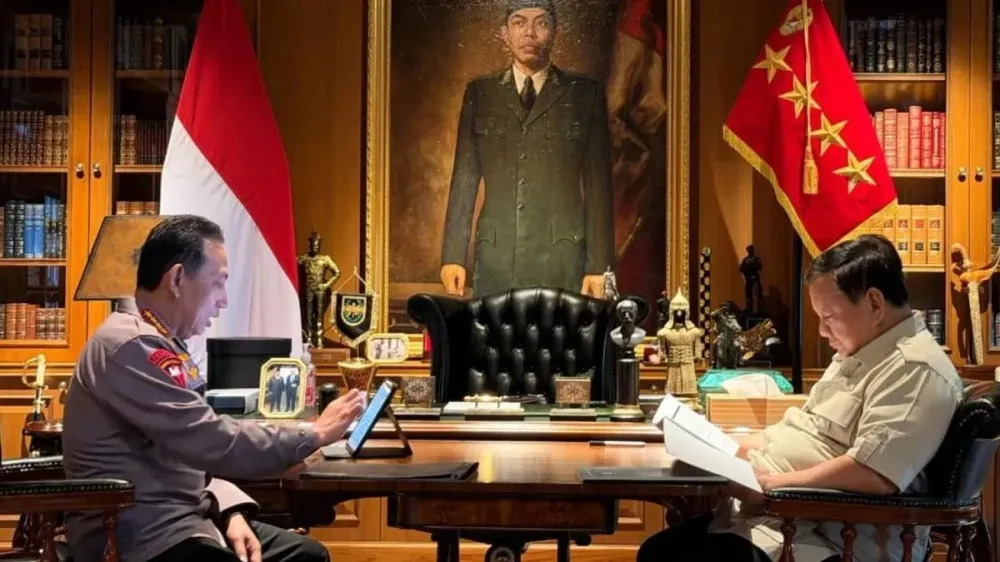
Alleged surveillance and Ahrie's denial
Listyo Sigit remains head of the Presidential Staff Office. The case also involves Inspector General Ahrie Sonta Nasution, Inspector General Eko Hadi Santoso and Inspector General Slamet Uliandi, the latest to be named a suspect.
The allegations center on the Lawful Interception Management System (LIMS), the police wiretapping system reserved for law enforcement and national security. According to Kompas, Listyo Sigit and his associates are suspected of using it to monitor President Prabowo Subianto and numerous other figures. The account says they moved the equipment to the private home of an officer involved in the alleged operation.
Ahrie's lawyer, Krisna Murti, disputed his client's involvement in surveillance of the president. He said Ahrie denied tapping anyone inside the presidential palace or targeting Prabowo's phone line. According to Krisna, Ahrie was following a superior's instructions to analyze numbers supplied to him. The lawyer also noted Ahrie's previous service as Listyo Sigit's personal secretary and as an aide to Prabowo.
Why Kompas urges an ethics hearing
The Kompas commentary argues that police discipline and professional obligations require immediate attention, rather than being left unresolved until the criminal case ends. It describes the alleged misuse of state surveillance equipment as a breach of loyalty, integrity and the officers' oath to the nation.
The commentary identifies dismissal without honor, known as PTDH, as a sanction that the police Professional Ethics Commission (KKEP) could impose. In its assessment, that process need not await a final, legally binding criminal judgment.
Kompas presents ethical and criminal sanctions as distinct but mutually reinforcing under police administrative law. It also warns that allowing the suspects to retain their police membership during the criminal proceedings could impede an objective investigation.
Criminal charges and evidence
On November 3, 2026, Commissioner General Asep Safrudin, head of the National Police Criminal Investigation Agency (Bareskrim), announced charges under three provisions. Article 258 of the new Criminal Code, Law No. 1 of 2023, carries a maximum prison term of 10 years; Article 332 of the code carries up to six years; and Article 32 of the Electronic Information and Transactions (ITE) Law carries up to eight years.
Safrudin also reported that investigators had interviewed 10 witnesses and three expert witnesses. The evidence seized included 11 mobile phones, an iPad and four flash drives.
Treason remains an investigative question
The Kompas commentary also addresses public debate about applying the treason provisions of the 2023 Criminal Code. It argues that the debate has a basis because turning state wiretapping equipment against the president could constitute a crime against national security.
On November 3, Coordinating Minister for Law, Human Rights, Immigration and Corrections Yusril Ihza Mahendra said investigators had found no indication of treason. He nevertheless described the alleged surveillance of the president and ministers as a serious matter for any country.
National Police Chief General Suyudi Ario Seto has established a special task force under Safrudin to investigate the alleged wiretapping. Police spokesman Brigadier General Trunoyudo Wisnu Andiko said on November 5 that the team was examining whether potential treasonous motives were involved. Investigators were also profiling those targeted and tracing the sources of funding.