
Indonesia presses developed nations to fulfill climate finance commitments at COP31
Indonesia called on developed countries to lead efforts to provide at least $300 billion a year in climate finance by 2035 and expand technology transfers, as presidential envoy Hashim Djojohadikusumo addressed the COP31 Leaders' Summit in Antalya, Türkiye, on November 12.

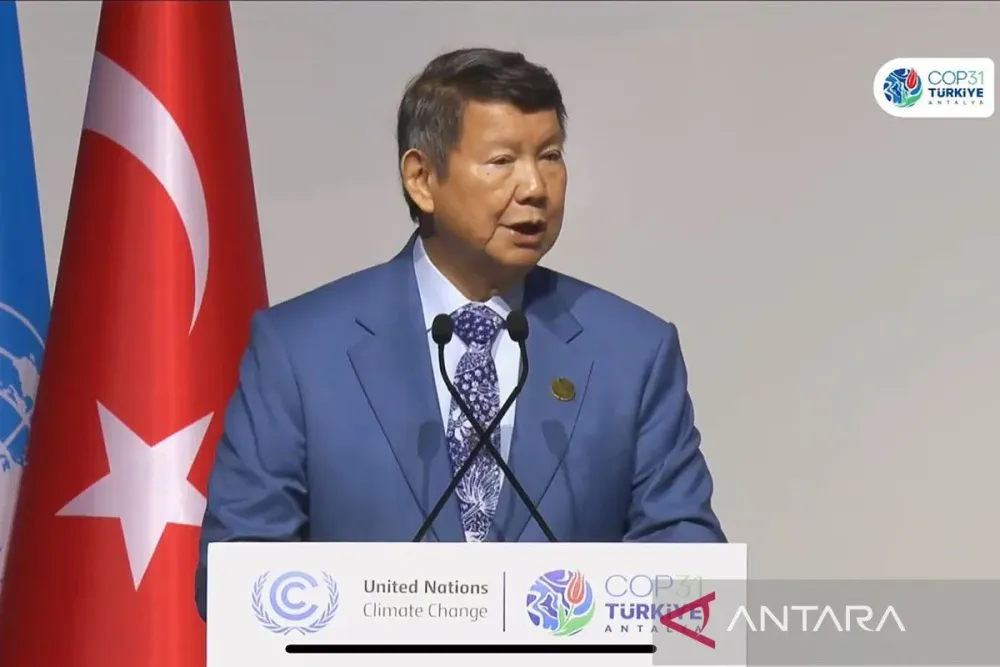
Turning finance targets into funding
Hashim, Indonesia's presidential special envoy for climate change and energy, urged governments to deliver on both the New Collective Quantified Goal, which sets the $300 billion annual target, and the Baku to Belém Roadmap, which aims to bring financing for developing countries to $1.3 trillion a year by 2035.
He said responsibility for climate action should reflect countries' differing abilities to strengthen resilience on their own. Major powers should help other nations prepare for climate impacts, he argued, particularly where access to finance and technology is limited. His appeal for concrete action echoed a call at the Fourth International Conference on Financing for Development.
The COP30 Presidency outlined possible routes to the larger funding target in a report presented on November 8, "Implementing the Baku to Belém Roadmap to 1.3T." It estimated that specific financing approaches and policy interventions could bring annual climate finance for developing countries to between $1.27 trillion and $1.41 trillion by 2035. Its business-as-usual scenarios put international climate finance at only $458 billion to $461 billion annually by that year.
At COP31, an EU official cited the latest OECD report as showing that developing countries received $136.7 billion in public climate finance in 2025, with the European Union contributing one-third. The total exceeded the original annual target of $100 billion agreed at COP15 in 2009.
Finance disputes shape the summit agenda
COP31 opened on November 9 in Antalya, with Türkiye and Australia serving as co-hosts. Organizers expected nearly 100,000 delegates over the roughly ten-day summit.
Finance was contested from the opening plenary. According to Down To Earth, delegates adopted a standalone Climate Finance Work Programme on November 9, meeting a key demand from developing countries, including India. The European Union opposed the move, saying the COP30 decision had not established a separate agenda item. Proposals to create separate agenda items for tripling adaptation finance and addressing climate-related trade measures were dropped.
UNEP's Adaptation Gap Report 2026 put international public adaptation finance flowing from developed to developing countries at $28.2 billion to $31.7 billion in 2024. It estimated annual adaptation needs of $305 billion by 2035.
Addressing the Leaders' Summit on November 11, UN Secretary-General António Guterres proposed a "climate justice compact" to support developing countries in moving away from fossil fuels while protecting people already suffering from climate change. He also called for governments to tax fossil fuel windfall profits.
Indonesia expands its financing options
Hashim said Indonesia was pursuing all avenues for climate financing, including carbon pricing. He pointed to the country's development of a National Carbon Unit Registry System and the issuance of implementing regulations across sectors in 2026.
IKI Indonesia Policy Updates reported that Indonesia launched the Carbon Unit Registry System, known as SRUK, on July 9, 2026. Minister of Environment/Head of BPLH Regulation No. 10 of 2026, enacted July 2, established the system. It tracks carbon units through their full lifecycle in both compliance and voluntary markets.
Hashim said climate financing must be easier to access, more affordable and consistent with national priorities. Cooperation should accommodate countries' different circumstances and produce tangible results, he added, urging governments to use COP31 to put plans into practice.
"Indonesia stands ready to cooperate with all partners with due regard for mutual respect and shared responsibilities," he said.