
Rescue teams save three critically endangered orangutans from West Kalimantan wildfires
Conservation teams in West Kalimantan have rescued three orangutans driven from their forest habitat by wildfires, including a severely burned mother and infant found in a palm oil plantation. The rescues are part of escalating efforts as fires spread across the province.

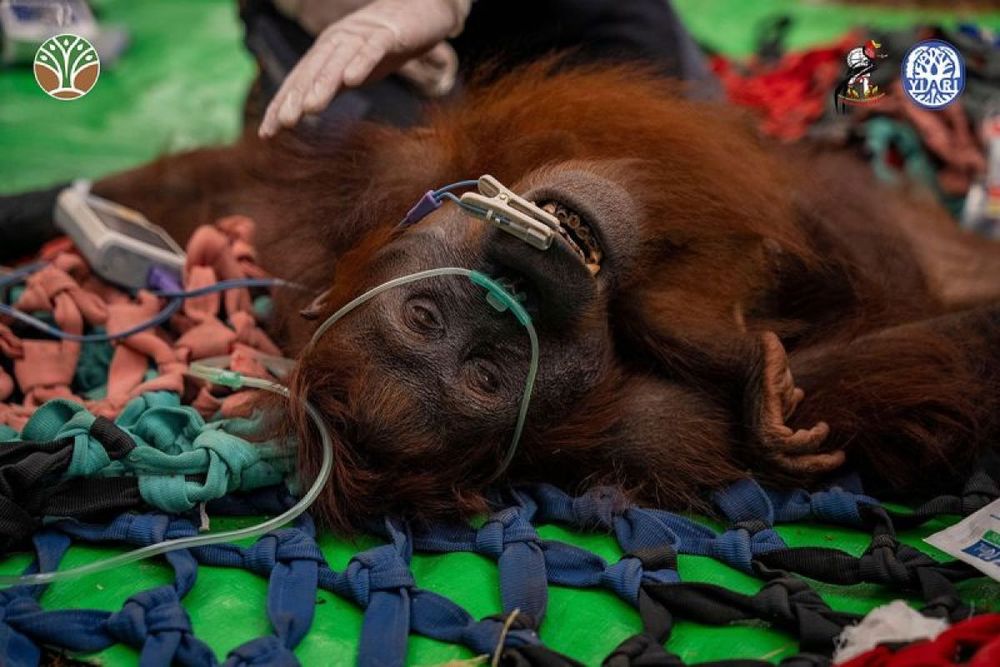
Rescue teams save three critically endangered orangutans from West Kalimantan wildfires
Conservation teams have rescued three critically endangered orangutans forced from their forest habitat by wildfires in Ketapang District, West Kalimantan, in two separate operations conducted by the province's Natural Resources Conservation Agency (BKSDA) and the Indonesian Nature Rehabilitation Initiative Foundation (YIARI).
The rescues took place in Simpang Hilir Subdistrict and included a mother with her offspring discovered in a palm oil plantation in Penjalaan Village, and an adult male found in Padu Banjar Village. All three orangutans are classified as Critically Endangered by the International Union for Conservation of Nature.
Mother and infant found in critical condition
YIARI President Director Karmele Llano Sanchez said the animals were driven from their habitat in North Kayong District by spreading forest and land fires. The mother, named Mama Penja, and her offspring were found in critical condition, severely emaciated and barely moving despite human activity nearby.
After tranquilization, the medical team administered intravenous fluids and oxygen before transporting the pair to YIARI's rehabilitation center. Medical examinations revealed Mama Penja suffered severe dehydration, anemia, and burns on both feet with peeling skin. Her teeth were also damaged. The burns are believed to have resulted from walking across burning peatland.
Peatlands in the region are particularly hazardous for wildlife because when drained for agricultural development, they become highly flammable and can burn underground for extended periods while releasing vast amounts of smoke and carbon. These conditions not only inflict direct injuries but also severely limit wildlife access to food sources. Sanchez noted that Mama Penja immediately began searching for food upon regaining consciousness.
Previously rescued male orangutan found again
The third orangutan, an adult male named Kumbang, was rescued in Padu Banjar Village. A microchip scan confirmed he had previously been rescued and released in the same area in 2022. YIARI Operations Director Argitoe Ranting said spreading fires likely drove Kumbang from his habitat into residential areas and plantations.
Medical examinations revealed respiratory problems, bodily injuries, snare marks, and a suspected bullet fragment in his right hand. The habitat at both rescue sites is of particular concern as the forests in Penjalaan and Padu Banjar villages serve as orangutan habitat and buffer zones for Gunung Palung National Park, which shelters approximately 2,500 orangutans representing about 10-14% of the remaining southwestern Bornean orangutan subspecies.
Intensifying wildfire crisis across Indonesia
The rescues occur against a backdrop of intensifying wildfires across Indonesia. As of August 2026, the Indonesian Ministry of Forestry reported that 202,000 hectares of forests and land had burned nationwide, with West Kalimantan identified as one of six priority provinces for fire prevention and response. By mid-2026, the province had recorded 28,216 hectares of burned area, the largest of any Indonesian province.
Ketapang District has been particularly hard hit, recording 3,715 fire hotspots with moderate to high confidence levels from January to July 2026, the highest concentration in West Kalimantan. The district's geography of low-lying coastal plains and peatlands becomes especially vulnerable when drainage for plantations makes the terrain susceptible to ignition during drought conditions.
A strengthening El Niño weather pattern is contributing to hot, dry conditions across Indonesia and is expected to persist through October 2026 and potentially into early 2027, similar to previous severe fire years in 1997 and 2015. Between September 1-7, 2026, Indonesia released 19.7 million metric tons of fire emissions, the highest of any country globally during that week and representing more than one-third of total worldwide fire emissions.
Growing toll on orangutan populations
Chief of West Kalimantan's BKSDA Murlan Dameria Pane confirmed all three orangutans are receiving treatment at YIARI's rescue center in Ketapang. She reported that conservation teams have now rescued 21 orangutans affected by forest and land fires in the province as of mid-September, though one orangutan named Sempurna died on August 30 from respiratory distress and smoke exposure after being found near an oil palm plantation in Ketapang District.
The vulnerability of orangutans to such disasters is compounded by habitat distribution patterns. Approximately 75% of remaining wild orangutan populations exist outside protected areas in forests being rapidly logged and converted for agriculture, making them particularly susceptible to both habitat loss and fire-related displacement into human-dominated landscapes.
Pane urged residents to immediately report any fire-affected wildlife to accelerate rescue efforts. Reports can be made to the BKSDA West Kalimantan call center at 0811-5670-041 or 0811-5776-767.
YIARI Chairman Silverius Oscar Unggul emphasized the need for rapid response, noting that fires are increasingly restricting orangutans' access to forests and forcing them into landscapes that threaten their health and safety.