
Critically endangered orangutan seen foraging near East Kalimantan highway, raising traffic safety concerns
A Bornean orangutan has been spotted three times along the Sangatta-Rantau Pulung road near Kutai National Park, prompting concerns about vehicle collisions with the critically endangered species.

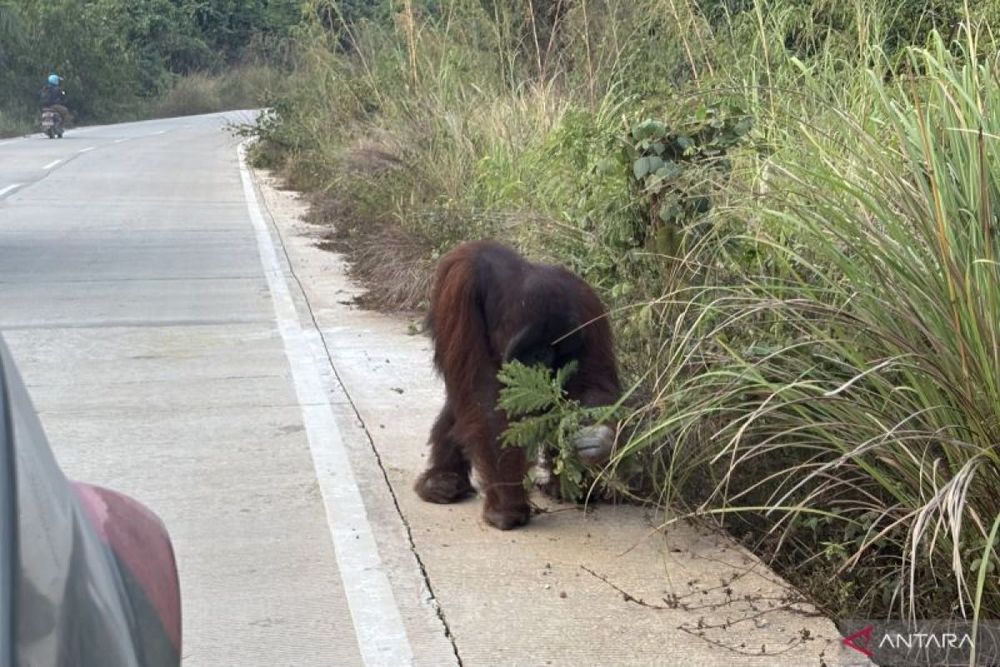
Critically endangered orangutan seen foraging near East Kalimantan highway, raising traffic safety concerns
A Bornean orangutan has been observed foraging along the Sangatta-Rantau Pulung road in East Kutai District, East Kalimantan, on three separate occasions, raising concerns about traffic risks to the critically endangered species.
Local resident Yuristio, who frequently travels the road, reported the repeated sightings on Monday. "I've seen orangutans there almost three times. Sometimes they stay by the roadside, and sometimes they cross the road," he said in Sangatta.
The protected primate, scientifically known as Pongo pygmaeus, was observed eating seeds and young leaves along the roadside. The Bornean orangutan was up-listed from Endangered to Critically Endangered by the International Union for Conservation of Nature in July 2016, with current populations estimated at only 104,700 individuals, down from approximately 230,000 a decade ago.
Road adjacent to major orangutan habitat
The Sangatta-Rantau Pulung road runs adjacent to Kutai National Park, which spans approximately 192,709 hectares and is home to an estimated 1,700 orangutans, likely representing East Kalimantan's largest population of Northeast Bornean orangutans. The park faces ongoing threats from forest clearing for agriculture, coal mining, fires, and poaching.
Yuristio noted that the orangutans typically appear along the roadside in the late afternoon, with their large bodies sometimes resembling fallen tree trunks from a distance. The presence of vehicles raises significant concerns about potential collisions with the wild animals.
"Vehicles usually have to stop and wait for the orangutan to cross the road or return to the forest," he said. Such incidents occur frequently in East Kalimantan because roads run near orangutan habitats, and the Natural Resources Conservation Agency has previously asked motorists to give way to orangutans crossing roads.
An ANTARA team traveling along the Sangatta-Rantau Pulung road on Monday afternoon observed a large reddish-brown Bornean orangutan that remained beside the road for more than 30 minutes, eating young leaves before returning to the forest.
Broader population crisis
The sightings come amid a broader crisis affecting orangutan populations across Kalimantan. Between 1999 and 2015, the orangutan population across Borneo decreased by more than 100,000 individuals. Currently, approximately 57,350 Bornean orangutans live in forests fragmented by industrial concessions, with nearly 80 percent residing outside protected areas, making encounters with human development more likely.
Recent wildfires have compounded the threats facing orangutans in the region. Environmental organization Geopix reported that wildfires have impacted approximately 60 percent of Bornean orangutan habitat, with 17,865 wildfire hotspots detected inside orangutan habitat areas between June 1 and August 28, 2026. These fires can disrupt fruit tree production and force orangutans to seek food in villages and farms, increasing human-wildlife conflict.
The species' extremely slow reproductive rate makes population recovery particularly challenging. Female orangutans typically give birth once every seven to eight years, slower than any other primate, meaning that each individual lost to traffic accidents or other threats has significant long-term impacts on population viability.