
Yokogawa Opens Regional Cyber Resilience Center in Singapore to Combat Rising OT Security Threats
Yokogawa Engineering Asia establishes the Industrial Cyber Resilience Center in Singapore to address escalating operational technology cybersecurity challenges across Southeast Asia, Oceania, and Taiwan through training, assessment, and incident response capabilities.

Yokogawa Opens Regional Cyber Resilience Center in Singapore to Combat Rising OT Security Threats
Yokogawa Engineering Asia has opened the Industrial Cyber Resilience Center (ICRC) at its Singapore headquarters, establishing a regional hub dedicated to strengthening operational technology cybersecurity capabilities across Southeast Asia, Oceania, and Taiwan. The facility offers comprehensive training, assessment services, and incident response programs designed to help industrial organizations close critical gaps in their cyber defense posture.
The center's launch comes as the region faces mounting cybersecurity pressures. Southeast Asia recorded more than 135,274 ransomware attacks in 2024 alone, representing 67% of all regional cyber incidents that year and marking the highest concentration of cybersecurity challenges ever documented in ASEAN markets. Industrial cybersecurity reports from 2025 showed a 46% increase in ransomware attempts against industrial operators in a single quarter, with three new threat groups emerging specifically to target operational technology and industrial control system environments.
The operational technology security market reflects this urgency, projected to grow from USD 27.39 billion in 2026 to USD 58.94 billion by 2031, representing a compound annual growth rate of 16.6%. This expansion is driven by escalating ransomware attacks, industrial espionage, and the convergence of information technology and operational technology systems.
AI Accelerates Attack Capabilities
Cyber adversaries are increasingly leveraging artificial intelligence to identify vulnerabilities and execute attacks with unprecedented speed and scale. IBM's 2026 X-Force Threat Intelligence Index documented a 44% increase in attacks exploiting public-facing applications, with AI tools enabling attackers to weaponize vulnerabilities faster than organizations can deploy protective patches. An International AI Safety Report documented a threat actor using AI models in November 2025 to automate 80-90% of a cyber intrusion, limiting human involvement to critical decision points only.
The 2026 Dragos OT Cybersecurity Report revealed that adversaries have evolved beyond simple pre-positioning tactics to actively mapping control loops and understanding how to manipulate physical industrial processes, with most organizations lacking the visibility needed to detect these threats before operational impact occurs.
Legacy Systems Create Vulnerabilities
Many industrial organizations continue operating legacy operational technology systems designed decades ago for isolated environments without internet connectivity. These systems lack modern security controls such as encryption, authentication, and patch management capabilities, creating significant vulnerabilities when connected to corporate IT networks. The convergence of IT and OT environments presents distinct challenges that traditional IT-centric response procedures were not designed to address, particularly regarding safety, availability, and operational continuity requirements.
A 2026 survey of over 600 global industrial cybersecurity leaders revealed a striking disconnect between perception and reality. While 88% described their OT cybersecurity programs as mature, only 21% reported having a complete inventory of their OT assets. Industrial organizations experienced an average of 16.2 hours of downtime from their most significant cybersecurity incidents in 2026, resulting in losses reaching up to $500,000 per hour.
Structured Framework for Resilience
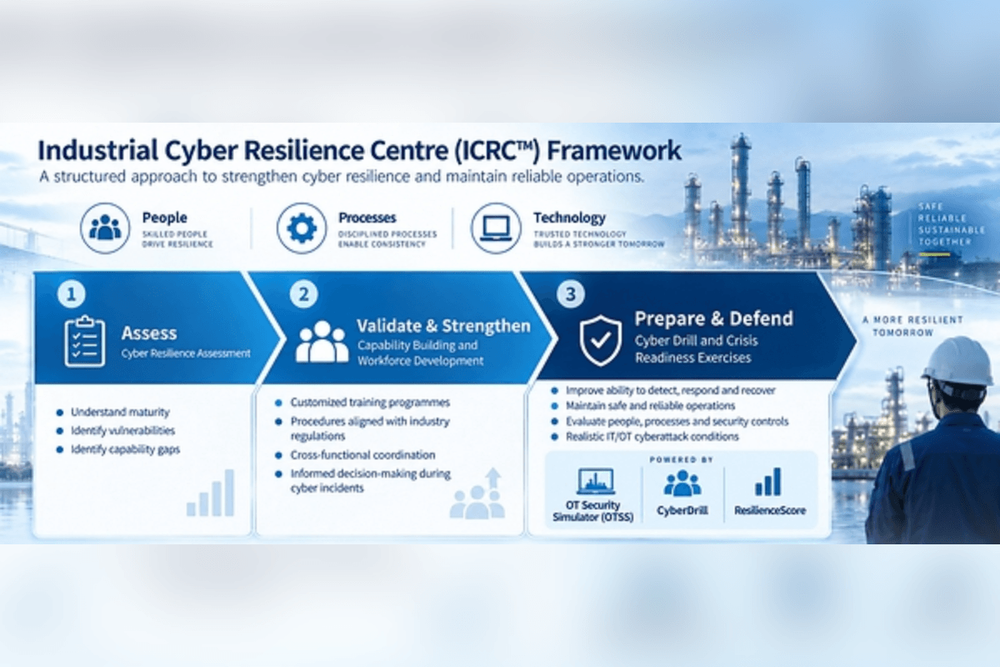
The ICRC addresses these challenges through a three-phase framework combining assessment, capability building, and crisis readiness. The center begins with cyber resilience assessments to identify maturity levels, vulnerabilities, and capability gaps. Organizations then participate in customized training programs designed to develop workforce competencies, establish procedures aligned with industry regulations, and enhance cross-functional coordination for informed decision-making during cyber incidents.
The final phase employs cyber drill and crisis readiness exercises using Yokogawa's OT Security Simulator, cyber drill scenarios, and ResilienceScore solutions to strengthen organizations' ability to detect, respond to, and recover from cyber incidents while maintaining safe and reliable operations.
"With the launch of the ICRC, Yokogawa is reinforcing its commitment to helping customers navigate an increasingly complex cybersecurity landscape. Through the center, we are investing in both advanced capabilities and workforce development to strengthen resilience across IT and OT environments. Our goal is to help organizations build cyber resilience, enabling them to operate securely and innovate with confidence."
Chay Kin Wah, President and CEO of Yokogawa Engineering Asia, emphasized the company's commitment to the region.
The Singapore location builds on Yokogawa's established regional presence. The company established its Singapore office as regional headquarters in 1974, and the facility now serves multiple strategic functions including manufacturing of Distributed Control & Safety Systems and operations as a Global Engineering Centre overseeing multinational projects across Southeast Asia, Oceania, and Taiwan.
Beyond Prevention to Response Readiness
Charles Lim, Head of Digital Security Solution at Yokogawa Engineering Asia, emphasized the center's unique focus on operational preparedness.
"A key challenge for many organizations is not the lack of cybersecurity technologies, but the ability to recognize abnormal situations, respond effectively, and recover quickly from an incident. What makes the ICRC unique is its ability to validate organization's preparedness by testing people, processes, and security controls under realistic cyber-physical conditions."
Unlike IT environments, OT cyber incidents require decision-making that accounts for safety considerations, production continuity, and asset integrity. The center's approach recognizes that cyber resilience extends beyond individual organizations to encompass coordination across stakeholders, supply chains, and interconnected operational networks.
Founded in Tokyo in 1915, Yokogawa provides measurement, control, and information solutions across energy, chemicals, materials, pharmaceuticals, and food industries. The company operates through a global network of 136 companies spanning 63 countries with more than 18,000 employees worldwide.