
Indonesia's Creative Economy Contributes $90 Billion to GDP, Employs 27.4 Million Workers
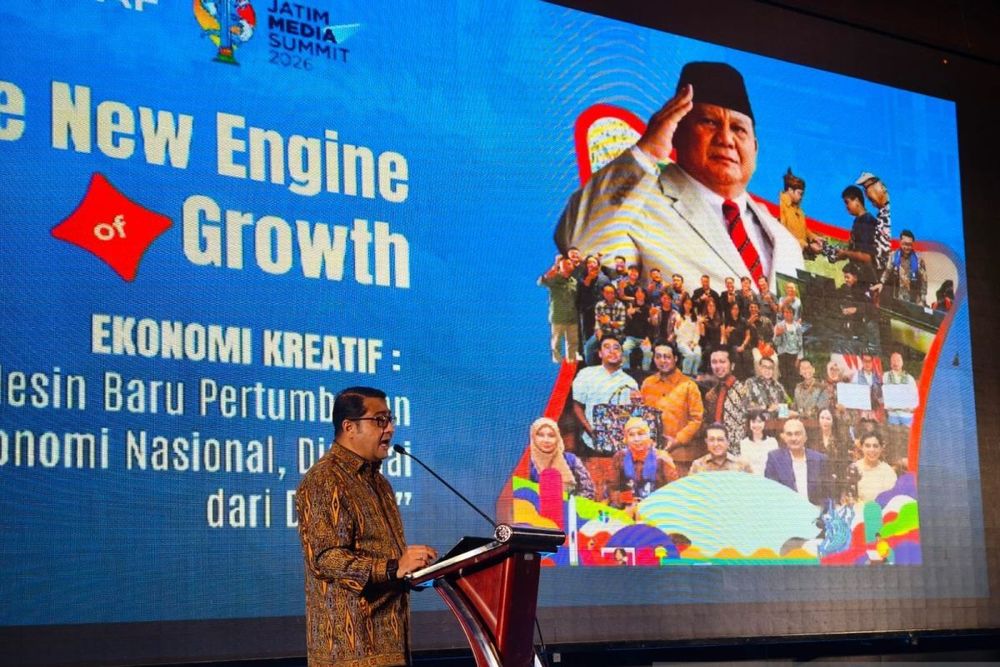
Indonesia's creative economy drives national growth with $90 billion GDP contribution
Indonesia's creative economy has become a central pillar of national economic growth, contributing more than Rp 1,500 trillion (approximately $90 billion) or around 7 percent to the country's GDP while employing 27.4 million people—representing 18.7 percent of the national workforce.
Creative Economy Minister Teuku Riefky Harsya emphasized this transformation at the 2026 East Java Media Summit in Surabaya on Thursday, describing the sector as a critical engine for creating quality jobs and enhancing the competitiveness of Indonesian products in global markets.
If culture is the foundation, then applying innovation, technology, and creativity to its outputs gives birth to the creative economy
Harsya said, addressing the strategic importance of the sector established as a standalone ministry in October 2024 under President Prabowo Subianto's administration.
The minister identified East Java as holding significant potential for creative economy development, supported by rich cultural heritage, skilled human resources, and a growing creative ecosystem. The province is part of a vital regional bloc—together with West Java and Central Java, these three provinces account for 57.81 percent of Indonesia's total creative economy workforce.
Focus on quality employment
Harsya stressed that the government's development strategy prioritizes creating high-quality jobs requiring specialized skills, rather than simply expanding employment numbers. This approach addresses a critical challenge: of Indonesia's 7.47 million unemployed people, approximately 82.6 percent are Gen Z and Millennials.
We want to create high-quality jobs. The word 'quality' is key here because it requires specialized skills
He explained, noting that more than 50 percent of creative economy workers are already under 40 years old.
The minister warned that without this quality focus, creative economy businesses risk remaining confined to the micro, small, and medium enterprise level. To prevent this, he called for capacity building through mastery of digital technology and artificial intelligence to boost productivity, innovation, and competitiveness.
Investment surge and export growth
The creative economy sector has attracted substantial investment, reaching Rp 183.01 trillion (approximately $10.1 billion) in 2025—a 32.23 percent increase from Rp 138.4 trillion the previous year and nearly double the Rp 89.37 trillion recorded in 2023. Investment in the first half of 2025 alone reached Rp 90.1 trillion ($5.4 billion), with Singapore, Hong Kong, South Korea, the United States, and China emerging as the top five sources.
Export performance has been equally robust, with creative economy products generating $26.68 billion in January-October 2025, representing 11.96 percent of Indonesia's non-oil and gas exports. Fashion led the way at $14.86 billion, followed by crafts at $11.10 billion, demonstrating the sector's capacity for international competitiveness.
Downstreaming and digital integration
Beyond enhancing human resource skills, Harsya advocated for downstreaming in the creative industry by strengthening local products to reduce foreign dominance in the domestic market. He emphasized that Indonesia's creative economy—comprising 17 subsectors including culinary, fashion, crafts, architecture, design, film, gaming, advertising, publishing, performing arts, and cultural heritage—possesses enormous potential requiring coordinated support.
The minister expressed confidence that strengthening the creative economy ecosystem through upskilling, digital technology integration, and product downstreaming will support sustainable national economic growth while enhancing Indonesia's added value and competitiveness in global markets.
Government data shows the sector's contribution has grown consistently, from Rp 1,611.2 trillion (7.28 percent of GDP) in 2024 to more than Rp 1,500 trillion in 2025, underscoring its expanding role in the national economy.