
Indonesia's 2045 ambitions must rest on human rights, deputy minister says
Indonesia must put human dignity at the center of its development toward 2045, Deputy Human Rights Minister Mugiyanto Sipin said at a Jakarta dialogue, calling for justice, protection, and prosperity that reach everyone rather than economic progress alone.

Rights in public life and government
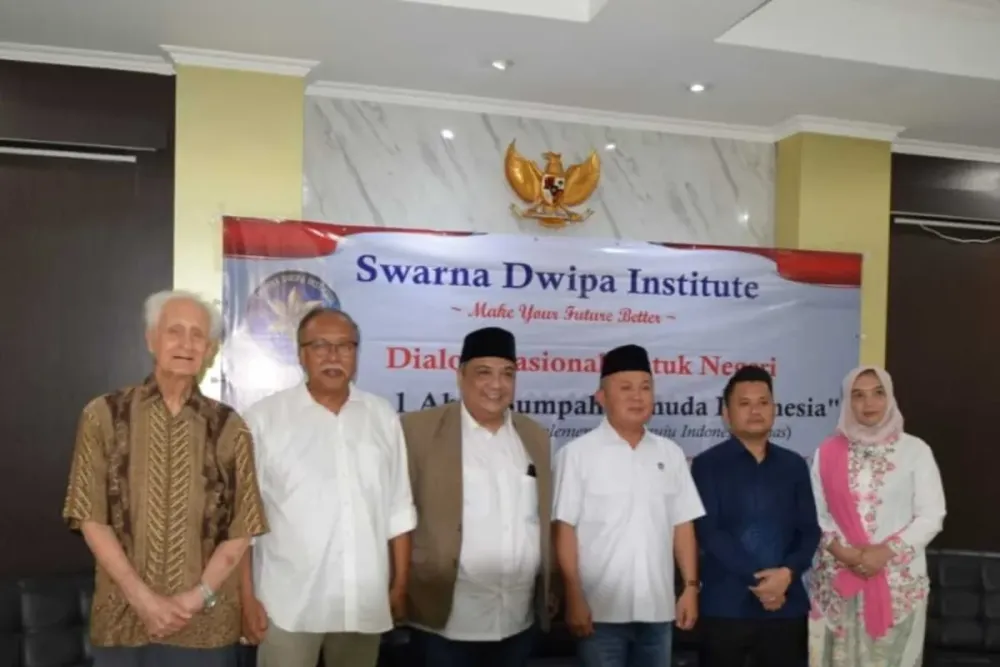
Mugiyanto addressed the National Dialogue Toward One Century of the Youth Pledge on October 31, 2026. The Swarna Dwipa Institute hosted the gathering at Jakarta's Youth Pledge Museum.
"Human rights need to become a living ethic in every environment," he said in a statement released Sunday, November 1. Laws and institutions are not enough, he said; respect for rights must also shape how people behave, how policies are made, and how the state acts.
He urged the public to challenge discrimination, scrutinize those in power, seek justice, and hold government accountable. Indonesia should also help shape international thinking on human rights, he said, while earning credibility through its ideas and accountable practices.
"The world's human rights reference point is not a title we give ourselves. It is trust earned when our thinking deserves to be referenced and our practice can be trusted," Mugiyanto said.
Measuring progress beyond economic growth
The Golden Indonesia 2045 vision is established in Law No. 59/2024 on the 2025–2045 National Long-Term Development Plan, known as the RPJPN. According to the Ministry of National Development Planning, or Bappenas, the plan contains five goals, eight missions, 17 development directions, and 45 key development indicators.
Its targets include bringing per capita income to developed-country levels, placing Indonesia among the world's five largest economies, lowering poverty to 0.5–0.8 percent, and reducing greenhouse gas emissions toward net zero.
At the dialogue, Swarna Dwipa Institute observer Febby Lintang argued that economic growth, per capita income, and technological mastery alone would not adequately measure success. Micro-level measures should also capture the treatment of vulnerable groups, including women, children, and people with disabilities, as well as equal access to education, public facilities, and jobs.
The economic ambition also carries substantial growth requirements. In a Selected Issues Paper published in February 2026, using information available as of December 16, 2025, the IMF estimated that reaching high-income status by 2045 would require real GDP growth of about 5.5–6.5 percent a year over two decades. It estimated that scaling up public investment efficiently could close about one-third of the long-run income gap relative to the high-income benchmark.
Social justice, oversight, and shared welfare
Academic Frans Magnis-Suseno linked the ideals of independence to social justice and the fight against corruption. Development would have little meaning unless prosperity reached every part of society, he warned.
Magnis-Suseno said national unity must take practical form through the social justice enshrined in Pancasila's fifth principle. He described corruption as a serious threat to public trust and the country's future, and urged representative institutions to oversee government and defend the interests of farmers, fishermen, laborers, and poorer groups.
Warsito Ellwein of Agenda 45 said nationalism begins with respecting and protecting Indonesian people. He identified shared welfare, social justice, and environmental sustainability as three priorities for the country's future.
The speakers also included Ulung Rusman of the INTI Association and Slamet Ariyadi, a member of House of Representatives (DPR) Commission III and chairman of BM-PAN. Participants called for unity to be expressed through practical action, cooperation, and attention to public needs. They argued that Golden Indonesia must offer an inclusive, dignified, just, and prosperous life, not merely economic gains.
Six priorities ahead of the Youth Pledge centenary
The Swarna Dwipa Institute outlined six priorities for development toward 2045: stronger unity and tolerance, respect for human rights, equitable social justice, the eradication of corruption, inclusive and sustainable development, and a larger role for young people.
The gathering's theme was "Toward One Century of the Youth Pledge: Thinking, Spirit, and Implementation Toward Golden Indonesia." Its name refers to Sumpah Pemuda, the pledge of one homeland, one nation, and one language made at the Second Youth Congress on October 27–28, 1928.
The pledge is commemorated each October 28. The 2026 observance marked its 98th anniversary, ahead of the centenary in 2028.