
Activists Demand National Emergency Declaration as Femicide Crisis Deepens in Indonesia
Women's rights organizations are calling on the Indonesian government to declare femicide a national emergency after at least 239 women were killed in 2025, part of a broader crisis of gender-based violence affecting over 376,000 women.

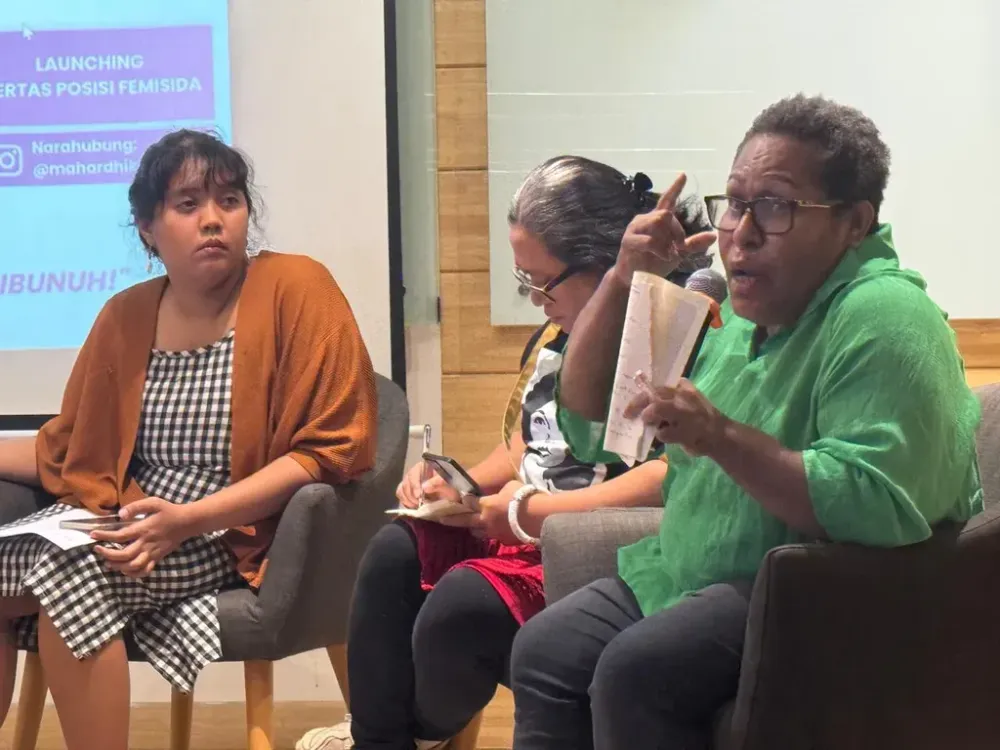
Government Urged to Declare Femicide as a National Emergency
Women's rights activists have issued an urgent call for the Indonesian government to declare femicide a national emergency, warning that gender-based hate crimes have reached a critical threshold that demands immediate state intervention.
The Mahardhika National Women's Committee delivered the demand at a press conference in Jakarta on Tuesday, October 20, 2026, during the launch of a position paper evaluating two years of the Prabowo Subianto-Gibran Rakabuming administration.
"One woman was murdered simply because she was a woman. We should be angry as a nation; as one country, we must be outraged. We demand that the government immediately declare femicide as a national emergency."
Mutiara Ika, Coordinator of the Political Department at the Mahardhika National Women's Committee, made this statement emphasizing the urgency of the situation.
The National Commission on Violence Against Women recorded at least 239 cases of murder against women in Indonesia throughout 2025. Documentation from the Jakarta Feminist organization reveals an even starker picture: 230 femicide victims in 2025, including 31 underage girls, representing an increase from 209 cases in 2024. On average, one woman is killed every two days.
These killings occur within a broader context of escalating violence. Komnas Perempuan's 2025 annual report documented 376,529 cases of gender-based violence against women throughout the year, representing a 14.07 percent increase compared to the previous year. Sexual violence was the most prevalent form with 22,848 cases, followed by psychological violence at 15,727 cases, physical violence at 14,126 cases, and economic violence at 5,942 cases. Women aged 18-24 showed the highest vulnerability.
A Global Crisis with Regional Dimensions
Indonesia's femicide crisis mirrors global patterns. According to UN Women and the UN Office on Drugs and Crime, approximately 50,000 women and girls were killed by intimate partners or family members globally in 2024, representing 60 percent of all intentional killings of women and girls. This translates to an average of 137 women and girls killed every day, or one every 10 minutes.
In Asia specifically, 17,400 women and girls were killed by intimate partners or family members in 2024, with a rate of 0.7 victims per 100,000 female population. While lower than the global average, this still represents thousands of deaths across the region.
Data Gaps and Impunity
Activists criticized the absence of an official state documentation and categorization system for femicide crimes, which they say has hindered effective law enforcement. Despite the passage of Indonesia's Sexual Violence Crime Law in 2022—the country's first dedicated legislation addressing sexual violence—implementation remains inadequate.
The law recognizes nine forms of sexual violence including physical and non-physical sexual abuse, forced contraception, forced sterilization, forced marriage, sexual torture, sexual exploitation, sexual slavery, and online sexual violence. Article 15 provides for additional penalties when sexual violence results in the victim's death, yet activists say this provision is rarely applied.
Impunity remains widespread, including for perpetrators within security forces. Cases highlighted include the murder of Elis Agustina Yotha in Papua, who was doused and set on fire by her husband, a member of the Indonesian Air Force. Another case involved the death of Mira, a transgender woman, after being set on fire by a mob in North Jakarta in 2020.
"Data on the murder of women now employs militaristic methods, ranging from burning to mutilation."
Shakur, a member of the Political Department of the Mahardhika National Women's Committee, noted that the difficulty in obtaining comprehensive data reflects how the state system tends to minimize the femicide phenomenon.
Legal Framework Under Scrutiny
The position paper strongly criticized Indonesia's new Criminal Code, which took effect on January 2, 2026. The code criminalizes consensual sex outside marriage with up to one year imprisonment and cohabitation outside marriage with up to six months imprisonment. These are complaint-based offenses that can only be prosecuted if a spouse, parent, or child files a complaint.
"This article is heavily laden with patriarchal norms that control women's bodies. Provisions like this place citizens' sexuality under the surveillance of the state and family."
Afifah, Chairperson of the Mahardhika National Women's Committee, made this statement criticizing the new legal provisions.
At the regional level, Komnas Perempuan has documented 192 discriminatory regional regulations. Activists also pointed to Presidential Regulation No. 111 of 2025, which classifies the "spread of LGBT culture" as a non-military threat to national security alongside separatism and terrorism. Human Rights Watch documented at least six national laws and more than 45 anti-LGBT regional regulations that discriminate based on sexual orientation or gender identity.
Regulations in cities like Bogor have been used to restrict employment access for vulnerable groups and people with diverse gender identities, activists said.
Economic Pressures and Structural Violence
Economic vulnerability compounds the crisis. The Ministry of Manpower recorded approximately 88,000 workers affected by layoffs throughout 2025, with the majority being female workers in labor-intensive sectors.
During a discussion session following the press conference, participants highlighted cases of women ending their lives due to economic pressure, domestic violence, and debt traps. They argued that suicides triggered by systemic factors such as state-created poverty, heavy social reproductive burdens, and domestic violence should be categorized as a form of femicide.
"Many mothers are unable to bear seeing their children starving or trapped in online loan debts, leading them to end their lives. This is triggered by conditions that are systematically created, namely being impoverished and rendered powerless by the state."
Colonial Legacies and Structural Roots
Speakers at the discussion emphasized that femicide does not occur in isolation but represents the legacy of colonialism utilized by the state to maintain control, support capitalist development, and reinforce militarism.
Lini Zurlia from Asia Justice and Rights stressed that femicide must be analyzed in structural, institutional, and intersectional terms rather than as simple interpersonal violence.
"The assault on women's bodies is carried out through political, economic, cultural systems, and the brutal production of knowledge. Although the colonizers have departed, the character of colonialism is reproduced by modern states to maintain the concept of development based on economic growth."
Esther Haluk, a writer and feminist from Papua, emphasized that violence against indigenous women in Papua cannot be viewed merely as ordinary gender-based violence.
"The destruction and removal of indigenous women in Papua occur in the context of development and control over customary lands."
She noted that addressing femicide in Papua requires dismantling structural root causes and resolving practices of impunity.
Nurina Savitri from Amnesty International Indonesia highlighted the connection between militarism and femicide.
"As long as militarism is present and dominates in a country, femicide will persist. Past violence, such as that experienced by Gerwani in 1965, demonstrates how violence against women has been used as a tool of control that has never been fully resolved to this day."
Dian Septi of Marsinah.id called for building structured movement platforms such as feminist labor unions to challenge the system of oppression from the grassroots level.
"The state and economic-political policies have not positioned women as subjects, but rather employ a violent approach to maintain control. This then results in violence that is reproduced daily and systematically."