
Indonesia vows to block transnational crime networks amid rising regional drug trafficking
Coordinating Minister warns Indonesia will not serve as transit hub for illegal goods following major ketamine seizure in Riau Islands, emphasizing need for stronger maritime surveillance and international cooperation to dismantle smuggling networks.
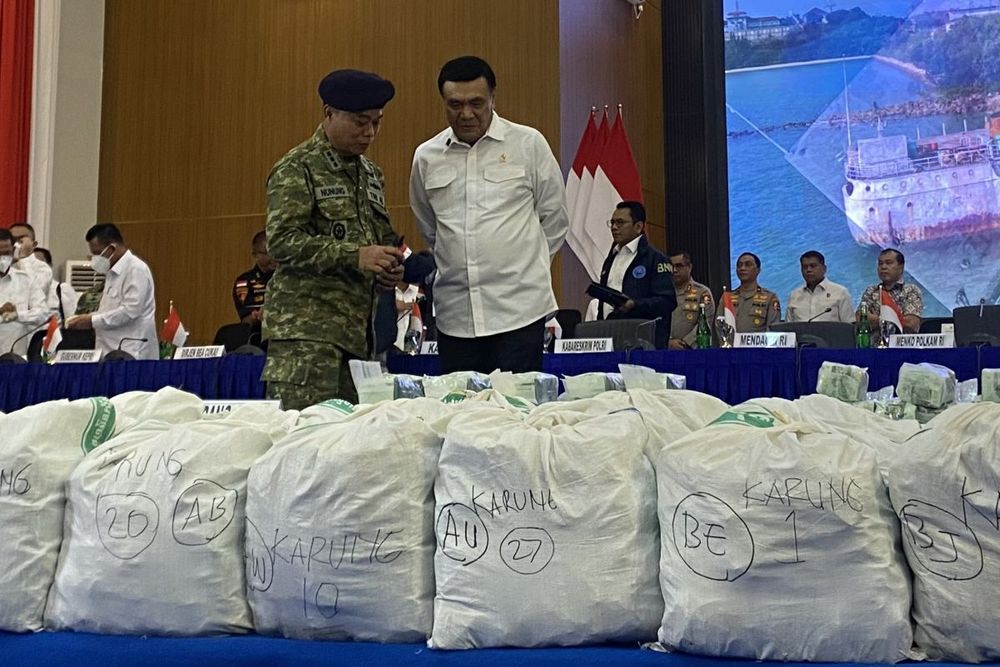
Indonesia warns against becoming hub for transnational crime
Indonesia has declared it will not tolerate serving as a transit hub, storage depot, or destination market for illegal goods entering through transnational crime networks, Coordinating Minister for Political and Security Affairs Djamari Chaniago announced following the destruction of 1.3 tons of illicit ketamine seized in a major maritime interdiction operation.
Speaking at the Batam IV Naval Regional Command Headquarters in the Riau Islands on Wednesday, the minister emphasized the government's determination to prevent criminal exploitation of Indonesia's extensive maritime borders.
This sends a message to all parties that Indonesia must not become a transit point, storage depot or market for transnational crime.
The seizure comes as Indonesia faces mounting pressure from international drug trafficking networks. As the world's largest archipelago with more than 17,000 islands and the world's second-longest coastline, the country presents significant surveillance challenges. Indonesia shares 2,019 kilometers of land boundaries with Malaysia, Timor Leste, and Papua New Guinea, alongside maritime borders with six countries.
The minister acknowledged that Indonesia's vast number of entry points requires continuous strengthening of maritime surveillance, particularly in strategic border areas such as the Riau Islands. Indonesian National Police data identifies Batam, Karimun, Tanjungpinang, and Anambas as the top four drug-prone areas in the province, with 129 drug-prone zones recorded, including 97 alert areas and 32 danger areas.
We understand that there are many entry points for illegal goods into Indonesia. What has been uncovered is only one route. Therefore, everyone must remain vigilant.
Focus on Dismantling International Networks
The minister stressed that success should not be measured merely by the volume of contraband confiscated, but by law enforcement's ability to identify and dismantle the international criminal networks behind the smuggling operations.
This disclosure is not just about the amount of evidence seized. What is far more important is the state's ability to detect, stop and dismantle the international network smuggling illegal goods.
Indonesia's geographical proximity to the Golden Triangle and Golden Crescent regions—the world's largest narcotics-producing areas—makes it particularly vulnerable to drug trafficking. International distribution routes frequently utilize Southeast Asian waters, including the Strait of Malacca, with maritime corridors linking Malaysia, Indonesia, and the Philippines becoming increasingly significant for smuggling operations.
The 1.3-ton ketamine seizure represents a substantial portion of regional trafficking activity. Recent UN Office on Drugs and Crime reports indicate that East and Southeast Asian countries reported ketamine seizures totaling 23.3 tons in 2023, with evidence suggesting an increase in trafficking from Europe to the region driven by rising supply and persistent Asian demand.
Record Enforcement Efforts
The Riau Islands have emerged as a critical frontline in Indonesia's counter-narcotics efforts. In June 2025, authorities conducted the country's largest-ever drug seizure when they intercepted 2 tons of methamphetamine off the coast of Riau Islands, with an estimated street value between US$200 million and US$400 million.
Nationally, Indonesia's National Narcotics Agency has seized more than 12.3 tons of narcotics between October 2024 and July 2026, preventing an estimated 48.3 million people from potential exposure and halting approximately Rp16.5 trillion (about US$896 million) in potential illicit economic activity.
Navy Chief of Staff Admiral Muhammad Ali, who attended Wednesday's event, highlighted the vital role of inter-agency cooperation in protecting Indonesia's territorial waters from maritime crime and smuggling. He said joint maritime law enforcement operations had disrupted various illicit activities throughout 2026, including trafficking of contraband and natural resources, preventing an estimated Rp12.4 trillion (US$790 million) in economic losses.
This is the result of synergy and collaboration between agencies in combating crime and smuggling through maritime routes.
The enforcement efforts come amid unprecedented levels of synthetic drug production in the region. East and Southeast Asian governments seized 236 tons of methamphetamine in 2024, representing record trafficking volumes from the Golden Triangle, particularly Myanmar's Shan State.
Indonesian National Police data shows narcotics cases ranked as the second-highest transnational crime category by victim count, with 5,016 victims in 2023 and 5,703 victims in 2024, following electronic data manipulation crimes.