
Indonesia Calls for Fixed Maritime Borders Despite Rising Sea Levels at UN Meeting
Indonesian Foreign Minister Sugiono urged the international community to maintain legally established maritime boundaries despite climate-driven sea-level rise, speaking at a UN high-level meeting that approved a declaration on the existential threat posed by rising oceans.

Indonesia Calls for Fixed Maritime Borders Despite Rising Sea Levels at UN Meeting
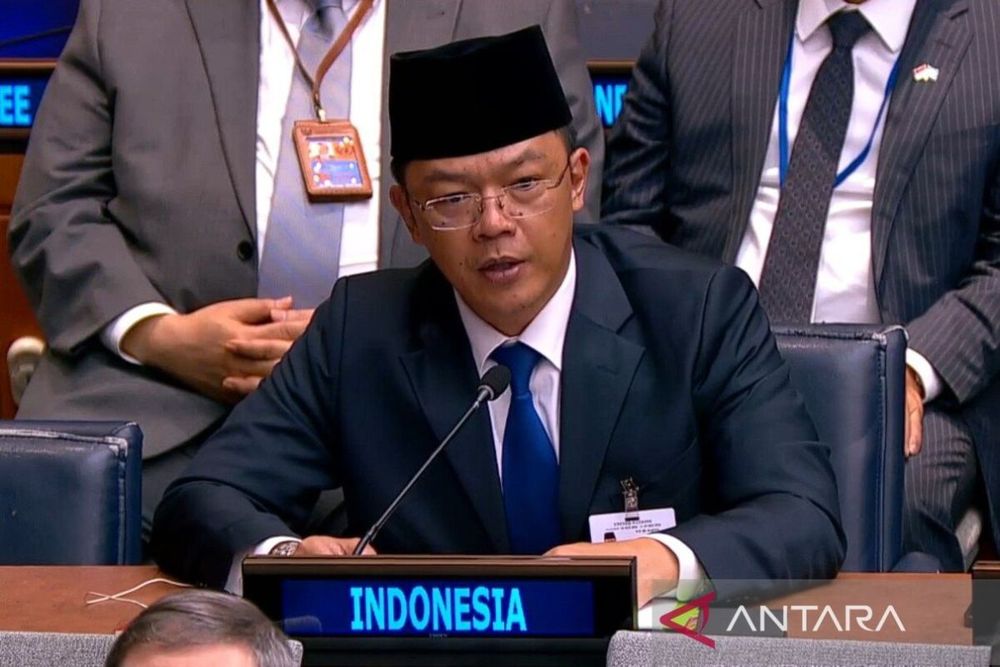
Indonesian Foreign Minister Sugiono has called on the international community to ensure that rising sea levels do not undermine legally established maritime boundaries, warning that climate change must not create legal uncertainty over national territorial waters.
Addressing the UN High-Level Meeting on Addressing the Existential Threats Posed by Sea-Level Rise in New York on Thursday, Sugiono emphasized that the United Nations Convention on the Law of the Sea (UNCLOS) must remain the definitive legal framework for maritime governance. The meeting approved a Declaration on Sea Level Rise, which will be sent to the General Assembly for formal adoption, emphasizing the need for knowledge-based adaptation measures to protect livelihoods and ensure legal certainty.
Changes caused by sea-level rise should not diminish lawfully established state baselines, maritime entitlements, and outer limits
Sugiono stated. He urged consistent application of UNCLOS and customary international law, aligned with interpretations by the International Court of Justice and the International Tribunal for the Law of the Sea.
The urgency of the issue was underscored by UN Secretary-General António Guterres, who reported that global sea levels rose by six millimeters in 2024, the highest annual increase ever recorded. For Indonesia, the threat is even more acute, with mean sea levels in Indonesian waters rising at 4.6 millimeters per year, exceeding the global average.
Archipelagic Nation Under Threat
As the world's largest archipelagic state, comprising approximately 17,500 islands scattered across the Indo-Pacific, Indonesia faces unique vulnerabilities to rising seas. Sugiono emphasized that the ocean is inseparable from the nation's identity, economy, and future.
Indonesia understands this reality. The sea is inseparable from our identity, our economy, and our future.
The stakes are considerable. Projections suggest that by 2050, Indonesia could lose approximately 2,000 small islands, with up to 5.9 million people potentially affected by annual coastal flooding by 2100. The minister warned that sea-level rise poses profound threats to coastal communities, causing loss of homes, disrupted livelihoods, and broad risks to public safety.
Our task now is to work together in ensuring that rising seas do not take away what generations have built and what future generations deserve
Sugiono said.
Domestic Mitigation Efforts
Indonesia has launched several initiatives to address coastal vulnerability. The government has rehabilitated over 13,000 hectares of mangrove forests under a coastal resilience program, an effort made more critical by the loss of more than 40 percent of the country's mangrove forests since 1980, despite Indonesia being home to the largest area of mangrove forest on Earth.
The centerpiece of Indonesia's coastal defense strategy is the Giant Sea Wall, a massive infrastructure project planned to stretch approximately 500 to 700 kilometers along Java's northern coast from Banten to Gresik. With an estimated cost of $80 billion and an expected construction timeline of 20 years, the project is targeted to commence in early 2027. The wall is expected to protect around 50 million people and safeguard areas contributing approximately 38 percent of Indonesia's gross domestic product.
International Legal Precedent
Indonesia's position on maintaining fixed maritime boundaries finds support in recent international legal developments. In 2025, the International Court of Justice clarified in an Advisory Opinion on climate change that UNCLOS imposes no obligation on states to update coastal baseline coordinates or maritime limits after baselines have been duly established, even as sea levels rise.
This position aligns with a landmark declaration issued by the Pacific Islands Forum on August 6, 2021, which stated that once maritime zones are lawfully established, Pacific Island States intend to maintain these zones without reduction, notwithstanding climate change-related sea-level rise.
Call for Global Action
Sugiono emphasized that effective mitigation measures must be grounded in science and accurate data, enabling governments to make informed decisions, develop resilient early warning systems, and provide stronger protections for vulnerable populations.
He called for accessible, adequate, and sustainable financing, along with technology transfers and capacity-building support for developing nations to ensure global climate resilience.
Resilience must go further. It must protect ecosystems, secure livelihoods, and create more economic opportunities.
Sugiono concluded.