
State Grid Shanghai Releases Urban Biodiversity Report at COP17
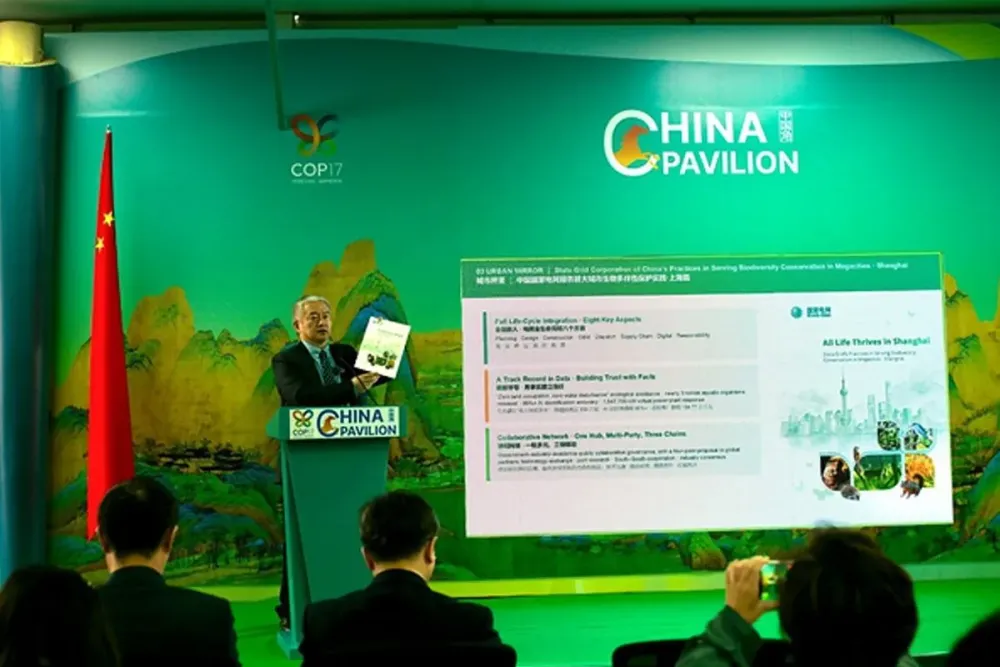
State Grid Shanghai Municipal Electric Power Company presented its approach to protecting biodiversity across the city's power network at COP17 in Yerevan, Armenia, releasing a report on Oct. 29 at a China Corner side event.

Power infrastructure in a major bird habitat
The report, "All Life Thrives in Shanghai: State Grid's Biodiversity Conservation Practices in Megacities • Shanghai," examines how an energy infrastructure company addresses conservation in a densely populated city.
Shanghai occupies a central position on the East Asian-Australasian Flyway. Its recorded wild bird population includes 534 species, roughly a third of the total recorded in China. The city's power grid serves more than 24 million people, and its main-grid transmission network extends over 5,800 kilometers, with substantial overlap with 6,335 square kilometers of identified wetlands.
State Grid Shanghai frames the need to protect those habitats while maintaining energy security as a challenge shared by high-density cities worldwide.
Conservation across the grid's life cycle
Rather than treating biodiversity solely as an environmental impact assessment requirement, the report describes incorporating it into management throughout the grid's life cycle. Its scope runs from planning and design through construction, operation and maintenance, and power dispatch. It also addresses materials, supply chains, digital tools and corporate responsibility.
The practices described include keeping planned infrastructure outside ecological redlines, restoring aquatic ecosystems during construction, protecting migratory bird habitats while the grid operates, and using green dispatch to support low-carbon electricity consumption.
The report sets out a collaborative mechanism named "One Hub with Multi-Party Driven by Three Chains." The company presents that mechanism as part of the shift toward routine biodiversity management and says the report offers a Chinese approach that other high-density cities can plan, implement and replicate.
The COP17 setting
The launch took place at "Cross-Sector Coexistence: Diverse Narratives Inspire Biodiversity Action," a China Corner side event hosted by the Center for Environmental Education and Communications of the Ministry of Ecology and Environment. Participants came from government, business, academia, the arts, social organizations and the public.
COP17, the 17th Meeting of the Conference of the Parties to the Convention on Biological Diversity, brought the first global stocktake of collective progress under the Kunming-Montreal Global Biodiversity Framework. Adopted in 2022, the framework had reached the halfway point to its 2030 targets.
The conference followed a UN report finding that progress was lagging on 22 of the 23 global nature targets for 2030, according to Carbon Brief. That report warned that the targets and the framework's mission would not be achieved without a rapid acceleration in collective implementation.
The same China Corner event also saw the release of the "Biodiversity Conservation Report Series of Chinese Enterprises," according to a PRNewswire release carried by Yonhap News Agency. The series featured State Grid Corporation of China as a representative case of efforts to bring power grid development into line with biodiversity conservation.
State Grid's wider conservation programs
State Grid's broader biodiversity work centers on three public welfare programs, according to press releases carried by Yonhap News Agency and AAP News. One, "Birds' Guardian Grid," also known as "Migratory Bird Lifeline," operates across 24 provinces and more than 40 major migratory bird habitats. Its reach includes all four of China's migratory flyways, and the releases report that more than 16,000 birds have been rescued and protected through the program.
A second program, "Nests of Life," also called "Life Nests," maintains an individual record for each artificial nest under its "one nest, one file" system. Starting in Sanjiangyuan, it has expanded to plateau grasslands in six provincial-level regions. In Qinghai Province's Sanjiangyuan region, the program has installed 6,053 artificial nests and recorded more than 3,100 successful nestings. The releases credit it with increasing the number of bird species in the reserve from 61 to 111.
The third program, "Green Power Ark," also called "Green Ark," supplies remote habitats with zero-carbon electricity through microgrids combining wind, solar and energy storage. It now reaches 17 national-level protected areas in nine provinces.
In Jiangsu, Green Power Ark has established a flagship project spanning land and water habitats. It uses zero-carbon electricity to monitor milu deer in Yancheng and Yangtze finless porpoises in Zhenjiang without disturbing the animals.