
Indonesia strengthens irrigation and farm risk planning to protect rice supplies
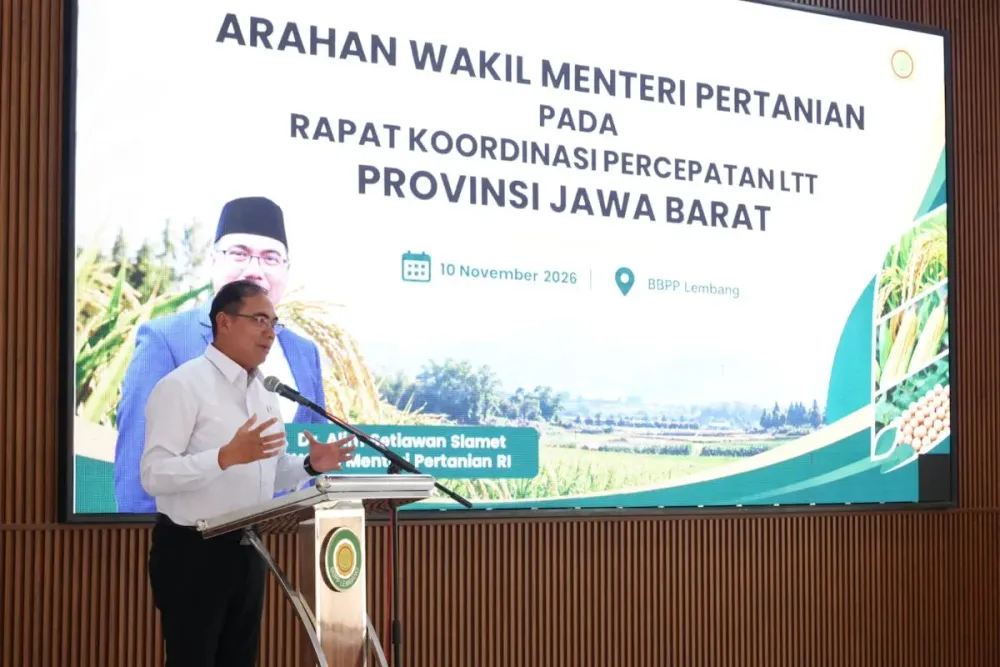
Indonesia is seeking to protect its long-term rice supply by raising farm output, improving irrigation and preparing for disruptions. Deputy Agriculture Minister Alim Setiawan Slamet said the effort must go beyond annual production targets to address climate change and other threats to food security.

Preparing for production disruptions
In a statement confirmed on Monday, Alim identified the conversion of agricultural land and geopolitical developments, alongside climate change, as increasingly complex challenges for farming. He called for closer coordination, technological innovation and greater preparedness to keep production sustainable.
"One key area that must be strengthened is the resilience of our agricultural production system so that it can adapt better to climate change," he said.
Alim said investment in pumps and irrigation needs to be accompanied by measures to reduce risks. Early detection and warning systems should allow authorities to respond quickly with alternative measures before a threat causes more serious damage to production.
Water infrastructure and drought risks
Alim put the expansion of pumping systems and irrigation networks among the priorities, while cautioning that supplying equipment is not enough: water sources also need protection.
An August 13, 2026, ANTARA report described a warning from Indonesia's Meteorology, Climatology and Geophysical Agency (BMKG) that a strengthening El Niño could make the dry season longer and drier in parts of the country. A positive Indian Ocean Dipole could further reduce rainfall from September through December 2026.
According to ANTARA, the Agriculture Ministry's Directorate General of Agricultural Land and Irrigation is preparing about 15,000 pumping irrigation units, 3,000 piped irrigation units and 3,000 water conservation structures. The work is focused on rice-growing centers and areas vulnerable to drought. The ministry is also preparing 56,000 water pumps in 2026 for rice fields that can draw from rivers, reservoirs, dams and irrigation canals.
Record stocks and the production outlook
Agriculture Minister Andi Amran Sulaiman reported rice stocks of 4.56 million tons for October 2026 during a plenary cabinet session with President Prabowo Subianto on October 21. According to the Cabinet Secretariat, he described that volume as a record high. He put national monthly needs at about 2.5 million tons and said supplies would remain sufficient through July 2027.
A separate outlook from the U.S. Department of Agriculture's Foreign Agricultural Service (FAS), dated July 23, 2026, projected declines for the 2026/27 crop year. It forecast a 0.9 percent reduction in Indonesia's harvested paddy area and a 0.6 percent drop in paddy production from 2025/26, with rice imports rising to 500,000 metric tons.
The FAS report also cited Indonesia's Statistics Agency (BPS), which estimated January-August 2026 paddy production at 43.89 million metric tons. That was 0.1 percent above the 43.86 million metric tons estimated for the corresponding period of 2024/25.
Planting preparations and farmer support
Alim said seed supplies must be ready when land preparation is completed to avoid planting delays. He expects the Modern Agriculture–Advanced Agricultural System program to raise seed demand and called for production and distribution arrangements to be made well ahead of planting.
In October 2026, Sulaiman also announced preparations to develop two million hectares of mineral soil land for food production. The first phase would cover 500,000 hectares, with the Agriculture Ministry, Defense Ministry and Indonesian National Defense Forces (TNI) working jointly.
Farmer training and financing are the focus of a separate government partnership with the United Nations. Launched on April 9, 2026, the program, "Leveraging Finance to Scale Up Climate-Resilient Food Systems," runs through 2027. According to the United Nations in Indonesia, it aims to teach climate-smart practices to at least 15,000 farmers in East Java and Lampung and mobilize $150 million from Indonesia's SDG Bond and Green Sukuk for at least 300,000 smallholders.