
Indonesia to deploy aircraft carrier with helicopters for disaster response operations
President Prabowo Subianto announces plans to convert incoming Italian aircraft carrier into mobile helicopter base for firefighting and disaster relief, amid widespread wildfires and recent volcanic eruptions across the archipelago.
Indonesia to deploy aircraft carrier with helicopters for disaster response operations
Indonesian President Prabowo Subianto has announced the government will convert the country's first aircraft carrier into a mobile helicopter platform dedicated to disaster mitigation operations, as the nation grapples with devastating wildfires and volcanic activity.
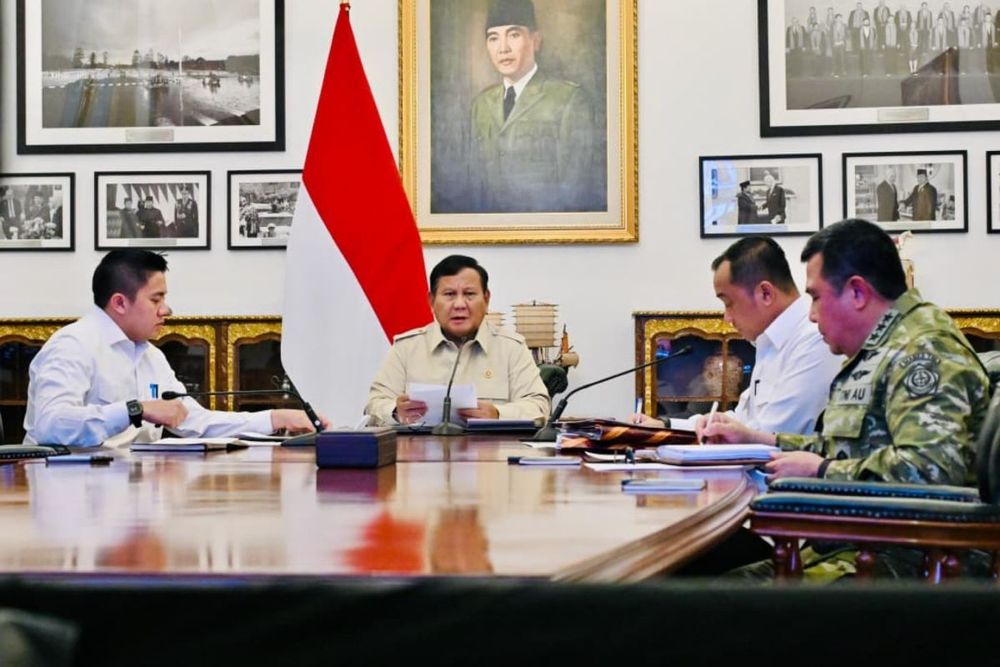
Speaking during a limited cabinet meeting on disaster response held virtually from Merdeka Palace in Jakarta on Monday, Prabowo outlined plans to refurbish ITS Giuseppe Garibaldi, which is currently en route from Italy, to support large-scale helicopter and drone deployment for emergency operations.
Carrier transfer from Italy
The vessel, originally commissioned by the Italian Navy in 1985 and decommissioned on October 1, 2024 after nearly 40 years of service, is being transferred to Indonesia as a donation. Italy opted for the transfer rather than dismantling the carrier, which would have cost nearly €19 million, while maintaining it until transfer required approximately €5 million. The vessel is valued at roughly €54 million.
The carrier departed Taranto, Italy on August 24, 2026 and is expected to arrive in Indonesia between September 15 and 20, with a commissioning ceremony scheduled for September 25 under its new name, KRI Gajah Mada.
Helicopter deployment capacity
Upon customisation, Prabowo said the vessel will carry up to 10 medium-class helicopters for disaster operations. The carrier's technical specifications indicate it can accommodate up to 18 helicopters in various configurations, with a flight deck measuring 174 meters in length and 30.5 meters in width.
We will refurbish the vessel, transforming it into a carrier of helicopters and drones. If we have 10 helicopters, we will be able to immediately reach the areas most saturated by wildfires. This endeavor will substantially strengthen our response.
The president explained the carrier will function as a mobile launching and landing platform for helicopters such as the Black Hawk and MI-17, which can carry four to five metric tons of water for firefighting operations. Indonesia has approved financing of up to $450 million in foreign loans for the carrier acquisition and associated equipment, alongside up to $250 million for transport helicopters and $300 million for utility helicopters.
Wildfire crisis intensifies
The announcement comes as Indonesia battles an unprecedented wildfire crisis. According to the Ministry of Forestry, 202,000 hectares of forests and land had burned across the country as of August 18, 2026, representing a 110 percent increase in affected land from January through June compared to the same period in 2023.
South Sumatra currently faces the most severe situation with 1,429 wildfire hotspots detected by Environment Ministry satellites as of late August, followed by West Kalimantan with 1,226 and Central Kalimantan with 811. Indonesia has already deployed 30 aircraft for cloud-seeding and water-bombing operations over Kalimantan, with another 22 helicopters covering Sumatra as part of ongoing suppression efforts.
Multiple concurrent disasters
Beyond wildfires, the nation is responding to multiple concurrent disasters. Mount Anak Krakatau erupted on the evening of September 5, 2026, ejecting volcanic ash up to 15 kilometers high and forcing the closure of Soekarno-Hatta International Airport. The eruption disrupted thousands of flights, leaving over 270,000 passengers stranded.
Communities in East Nusa Tenggara are still recovering from a magnitude 7.8 earthquake that struck on August 15, 2026, killing at least 129 people, injuring 1,723, and damaging approximately 98,900 homes, with 27,400 collapsed or severely damaged.
Prabowo emphasized the carrier initiative reflects a strategic shift toward proactive disaster preparedness.
We should not wait for a disaster to occur. It is crucial that we take preparatory steps well in advance.
He underscored the government's commitment to enhancing national capacity to respond to the archipelago's frequent natural disasters.