
Indonesia exports Brebes shallots to Thailand following supply surplus
Indonesia has begun exporting shallots from Brebes, Central Java, to Thailand after meeting domestic demand, with national production projected at 1.32 million tons in 2026 against consumption needs of 1.25 million tons.

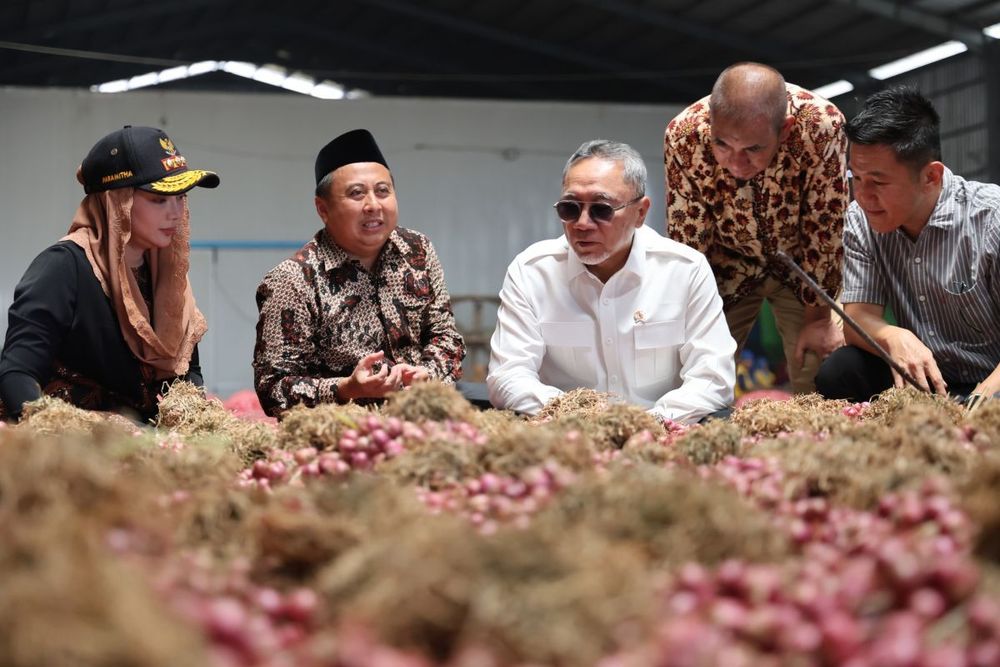
Indonesia exports Brebes shallots to Thailand following supply surplus
Indonesia has expanded shallot exports to Thailand from its key production hub in Brebes, Central Java, following a domestic supply surplus that allows the country to pursue wider international markets while maintaining price stability at home.
Coordinating Minister for Food Zulkifli Hasan announced the development during an inspection of a controlled atmosphere storage facility in Brebes District on Monday, where he oversaw the send-off of shallots bound for Thailand.
"We are grateful that the domestic need for shallots has been met. Now we are pushing for increased production for wider market and better prices, including the export market," Hasan stated.
Brebes District stands as Central Java's dominant shallot producer, accounting for approximately 20 percent of Indonesia's national output and 60 percent of the province's production. In 2023, the regency produced 289,496 tons of shallots, contributing 60.52 percent of Central Java's total output. The province itself represents between 24 and 30 percent of national production, making it Indonesia's most significant shallot production center.
The region maintains annual planting areas ranging from 30,000 to 35,000 hectares, generating between 300,000 and 350,000 tons of shallots each year. This production capacity has enabled Indonesia to serve both domestic and international markets, with Brebes shallots already exported to Vietnam, Malaysia, and Singapore alongside Thailand.
Thailand emerged as the largest importer of Indonesian shallots in 2025, with bilateral trade reaching USD 2.08 million. This established commercial relationship provides a solid foundation for the current export expansion. Indonesia's broader shallot export performance in 2023 saw approximately 9,430 tons valued at USD 11.67 million shipped to global markets.
The controlled atmosphere storage technology deployed at the Brebes facility plays a crucial role in export capability, preserving shallots and other horticultural commodities for three to six months. This extended shelf life enables producers to manage surplus inventory and meet international quality standards required by export markets.
National production projections processed by the National Food Agency indicate Indonesia will produce approximately 1.32 million tons of shallots in 2026, exceeding domestic consumption needs of around 1.25 million tons. The previous year saw production reach 1.43 million tons against consumption of 1.23 million tons, generating sufficient surplus to export 1,560 tons to global markets.
The minister emphasized that export expansion must not compromise domestic supply or price stability, ensuring increased production directly benefits farmers.
"Do not let farmers increase production but there is no demand. Therefore, the government ensures market availability, both domestic and abroad," Hasan stressed.
Shallots hold particular significance in Indonesian cuisine, consumed daily by most Indonesians as a key ingredient in numerous traditional dishes, making them essential household purchases for millions of families. This cultural importance underscores the government's priority on maintaining domestic supply stability before pursuing export opportunities.
The government is strengthening domestic market absorption through the Free Nutritious Meals program, operated by the National Nutrition Agency. Launched in January 2025, the program serves 82.9 million beneficiaries including school children, pregnant women, breastfeeding mothers, and toddlers, with a 2026 budget allocation of Rp268 trillion (US$14.7 billion). Government procurement of farmer-produced shallots for this program helps stabilize the domestic market.
Seed independence and productivity improvements
Beyond market expansion, authorities are implementing measures to enhance seed quality and boost shallot productivity. Indonesia currently depends significantly on imported shallot seeds, with commercial True Shallot Seed varieties used in pilot projects sourced from overseas due to limited domestic production capacity.
The government's seed improvement initiative aligns with Agriculture Policy Act 2017 No. 15, revised in May 2018, which aims to reduce import dependency, ensure quality seed availability, increase genetic diversity, and develop the domestic seed industry. Reducing reliance on imported seeds remains a strategic priority for strengthening the sector's long-term competitiveness.
These productivity and quality enhancement efforts must address ongoing sustainability challenges facing Indonesian shallot farming, including climate change impacts, water scarcity, pest pressures, price fluctuations, and limited access to resources and technology. Addressing these structural issues will determine whether Indonesia can maintain and expand its position in regional and global shallot markets while ensuring farmer prosperity.
The government's integrated approach combines market expansion, domestic demand management through social programs, and agricultural modernization to create a sustainable framework supporting both food security and farmer incomes in Indonesia's critical shallot sector.