
Three Indonesian collections added to UNESCO's Asia-Pacific documentary heritage register
A royal chronicle, a Balinese literary work and a Southeast Asian literary archive were among three Indonesian entries added to the Asia-Pacific Memory of the World register on November 5, 2026. The decision came at the 11th UNESCO Memory of the World Committee for Asia and the Pacific (MoWCAP) General Meeting in Jakarta.

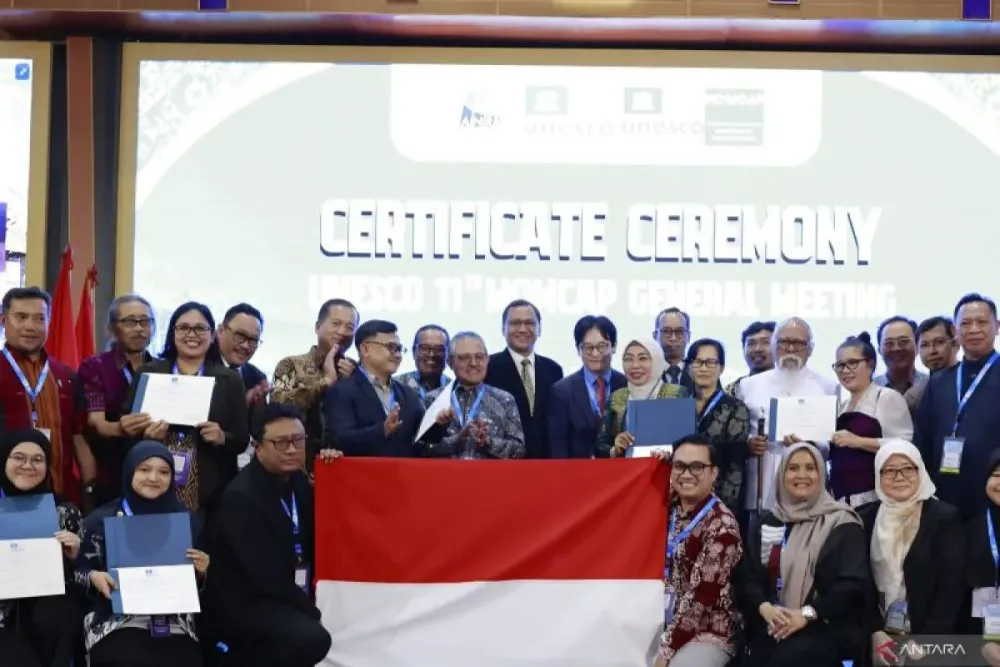
Jakarta meeting registers 21 collections
Indonesia hosted the meeting at the National Archives of the Republic of Indonesia (ANRI) Building. According to ANTARA, delegates registered 21 documentary heritage collections from 10 countries, including Indonesia's Bo' Sangaji Kai, Kidung Bhuwana Wina and the "Southeast Asian Literary Network" archive held by the H.B. Jassin Literary Documentation Center.
ANRI head Mego Pinandito, who also chairs Memory of the World Indonesia, said the recognition reflected Indonesia's commitment to documentary preservation. He said the three entries illuminate the country's history and intellectual traditions, as well as its social and cultural connections with Southeast Asia.
"UNESCO MoWCAP's trust in Indonesia, through ANRI, to host this event is an honor and a form of appreciation for the preservation of documentary heritage in Indonesia," Pinandito said.
Bima's royal chronicle and a proposed classroom role
Bo' Sangaji Kai records the history and governance of the Bima Sultanate, alongside its diplomatic and trading relationships in Southeast Asia. Its accounts address the role of the Sultanah and legal protections for women, and include an authentic record of Mount Tambora's 1815 eruption.
MoWCAP's nomination summary describes the manuscript as the Bima Sultanate's only surviving authentic royal chronicle and its most comprehensive one, covering the 17th through 19th centuries. The summary also identifies it as an indigenous account of the Tambora eruption, which MoWCAP calls the most powerful volcanic eruption in recorded human history.
The recognition has also prompted a proposal for local education. West Nusa Tenggara Governor Lalu Muhamad Iqbal said on November 5 that he wants the manuscript translated into Indonesian and relevant passages included in the regional school curriculum, particularly for the Mbojo cultural community, detikBali reported.
Balinese verse and Southeast Asian literary connections
Kidung Bhuwana Wina recounts political events, diplomacy and resistance to Dutch colonialism from a local perspective involving the kingdoms of Bali and Lombok. ANTARA describes it as the only known traditional Balinese kidung to document those events. The work represents Balinese intellectual, spiritual and literary traditions that remain alive through chanting on Saraswati Day.
MoWCAP's nomination list gives the title as Kidung Bhuwana Wināśa, or "The Song of the Vanished World." It dates the composition to 1918 and names its author as Ida Pedanda Ngurah, a poet and high priest from Griya Gede Belayu in Bali who lived from approximately the 1830s to the 1920s. Eight manuscripts survive in Bali and the Netherlands; two were written by the author himself.
The Indonesian literary archive recognized in Jakarta is the "Southeast Asian Literary Network," part of the H.B. Jassin Literary Documentation Center's modern literature collection. It traces modern literature's development and the intellectual and cultural exchanges among Southeast Asian writers.
According to MoWCAP, the center's collection grew from a personal project begun by literary critic H.B. Jassin in the 1930s into a public library holding about 155,000 items in many languages. The committee describes it as the region's only known collection of Southeast Asian literary materials.
The regional nomination cycle
Beyond selecting entries, the Jakarta meeting allowed member countries to review nominations and report on the Memory of the World program's progress. MoWCAP was established in 1998 as a subsidiary body of the program's International Advisory Committee and reviews regional-register nominations every two years, according to The Asia Business Daily.
The newspaper reported that 24 nominations were considered in the 2026 cycle. Each country can submit up to three nominations per cycle.
MoWCAP's published list of admissible nominations included two joint submissions involving Indonesia: "Batik Archives: Global Trading and Cultural Networks in the Asia-Pacific 1870–1990," submitted with Malaysia and Singapore, and "Manuscripts and Archives of Temulawak: Local Knowledge for Modern Medicine (1897–2024)," submitted with Timor-Leste.
Other nominees included India's Arthaśāstra by Kauṭilya, an ancient treatise on statecraft; the Philippines' Laguna Copperplate Inscription; and Mongolia's Iconographic Biography of the Buddha.
South Korean entries also recognized
The same meeting added South Korea's "Danwon High School 4.16 Archive" and "Suunjapbang and Eumsikdimibang" to the regional register, The Asia Business Daily reported. The additions increased South Korea's regional entries from six to eight and brought its total across the regional and international Memory of the World registers to 28. They were the country's first new inscriptions since 2022, a four-year interval.
Compiled by bereaved families and citizens, the Danwon High School archive contains 235,220 records documenting the 2014 Sewol ferry sinking, according to MoWCAP's nomination list. The disaster killed 304 people, including 250 students from the school.