
5.9-magnitude earthquake strikes near Jakarta's Thousand Islands with no tsunami threat
A deep earthquake measuring 5.9 magnitude occurred 69 kilometers northeast of Kepulauan Seribu early Saturday morning, felt across multiple provinces but posing no tsunami risk according to BMKG.

5.9-magnitude earthquake strikes near Jakarta's Thousand Islands with no tsunami threat
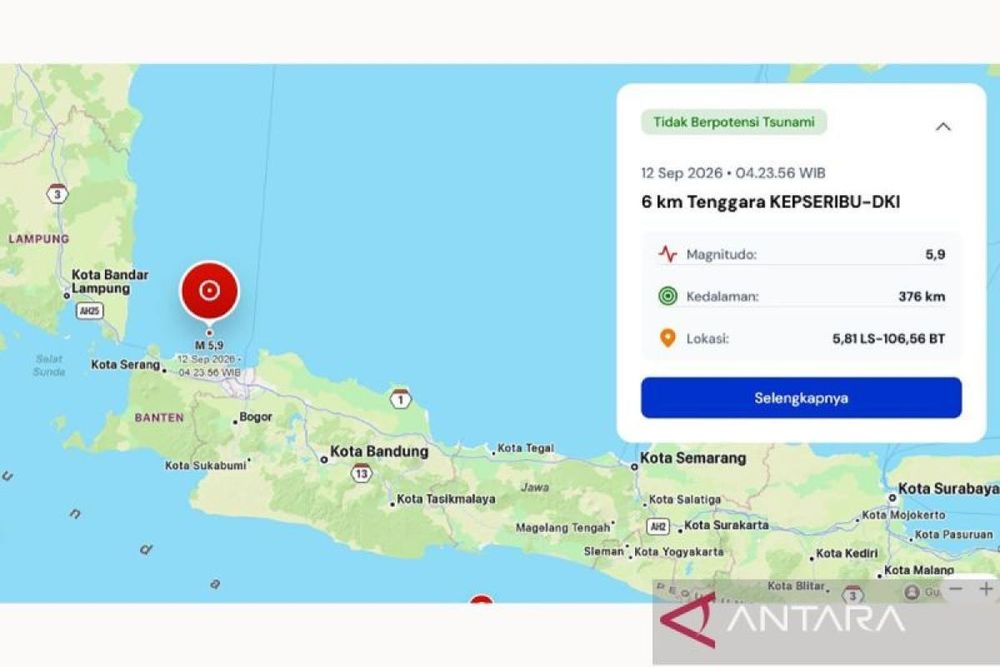
A magnitude 5.9 earthquake struck northeast of Jakarta's Kepulauan Seribu archipelago at 4:23 a.m. local time on Saturday, September 12, 2026, with the Meteorology, Climatology, and Geophysics Agency (BMKG) confirming no tsunami potential from the deep tremor.
The epicenter was located approximately 69 kilometers northeast of Kepulauan Seribu, an archipelago comprising roughly 342 islands scattered across Jakarta Bay with a population of 27,749 according to the 2020 census. The earthquake occurred at a depth of 376 kilometers beneath the ocean floor.
BMKG attributed the earthquake to intraslab activity within tectonic plates, a phenomenon caused by the breaking of rocks on the Australian Oceanic Plate that extends deep into the Java Sea. Such deep earthquakes, occurring between 300 and 650 kilometers beneath the surface, are characteristic of the region north of Java where the Indo-Australian Plate subducts beneath the Eurasian Plate.
Widespread Tremors Across Multiple Provinces
The tremor registered at IV on the Modified Mercalli Intensity (MMI) scale across large areas of Pandeglang, Lebak, and Serang districts in Banten province, Cianjur District in West Java, and Tanggamus District in Lampung. At this intensity level, earthquakes are felt indoors by many people and outdoors by few, with dishes, windows, and doors disturbed, walls making creaking sounds, and the sensation resembling a heavy truck striking a building.
Lighter shaking at III MMI was reported by residents in Tangerang, Banten, Tanjung Priok in North Jakarta, and Cilacap in Central Java, where the tremor was felt by people at rest but not strong enough to cause noticeable disturbance to objects.
No Aftershocks Recorded
As of 5:00 a.m. local time, BMKG reported no aftershocks from the event. Deep-focus earthquakes at depths greater than 300 kilometers rarely trigger aftershocks because stress release tends to occur entirely within a single main event in the homogeneous oceanic lithosphere, unlike shallower earthquakes that often produce subsequent tremors.
BMKG, which operates a seismic monitoring network with more than 400 sensors spread throughout Indonesia, advised residents to stay clear of damaged structures and remain calm while the agency continues monitoring the situation.
Regional Seismic Context
Indonesia sits at the convergence of several major tectonic plates, including the Indo-Australian Plate, Pacific Plate, Eurasian Plate, and Philippine Sea Plate. The subduction of the Indo-Australian Plate beneath the Eurasian Plate along the Sunda Trench serves as the primary driver of seismic activity in the Java region.
Jakarta experiences approximately 9.9 earthquakes per year on average, with magnitude 6 or higher earthquakes occurring roughly once every 25 to 30 years based on seismic data from 1900 to present. The city also faces earthquake risk from a subduction zone approximately 300 kilometers south along the Java Trench, where the Australian Plate subducts beneath the Sundaland Block at a convergence rate of about 60 millimeters per year, with the potential to generate earthquakes as large as magnitude 8.7.