
Indonesia Urges More Intermediate Manufacturing to Strengthen Supply Chains
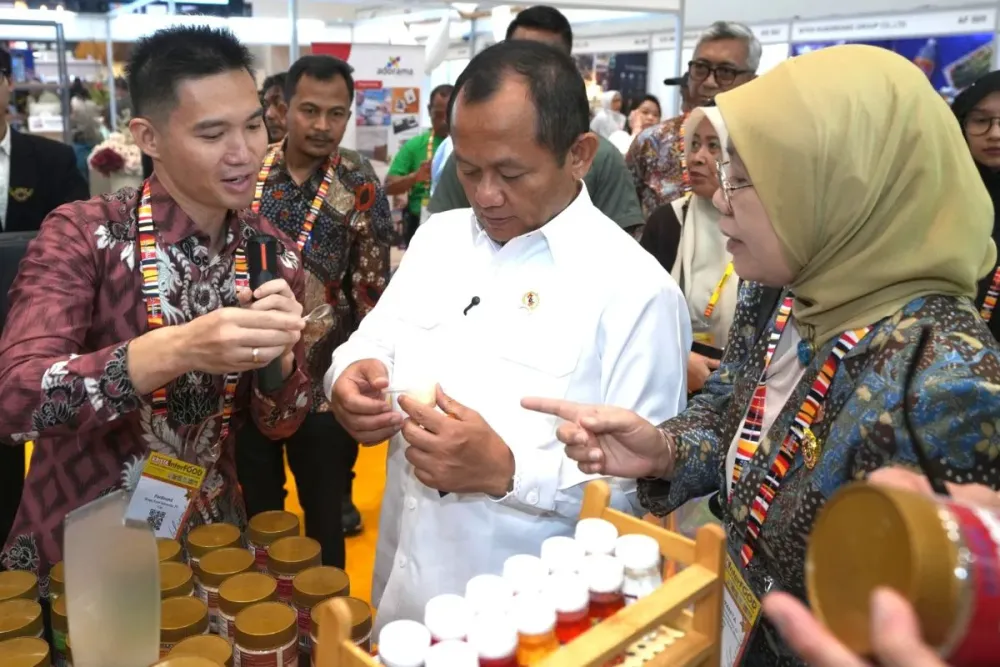
Indonesia's Industry Minister Muhammad Sarmuji called on domestic businesses to expand intermediate processing, saying it could increase the value of local commodities and strengthen national supply chains. He spoke at the Indonesia Food Innovation Awards in Tangerang on November 4.

Supplying businesses as well as consumers
Sarmuji urged food producers to look beyond finished goods sold directly to consumers and pursue opportunities to supply other companies. "Intermediate products enable food businesses to take a broader role in the value chain—not only selling final products to consumers, but also supplying needs for other businesses and industries," he said.
Among the innovations he highlighted were noodles made from sago and cassava, algae extracts, and fish-collagen processing. He said turning agricultural and marine by-products into higher-value products offers opportunities for small and medium-sized enterprises while supporting circular economy goals.
Food and beverage production grew 6.77 percent in the first half of 2026 and represented 41.86 percent of Indonesia's non-oil manufacturing GDP. Investment realized in the sector totaled 47.74 trillion rupiah ($2.64 billion), with domestic capital providing 59 percent.
The sector, which employs about 6.9 million people, exported $34.65 billion in goods from January through August 2026. Imports of $9.7 billion left a trade surplus of nearly $25 billion.
Processing ambitions extend beyond food
Sarmuji also called for using Indonesia's biodiversity to develop pharmaceutical raw materials and reduce dependence on imports. He advocated promoting Indonesian cuisine abroad through culinary exports as a form of soft diplomacy.
The minister has described a broader shift in Indonesia's downstreaming strategy beyond minerals. He pointed to nickel's progression from raw ore processing into battery components and electric vehicles, while identifying palm oil, coconuts, seaweed and the country's biodiversity as areas now drawing government attention.
The Industry Ministry has cited estimates that substituting domestic production for Rp400 trillion (about $22.22 billion) in imports could accelerate economic growth by 1.71 percent and produce Rp627.58 trillion (about $34.87 billion) in additional economic output. It also cited Central Statistics Agency (BPS) simulations estimating that each Rp1 spent on domestic products generates a Rp2.2 impact on national economic growth.
Capacity targets and manufacturing's economic role
Sarmuji took office on October 1, 2026, replacing Agus Gumiwang Kartasasmita under Presidential Decree No. 104/P of 2026. He has set an industrial capacity utilization target of 80-85 percent, compared with the current 66.13 percent, saying greater utilization would create room for domestic industry to expand.
According to the minister, manufacturing exports totaled $159.55 billion as of August 2026, accounting for 82.40 percent of Indonesia's exports. The sector also accounted for 38.98 percent of total realized national investment.
October indicators show stronger activity
At the awards event, Sarmuji cited manufacturing momentum as a sign of strength. Indonesia's S&P Global Manufacturing Purchasing Managers' Index rose from 52.4 in September to 54.0 in October 2026. S&P Global and the Industry Ministry described the October result as the strongest expansion since March 2024, a 31-month high.
ANTARA News reported that new orders helped drive the increase, growing at their fastest pace in five years. Growth in new export orders was the highest recorded since the survey began in April 2011, reflecting stronger international demand for Indonesian manufactured goods.
S&P Global figures cited by the ministry placed Indonesia ahead of several Asia-Pacific economies in October: Japan recorded 53.3, Vietnam 52.3, China 52.0, South Korea 51.3, Malaysia 51.0 and Australia 49.6.
The Industrial Confidence Index (IKI) also improved. Its October 2026 reading of 53.77 was 1.84 points above September's 51.93 and 0.27 points above the 53.50 recorded in October 2025, indicating continued improvement in confidence among industrial businesses.